Skip to content

December 2012

Revealed: how the FBI coordinated the crackdown on Occupy

New documents prove what was once dismissed as paranoid fantasy: totally integrated corporate-state repression of dissent
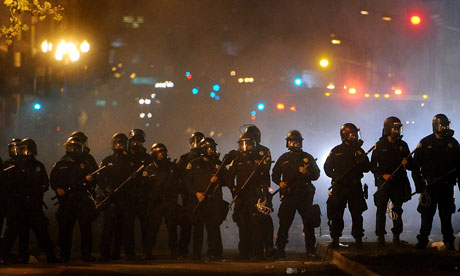
 

Police used teargas to drive back protesters following an attempt by the Occupy supporters to shut down the city of Oakland. Photograph: Noah Berger/AP
 
By Naomi Wolf
The Guardian, December 29, 2012
 
It was more sophisticated than we had imagined: new documents show that the violent crackdown on Occupy last fall – so mystifying at the time – was not just coordinated at the level of the FBI, the Department of Homeland Security, and local police. The crackdown, which involved, as you may recall, violent arrests, group disruption, canister missiles to the skulls of protesters, people held in handcuffs so tight they were injured, people held in bondage till they were forced to wet or soil themselves –was coordinated with the big banks themselves.
 
The Partnership for Civil Justice Fund, in a groundbreaking scoop that should once more shame major US media outlets (why are nonprofits now some of the only entities in America left breaking major civil liberties news?), filed this request. The document – reproduced here in an easily searchable format – shows a terrifying network of coordinated DHS, FBI, police, regional fusion center, and private-sector activity so completely merged into one another that the monstrous whole is, in fact, one entity: in some cases, bearing a single name, the Domestic Security Alliance Council. And it reveals this merged entity to have one centrally planned, locally executed mission. The documents, in short, show the cops and DHS working for and with banks to target, arrest, and politically disable peaceful American citizens.
 
The documents, released after long delay in the week between Christmas and New Year, show a nationwide meta-plot unfolding in city after city in an Orwellian world: six American universities are sites where campus police funneled information about students involved with OWS to the FBI, with the administrations' knowledge (p51); banks sat down with FBI officials to pool information about OWS protesters harvested by private security; plans to crush Occupy events, planned for a month down the road, were made by the FBI – and offered to the representatives of the same organizations that the protests would target; and even threats of the assassination of OWS leaders by sniper fire – by whom? Where? – now remain redacted and undisclosed to those American citizens in danger, contrary to standard FBI practice to inform the person concerned when there is a threat against a political leader (p61).
 
As Mara Verheyden-Hilliard, executive director of the PCJF, put it, the documents show that from the start, the FBI – though it acknowledges Occupy movement as being, in fact, a peaceful organization – nonetheless designated OWS repeatedly as a "terrorist threat":
 
"FBI documents just obtained by the Partnership for Civil Justice Fund (PCJF) … reveal that from its inception, the FBI treated the Occupy movement as a potential criminal and terrorist threat … The PCJF has obtained heavily redacted documents showing that FBI offices and agents around the country were in high gear conducting surveillance against the movement even as early as August 2011, a month prior to the establishment of the OWS encampment in Zuccotti Park and other Occupy actions around the country."
 
Verheyden-Hilliard points out the close partnering of banks, the New York Stock Exchange and at least one local Federal Reserve with the FBI and DHS, and calls it "police-statism":
 
"This production [of documents], which we believe is just the tip of the iceberg, is a window into the nationwide scope of the FBI's surveillance, monitoring, and reporting on peaceful protestors organizing with the Occupy movement … These documents also show these federal agencies functioning as a de facto intelligence arm of Wall Street and Corporate America."
 
The documents show stunning range: in Denver, Colorado, that branch of the FBI and a "Bank Fraud Working Group" met in November 2011 – during the Occupy protests – to surveil the group. The Federal Reserve of Richmond, Virginia had its own private security surveilling Occupy Tampa and Tampa Veterans for Peace and passing privately-collected information on activists back to the Richmond FBI, which, in turn, categorized OWS activities under its "domestic terrorism" unit. The Anchorage, Alaska "terrorism task force" was watching Occupy Anchorage. The Jackson, Michigan "joint terrorism task force" was issuing a "counterterrorism preparedness alert" about the ill-organized grandmas and college sophomores in Occupy there. Also in Jackson, Michigan, the FBI and the "Bank Security Group" – multiple private banks – met to discuss the reaction to "National Bad Bank Sit-in Day" (the response was violent, as you may recall). The Virginia FBI sent that state's Occupy members' details to the Virginia terrorism fusion center. The Memphis FBI tracked OWS under its "joint terrorism task force" aegis, too. And so on, for over 100 pages.
 
Jason Leopold, at Truthout.org, who has sought similar documents for more than a year, reported that the FBI falsely asserted in response to his own FOIA requests that no documents related to its infiltration of Occupy Wall Street existed at all. But the release may be strategic: if you are an Occupy activist and see how your information is being sent to terrorism task forces and fusion centers, not to mention the "longterm plans" of some redacted group to shoot you, this document is quite the deterrent.
 
There is a new twist: the merger of the private sector, DHS and the FBI means that any of us can become WikiLeaks, a point that Julian Assange was trying to make in explaining the argument behind his recent book. The fusion of the tracking of money and the suppression of dissent means that a huge area of vulnerability in civil society – people's income streams and financial records – is now firmly in the hands of the banks, which are, in turn, now in the business of tracking your dissent.
 
Remember that only 10% of the money donated to WikiLeaks can be processed – because of financial sector and DHS-sponsored targeting of PayPal data. With this merger, that crushing of one's personal or business financial freedom can happen to any of us. How messy, criminalizing and prosecuting dissent. How simple, by contrast, just to label an entity a "terrorist organization" and choke off, disrupt or indict its sources of financing.
 
Why the huge push for counterterrorism "fusion centers", the DHS militarizing of police departments, and so on? It was never really about "the terrorists". It was not even about civil unrest. It was always about this moment, when vast crimes might be uncovered by citizens – it was always, that is to say, meant to be about you.

Protest Against the Rape Culture in India

Protesters react as Indian police officers use a water cannon to disperse them near the India Gate as they protest against the gang rape and brutal beating of a 23-year-old student on a bus last week, in New Delhi, India, on December 23, 2012. The attack last Sunday has sparked days of protests across the country. Thousands gathered to protest against current rape laws and government handling of recent rape cases all over India. (AP Photo/Saurabh Das) 

Rape Cultures in India

By Pratiksha Baxi
Kafila, December 23, 2012
 
Delhi has tolerated intolerable forms of sexual violence on women from all backgrounds in public spaces for decades. It is a public secret that women are targetted in streets, neighbourhoods, transport and workplaces routinely. There have been countless campaigns and appeals to all agencies concerned to think of safety of women as an issue of governance, planning and prevention. However, prevention of sexual violence is not something, which features in the planning and administration of the city. It is not seen as an issue for governance that extinguishes the social, economic, and political rights of all women.
 
 It is a public secret that rape of women in moving vehicles is popularly seen as a sport. The sexualisation of women’s bodies accompanies the projection of cars as objects of danger and adventure. Private buses now participate in this sexualisation of moving vehicles as a site of enacting pornographic violence. In this sense, safety is not seen as a commodity that can be bought, purchased or exchanged. Men consume images of a city tolerant of intolerable violence. City planners enable rapists to execute a rape schedule. Streetlights do not work. Pavements and hoarding obstruct flight. Techniques of surveillance and policing target women’s behaviour, movement, and clothing, rather than policing what men do. The city belongs to heterosexist men after all.
 
Students chant anti-police slogans during a protest against the Indian governments reaction to recent rape incidents in India in front of the Presidential Palace on December 22, 2012 in New Delhi, India. (Daniel Berehulak/Getty Images)
The brutality of the assault on the 23 year old student who was gangraped and beaten mercilessly with iron rods when she resisted has anguished all of us—generating affect similar to the infamous Birla and Ranga murders decades ago. The nature of life threatening intestinal and genital injury has shockedresulting in angry protests in the city and elsewhere.Yet most remain unaware that the brutality accompanying sexual violence such as assault with iron rods, swordsand other objects; mutilating a woman’s body with acid;stripping and parading women; and burning them after a brutal gangrape routinelyscar the pages ofourbloodied law reporters. There is no political or judicial framework to redress such forms of aggravated sexual assault.
 
The judiciary, tall exceptions apart, construct rape as sex. This perspective from the rapist’s point of view, does not frame rape as political violence,which posits all women as sexual objects. Rape is repeatedly constructed as an act of aberrant lust, pathological sexual desire or isolated sexual deviancy.
 
Politicians for most part do no better. The parliamentary discourse on rape, after the brutal attack on the 23 year old woman who is fighting for her life, uses sexual violence as a resource for doing politics, and therefore re-entrenches rape culture. By arguing that rape is worse than death and rape should attract death penalty, rape survivors are relegated the space of the living dead. The social, political and legal mechanisms of shaming, humiliating, and boycotting rape survivors are not challenged. Nor are the mechanisms of converting rape narratives into a source of further titillation and excitement displaced. Rather most political actors convert rape into a technique of doing party politics. No one reflects seriously on why India sports a rape culture—surely the political and social toleration of intolerable sexual violence in everyday and extraordinary contexts of violence produces an effect of immunity and impunity to men who enjoy rape.
 
Indian youth hold candles and placards as they take part in a candlelight vigil following the gang rape of a student last week in the Indian capital during a rally in Ahmedabad, on December 23, 2012. (Sam Panthaky/AFP/Getty Images)
The right wing politician who is exhausting lung power on death penalty for rapists is not concerned with how a strident Hindu nationalism is built on violated bodies of women. Nor are such politicians concerned with what may happen to women if rape is punishable by death—surely there will be more murders and even more acquittals, since judges prefer to give lower than the mandatory sentence in rape cases. They have not marked the upsurge of the phenomena of burning and mutilating women after rape, as reported in the media, after a spate of such cases in Uttar Pradesh last year. Nor has any political party even acknowledged or apologised for the sexual violence during mass scale violence. Surely if chief ministers who get elected year after year dismiss mass scale sexual violence as a figment of imagination, this generates, endorses and even celebrates a new national rape culture.
 
The men (and even some women in positions of power) who lead India are successfully able to de-link the celebratory stories of neoliberalism, militarisation, nationalism,growth and development from the toleration of sexual violence as a sport, a commodity, as collateral damage, or a necessary technique to suppress women’s autonomy. Fact of the matter is that Surekha Bhotmange and her daughter were stripped, paraded, raped and killed in Khairlanji for expressing and asserting their autonomy. The men who assaulted and murdered them were not tried for rape.  Does anyone even remember that Bhanwari Devi’s appeal still languishes in the Rajasthan High Court? A courageous woman in whose debt all middle class women working in universities and everywhere else remain for the promulgation of the Vishaka judgment. We got the guidelines on sexual harassment in the workplace, but Bhanwari Devi did not get justice.  All of us remain in the debt of BilkeesBano who is perhaps the first survivor of mass scale sexual violence in Independent India to secure a prosecution in a rape and riot case but only after the trial was transferred. Manorama’s gangrape and murder by the army did not result in the withdrawal of AFSPA, which gives the army the licence to rape as ifto rape is in the line of duty. Can we de-link these issues from what Delhi protests today? Surely we must make these connections since we have benefited from the courageous litigation by women whose lives have been made absolutely abject.We must then equally resist the politics, which institutes public amnesia about these voices of suffering.
 
Indian demonstrators burn an effigy representing rapists during a protest calling for better safety for women following the rape of a student in New Delhi, on December 26, 2012. (Sajjad Hussain/AFP/Getty Images)
Alas, the brutality that Delhi witnessed is the effect of the toleration and celebration of rape cultures in India. Men and women, alike, from all classes, castes and communities must adopt a stance of solidarity that will not tolerate politicians, police officers, planners, judges and lawyers who build their careers on silencing the voices of raped women. Only a heightened intolerance for any kind of sexual violence as a social force will begin to chip away at the monumentalisation of rape cultures in India. Our collective melancholia must be far more productive.
 
Pratiksha Baxi is Assistant Professor, Centre for the Study of Law and Governance, Jawaharlal Nehru University

Protesters gather outside the Presidential Palace in New Delhi, on December 22, 2012. Police in India's capital used tear gas and water cannons to push back thousands of people who tried to march to the presidential mansion. (AP Photo/Tsering Topgyal)

Police try to stop demonstrators near the presidential palace during a protest rally in New Delhi, on December 22, 2012. (Reuters/Adnan Abidi)

Police use water cannons to disperse demonstrators near the presidential palace in New Delhi, on December 22, 2012. (Reuters/Adnan Abidi)

An Indian policeman charges with his baton to disperse protesters demonstrating against a gang rape and brutal beating of a 23-year-old student on a bus, in New Delhi, on December 23, 2012. (AP Photo/Tsering Topgyal)

Protesters shield themselves as Indian police prepare to beat them during a violent demonstration near the India Gate, on December 23, 2012. (AP Photo/Kevin Frayer

Indian demonstrators are hit by water cannon during a protest calling for better safety for women following the rape of a student last week, in front the India Gate monument in New Delhi, on December 23, 2012. (Tengku Bahar/AFP/Getty Images)

Indian policemen are sprayed with police water cannon aimed at protestors during a violent protest in New Delhi, on December 23, 2012. (AP Photo/Altaf Qadri)

Police climb a wall as they are chased away by demonstrators during a protest rally near the presidential palace in New Delhi, on December 22, 2012. (Reuters/Adnan Abidi)

Indian women protesting against the brutal gang-rape of a woman last week attempt to remove police barricades as they try to approach the residence of Indian Home Minister Sushilkumar Shinde in New Delhi, on December 24, 2012. Authorities shut down roads in the heart of India's capital on Monday to put an end to a week of demonstrations. (AP Photo/Mustafa Quraishi)

Police chase demonstrators during a protest rally near the presidential palace in New Delhi, on December 22, 2012. (Reuters/Adnan Abidi)

Indian music director and social activist Kishor Giri sits on a road median, showing his protest against the brutal gang-rape of a woman on a moving bus last week in New Delhi, in Gauhati, India, on December 25, 2012. (AP Photo/Anupam Nath)

Indian women hold placards outside the residence of Delhi Chief Minister Sheila Dikshit during a protest over the gang rape of a woman in New Delhi, on December 19, 2012. The outpouring of anger is unusual in a country where attacks against women are often ignored and rarely prosecuted. (AP Photo/Manish Swarup)

Demonstrating Indian school students hold placards as they shout anti-government slogans during a protest calling for better safety for women following the rape of a student in New Delhi on December 24, 2012. (Raveendran/AFP/Getty Images)

A demonstrator stands on a barricade erected by police and shouts slogans during a protest rally organized by various women's organizations in New Delhi, on December 21, 2012. (Reuters/Mansi Thapliyal)

Demonstrators shout slogans and carry a placard while standing on lamp posts during a protest rally near the presidential palace in New Delhi, on December 22, 2012. (Reuters/Ahmad Masood)

Indian protestors damage a government vehicle during a violent demonstration near the India Gate monument in New Delhi, on December 23, 2012. (AP Photo/Mustafa Quraishi)

Indian protesters and policemen throw stones at each other during a protest in New Delhi, on December 23, 2012. (AP Photo/Altaf Qadri)

A police officer and a demonstrator scuffle near the presidential palace during a protest rally in New Delhi, on December 22, 2012. Indian police used batons, tear gas and water cannon to turn back thousands of people marching on the presidential palace in intensifying protests against the gang-rape of a woman on the streets and on social media. (Reuters/Adnan Abidi)

Protesters shield themselves as Indian police beat them with sticks during a violent demonstration near the India Gate in New Delhi, on December 23, 2012. (AP Photo/Kevin Frayer)

Indian police fire tear gas towards protesters during a violent demonstration near the India Gate in New Delhi, on December 23, 2012. (AP Photo/Kevin Frayer)

An Indian man overwhelmed by tear gas lies on the ground during a violent protest in New Delhi, on December 23, 2012. (AP Photo/Altaf Qadri)

A female protester shouts as she is hit with an Indian police water cannon during a violent demonstration near the India Gate against a gang rape and brutal beating of a 23-year-old student on a bus last week, in New Delhi, on December 23, 2012. The attack last Sunday sparked days of protests across the country. (AP Photo/Kevin Frayer)

Photo Essay from The Atlantic


Climate Change Justice and Resistance from Doha to East Texas

Anne Petermann of the Global Justice Ecology Project discusses the recent climate conference in Doha, Qatar which is characterized more

Crises in Tuition & Predatory Student Lending

On International Human Rights Day we look at the right to education. Tyler Paige is one of 11 students occupying

Israel, Gaza and Egypt

In this show we talk with Sydney Levy of Jewish Voice for Peace about the recent Israeli attack on Gaza, the

Canada’s ‘Idle No More’ Movement Spreads Like Wildfire


The 'Idle No More' movement, a campaign of grassroots First Nations protests, has spread like wildfire over the past week in response to bills passed by the conservative Canadian government.

Chief Theresa Spence on 14th day of hunger strike

 
First Nations protesters march towards Parliament Hill during a demonstration as part of the spreading 'Idle No More' movement in Ottawa, Canada, December 21, 2012. REUTERS/Chris Wattie

 
By Craig Brown
Common Dreams, December 24, 2012
 
Anger to the recently passed C-45, the Harper government omnibus budget bill, has fueled the growing movement.
 
Bil C-45 includes changes to the Canadian Indian Act regarding how reserve lands are managed, making them easier to develop and be taken away from the First Nation people.
 
The bill also removes thousands of lakes and streams from the list of federally protected bodies of water. “This is unacceptable. They have made a unilateral decision remove the protection of waterways... Shell Canada has proposed to mine out 21km of the Muskeg River, a river of cultural and biological significance. This ultimately gives the tar sands industry a green light to destroy vital waterways still used by our people," stated Eriel Deranger, Communication Coordinator for the Athabasca Chipewyan First Nation.
 
Atiwapiskat First Nation Chief Theresa Spence has been on a hunger strike since December 11th, resolved to starve herself to death unless Prime Minister Stephen Harper meets to discuss treaty rights, and Canada’s relationship with its Indigenous peoples. She is currently living in a teepee on Victoria Island, in Ottawa, just a kilometer away from the Parliament buildings. So far, Harper has rejected calls to meet with Spence.
 
Chief Spence tweeted on Sunday, the 13th day of her hunger strike:
 
ChiefTheresaSpence@ChiefTheresa 
Grassroots and leaders plse keep the pressure and momentum going #idlenomore "I am still strong and will not give up!"
23 Dec 12 ReplyRetweetFavorite
 
Over the last few days Idle No More supporters took over malls and public spaces all over Canada and parts of the US with a series of flashmobs performing traditional round dances in support of the movement.
 
* * *


* * *


* * *
 
Idle No More's mission statement reads, in part:
 
On December 10th, Indigenous people and allies stood in solidarity across Canada to assert Indigenous sovereignty and begin the work towards sustainable, renewable development. All people will be affected by the continued damage to the land and water and we welcome Indigenous and non-Indigenous allies to join in creating healthy sustainable communities. We encourage youth to become engaged in this movement as you are the leaders of our future. There have always been individuals and groups who have been working towards these goals – Idle No More seeks to create solidarity and further support these goals. We recognize that there may be backlash, and encourage people to stay strong and united in spirit.
 
* * *
 
Happening Now: Common Dreams’ Live Coverage
Idle No More Movement Spreads Like Wildfire
 
PEHFLA Thank you @JustinTrudeau for showing leadership and compassion by meeting with @ChiefTheresa today. #LPC #idlenomore
48 seconds ago · reply · retweet · favorite
 
Dan_Radinovic @AmberLyon have u heard of #idlenomore, grassroots Native Canadian movement, @ChiefTheresa on day 15 of hunger strike. Cld u RT please.
about 1 minute ago · reply · retweet · favorite
 
TrickNig “@ChiefTheresa: @JustinTrudeau will be visiting @ChiefTheresa this morning.” #cdnpoli #onpoli #IdleNoMore
about 1 minute ago · reply · retweet · favorite
 
 
3 new tweets
 
northrnstarfish Hey @justinbieber thanks for being #idlenomore thelapine.ca/bieber-derps-h…
3 minutes ago · reply · retweet · favorite
 
RMComedy Researching online streaming internet radio platforms. We ready to do this @culturite @rpmfm! #BuildingIndigenousMediaPlatforms #IdleNoMore
4 minutes ago · reply · retweet · favorite
 
RuddKim RT @ChiefTheresa: @JustinTrudeau will be visiting @ChiefTheresa this morning.
6 minutes ago · reply · retweet · favorite
 
SidRyan_OFL Thinking about the obscene consumerism today, while Chief Spence starves herself so her ppl can have drinkable water. #IdleNoMore #cdnpoli
7 minutes ago · reply · retweet · favorite
 
DemocracyCanada I bow to @ChiefTheresa: as we feast, she chooses to go hungry - for her people! PLEASE meet with her, @pmharper! #cdnpoli #IdleNoMore #DAY16
8 minutes ago · reply · retweet · favorite
 
waub If you're going to the #idlenomore round dance at the Rideau Centre at noon, sing loud and dance hard! CBC will have a camera there
8 minutes ago · reply · retweet · favorite
 
michaelcwheeler This is a good sign that #IdleNoMore is penetrating mainstream RT @chieftheresa: @JustinTrudeau will be visiting @ChiefTheresa this morning.
9 minutes ago · reply · retweet · favorite
 
Outlaws52 RT @CSORG: @BarackObama Please put pressure on @pmharper to meet with @chieftheresa . He's letting her starve to death! #idlenomore
10 minutes ago · reply · retweet · favorite
 
kaishathompson “@ChiefTheresa: @JustinTrudeau will be visiting @ChiefTheresa this morning.” #IdleNoMore
10 minutes ago · reply · retweet · favorite
 
CherishFaith “@ChiefTheresa: Guess who came to celebrate Christmas night? A big supporter. @adamruebenbeach pic.twitter.com/432hrm1Q” #IdleNoMore
11 minutes ago · reply · retweet · favorite
 
kaishathompson Today as Canadians hit the mall, #IdleNoMore will bring their voices into the shopping areas. Check out the #Barrie ON protest!
11 minutes ago · reply · retweet · favorite
 
gardencoachwinn #IdleNoMore #IdleNoMore #IdleNoMore #IdleNoMore #IdleNoMore #IdleNoMore #IdleNoMore #IdleNoMore #IdleNoMore #IdleNoMore @IdleNoMore4
12 minutes ago · reply · retweet · favorite
 
CaraMcGregor Could someone recap me on the #idlenomore events when and where ... I'd like to attend durning the Holidays!
12 minutes ago · reply · retweet · favorite
 
ChiefDay @ChiefTheresa @JustinTrudeau Hopefully this visit is for "right" reasons. Humanitarian and Social Justice should supersede party politics.
13 minutes ago · reply · retweet · favorite
 
deejayndn “@VirtueInTheCity:"You've Inspired A Nation." A short film dedicated to Chief Spence. facebook.com/photo.php?v=10… … (3 min 54 sec)” #idlenomore
14 minutes ago · reply · retweet · favorite
 
Niigaanwewidam Off to ceremonies! I'll be #idlenomore -ing via the lodge! Miigwech gizhe manidoo!
16 minutes ago · reply · retweet · favorite
 
CSORG Aboriginal Affairs Minister concerned about Theresa Spence #idlenomore huff.to/YcNjOK via @HuffPostCanada
17 minutes ago · reply · retweet · favorite
 
remaerdyaD #flashmob has itself been trending ~ #idlenomore
17 minutes ago · reply · retweet · favorite
 
GwitchinKris #idlenomore and up with the birds. Headed to West Edmonton Mall First Nation (WEMFN) Round Dance #Hoka
18 minutes ago · reply · retweet · favorite
 
TippiStar Plz let us not forget Emil Bell & Raymond Robinson who are also on a hunger strike with chief Spence. Let their story be told #Idlenomore
20 minutes ago · reply · retweet · favorite
 
snolen Good take in the Guardian on Canada's swelling protests by First Nations people #idlenomore m.guardian.co.uk/commentisfree/…
20 minutes ago · reply · retweet · favorite
 
Crudmaestro @GGDavidJohnston When will you meet Chief Spence? #idlenomore #chiefteresa
24 minutes ago · reply · retweet · favorite
 
Nonanon_anon So @pmharper do you want Bieber's Diamond Jubilee back? thelapine.ca/bieber-derps-h… #pwned #idlenomore #cdnpoli #lpc #ndp #gpc
26 minutes ago · reply · retweet · favorite
 
mytiturk Sign #idlenomore Avaaz petition avaaz.org/en/petition/Ch…
27 minutes ago · reply · retweet · favorite
 
fernhilldammit I missed this. Justin Bieber derps PMSHithead over #IdleNoMore. thelapine.ca/bieber-derps-h… #ImportantNews
29 minutes ago · reply · retweet · favorite
 
NaomiAKlein Want 2 know what #IdleNoMore is all about? Don't miss @Pam_Palmater 's great interview on @democracynow 2day. democracynow.org
29 minutes ago · reply · retweet · favorite
 
reneelaprise @Pam_Palmater - that was a great interview on democracynow.org - I learn more every time I listen to you. #idlenomore
30 minutes ago · reply · retweet · favorite
 
anardozi Previous they had very negative stereotypes of First Nations peoples. From media and others. #IdleNoMore
31 minutes ago · reply · retweet · favorite
 
anardozi Spoke to two new immigrants about #IdleNoMore and history of colonial violence against First Nations. They had no idea;
32 minutes ago · reply · retweet · favorite
 
cmusician January, 2012: Crown - First Nations gathering about laying the groundwork for a “partnership.” soc.li/qV6TywB #cdnpoli #IdleNoMore
35 minutes ago · reply · retweet · favorite
 
ChiefDay #IdleNoMore start a twitter blitz to every MP; Senator; and the same for US Senate and House of Congress. "Harper; meet Chief Spence; today"
36 minutes ago · reply · retweet · favorite
 
NatriceR @Fast4Change @marclaferriere @chieftheresa make a difference! Speak out w/your actions and your voice! As Theresa Spence is doing
37 minutes ago · reply · retweet · favorite
 
CreativeCrip David Cameron & Stephen Harper ~ Crime Ministers extraordinaire #ukgov #wowpetition #cdngov #idlenomore
38 minutes ago · reply · retweet · favorite
 
urbanrezlife Good Morning Community Prayers for @ChiefTheresa
41 minutes ago · reply · retweet · favorite
 
gardencoachwinn @pmharper when would be a good time for you to meet @ChiefTheresa ? World is watching, waiting in solidarity with @IdleNoMore4 #IdleNoMore
44 minutes ago · reply · retweet · favorite
 
ecoSanity A selected compilation bit.ly/YfLIHI in support of the mass movement 4 Indigenous sovereignty @chieftheresa #idlenomore #cdnpoli
44 minutes ago · reply · retweet · favorite
 
AureliaCotta I wonder how different history would be if called native treaties "legally enforceable contracts" instead. #idlenomore #cdnpoli
44 minutes ago · reply · retweet · favorite
 
JaimeWGarcia Top political story of 2012, still making headlines ow.ly/1QxOz5 #IdleNoMore #skpoli #cdnpoli cc @ChiefTheresa
45 minutes ago · reply · retweet · favorite
 
cmusician E-mail Prime Minister Harper at pm@pm.gc.ca: Time to meet with FN leaders & commit to addressing longstanding issues #cdnpoli #IdleNoMore
47 minutes ago · reply · retweet · favorite
 
ehjertaas Great read: Hollow talk, half-lies: how #Harper deals with #FirstNations | iPolitics ipolitics.ca/2012/12/20/hol… #cdnpoli #IdleNoMore
49 minutes ago · reply · retweet · favorite
 
PMLaurier Obama's cutting short his vacation to address a growing crisis. Your move @PMHarper. Show some courage & meet with @ChiefTheresa #idlenomore
50 minutes ago · reply · retweet · favorite
 
WhoKnitYou @WhoKnitYou: You'll meet with any other world leader, why not a First Nations leader? @pmharper shame on you. #idlenomore
53 minutes ago · reply · retweet · favorite
 
Fnsolidarity Heres my stats in a week! @RMComedy: The Power of Social media #IdleNoMore #RoundDanceRevolution instagr.am/p/TsCpDWTfH8/ ow.ly/i/1isEW
56 minutes ago · reply · retweet · favorite
 
IdleNoMoreNews The Natives are restless. Wondering why? bit.ly/TVZJdN #IdleNoMore
57 minutes ago · reply · retweet · favorite
 
kemciver Brigette depape is an inspiration! Best gift to canada is #IdleNoMore www2.macleans.ca/2012/12/25/idl…
59 minutes ago · reply · retweet · favorite
 
IndianCAN2 Welcome web visitors from Toronto and New Orleans - #idlenomore
about 1 hour ago · reply · retweet · favorite
 
___Danno Harper has a heart of tar. He has no time for anything other than Big Oil, Chinese investors & celebrities like Justin Bieber #IdleNoMore
about 1 hour ago · reply · retweet · favorite
 
freedomjunkie David Suzuki Foundation letter of support for Idle No More davidsuzuki.org/media/news/201… via @DavidSuzukiFDN
about 1 hour ago · reply · retweet · favorite
 
Crudmaestro @pmharper, remember what (#ggi) youth in Québec did 2 your pal Jean Charest? #Idlenomore is no different. The youths don't like corruption.
about 1 hour ago · reply · retweet · favorite
 
Russell_Barth Keep in mind: .@pmharper's supporters are as sick and evil as he. He panders to racists as he ignores .@ChiefTheresa #cdnpoli #idlenomore
about 1 hour ago · reply · retweet · favorite
 
Join the conversation
* * *
 
Attawapiskat Chief Theresa Spence, center, sits between supporters Danny Matatawabin, left, and Angela Bercier in a teepee on Victoria Island in Ottawa during her hunger strike. (Photo; Julie Oliver, Ottawa Citizen)

How Occupy Won Over Religion


Religion is the means by which many imagine and work for a world more just than this one. Last year, Wall Street’s Trinity Church refused to shelter the movement; this year, churches and Occupiers are sharing a very different kind of Advent season.
Trinity Street protest
 
Photo credit: Rev. Michael Ellick, right, asks Rev. Matt Heyd of Trinity Wall Street, left, for space for Occupy Wall Street (Marc Beja)
By Nathan Schneider, YES! Magazine,  December 25, 2012
 
A year ago around this time, Occupy Wall Street was celebrating Advent—the season when Christians anticipate the birth of Jesus at Christmas. In front of Trinity Church, right at the top of Wall Street along Broadway, Occupiers set up a little model tent with the statuettes of a nativity scene inside: Mary, Joseph, and the Christ child in a manger, surrounded by animals. In the back, an angel held a tiny cardboard sign with a verse from Luke’s Gospel: “There was no room for them in the inn.”
Occupy Wall Street protesters entering a vacant lot on Canal Street and Sixth Avenue owned by Trinity Church, New York City, December 17, 2011, Eduardo Munoz/Reuters
 
The reason for these activists’ interest in the liturgical calendar, of course, was the movement’s ongoing effort to convince Trinity to start acting less like a real estate corporation and more like a church, and to let the movement use a vacant property that Trinity owns.
 
A small nativity scene set up in the style of the Occupy movement, calling for protesters to be be allowed a piece of land in New York, NY on Dec. 16, 2011.
A small nativity scene set up in the style of the Occupy movement, calling for protesters to be be allowed a piece of land in New York, NY on Dec. 16, 2011, The Christian Post/Stoyan Zaimov
 
A year later, even as a resilient few continue their 24-hour vigil on the sidewalk outside Trinity, churches and Occupiers are having a very different kind of Advent season together. Finding room in churches is no longer a problem for the movement.
 
The day after Hurricane Sandy struck New York in late October, Occupiers hustled to organize a massive popular relief effort, and Occupy Sandy came into being. By circumstance and necessity, it has mostly taken place in churches; they are the large public spaces available in affected areas, and they were the people willing to open their doors. Two churches on high ground in Brooklyn became organizing hubs, and others in the Rockaways, Coney Island, Staten Island, and Red Hook became depots for getting supplies and support to devastated neighborhoods. To make this possible, Occupiers have had to win the locals’ trust—by helping clean up the damaged churches and by showing their determination to help those whom the state-sponsored relief effort was leaving behind. When the time for worship services came around, they’d cleared the supplies off the pews.
 
Occupy Sandy at the Episcopal Church of St. Luke and St. Matthew in Brooklyn
 
“Occupy Sandy has been miraculous for us, really,” said Bob Dennis, parish manager at St. Margaret Mary, a Catholic church in Staten Island. “They are doing exactly what Christ preached.” Before this, the police and firemen living in his neighborhood hadn’t had much good to say about Occupy Wall Street, but that has changed completely.
 
Religious leaders are organizing tours to show off the Occupy Sandy relief efforts of which they’ve been a part, and they’re speaking out against the failures of city, state, and federal government. Congregations are getting to know Occupiers one on one by working together in a relief effort that every day—as the profiteering developers draw nearer—is growing into an act of resistance.
 
And that’s only one part of it. Months before Sandy, organizers with the Occupy Wall Street group Strike Debt made a concerted effort to reach out to religious allies for help on a new project they were calling the Rolling Jubilee; by buying up defaulted loans for pennies on the dollar, and then abolishing them, organizers hoped to spread the spirit of jubilee—an ancient biblical practice of debt forgiveness.
 
Outside the Church of St. Luke and St. Matthew in Brooklyn Gammablog.com
 
The religious groups jumped at the chance to help. Occupy Faith organized an event in New York to celebrate the Rolling Jubilee’s launch. Occupy Catholics (of which I am a part) took the opportunity to reclaim the Catholic concepts of jubilee and usury for the present economic crisis and released a statement in support of the Rolling Jubilee that has been signed by Catholics across the country.
 
The Rolling Jubilee idea has been hugely successful, raising more money more quickly than anyone anticipated—around $10 million in debt is poised to be abolished. But now Strike Debt, too, has turned its attention to working with those affected by the hurricane. On Dec. 2, the group published “Shouldering the Costs,” a report on the proliferation of debt in the aftermath of Sandy. The document was released with an event at—where else?—a church in Staten Island.
 
This newfound access to religious real estate is not merely a convenience for this movement; it has implications that a lot of people probably aren’t even thinking about yet. Occupy Wall Street has learned from the Egyptian Revolution before, and now, even if by accident, it is doing so again.
While Tahrir Square was still full of tents and tanks, and Hosni Mubarak was still in power, the editors of Adbusters magazine were already imagining a “Million Man March on Wall Street,” the idea that led to what would become their July 13, 2011, call to #occupywallstreet.
 
More than a year after the occupation at Zuccotti Park began, though, and nearly two years after crowds first filled Tahrir, neither revolt very much resembles its origins. The Egyptian Revolution, first provoked by tech-savvy young activists, has now been hijacked as a coup for the Muslim Brotherhood, a conservative religious party; its only viable challenger is none other than Mubarak’s ancient regime, minus only Mubarak himself. Occupy, meanwhile, has lost its encampments and, despite whatever evidence there is to the contrary, most of its enemies in power deem it no longer a threat.
 
Among many U.S. activists even today, the dream of creating a Tahrir-sized rupture in this country persists—of finally drawing enough people into the streets and causing enough trouble to make Wall Street cower. But what if something on the scale of Tahrir really were to happen in the United States? What would be the outcome?
 
I was thinking of this question recently while on an unrelated reporting mission at a massive evangelical Christian megachurch near the Rocky Mountains. Several thousand (mostly white, upper-middle-class) people were there that day, of all ages. They had come back after Sunday morning services for an afternoon series of talks on philosophy—far more people than attend your average Occupy action.
 
Every time I step foot in one of these places, it strikes me how they put radicals in the United States to shame. These churches organize real, life-giving mutual aid as the basis of an independent political discourse and power base. Church membership is far larger, for instance, than that of unions in this country.
 
If there were a sudden, Tahrir-like popular uprising right now, with riots in all the cities and so forth, I can’t help but think that it would be organizations like the church I went to that would come out taking power in the end, even more so than they already do—just as the Islamists have in Egypt.
If the idea of occupying symbolic public space was the Egyptians’ first lesson for Occupy Wall Street, this is the second: Win religion over before it beats you out.
 
Through religion, again and again, people in the United States have organized for power. Religion is also the means by which many imagine and work for a world more just than this one. Just about every successful popular movement in U.S. history has had to recognize this, from the American Revolution to labor, and from civil rights to today’s campaigners for marriage equality—and now Occupy.
 
When I stop by the Occupy Sandy hub near my house—the Episcopal Church of St. Luke and St. Matthew—and join the mayhem of volunteers carrying boxes this way and that, and poke my head into the upper room full of laptops and organizers around a long table, and see Occupiers in line for communion at Sunday services, I keep thinking of how Alcoholics Anonymous’ 12-step program ends. The 12th step is where you cap off all the self-involved inner work you’ve been doing, and get over yourself for a bit, and heal yourself by helping someone else.
 
Anyone who has been around Occupy Wall Street during the year since its eviction from Zuccotti Park knows it has been in need of healing. Whether through flood-soaked churches, or on the debt market, this is how the Occupy movement has always been at its best, and its most exciting, and its most necessary: When it shows people how to build their own power, and to strengthen their own communities, this movement finds itself.
 

Archive of Clearing the FOG Shows

Margaret Flowers and Kevin Zeese speaking in Ashland, OR in 2012. The Clearing the FOG website went public at the

Show on Global Agriculture and Trade Policy

This show featured noted Indian Journalist P. Sainath and International Program Director of the Institute for Agriculture and Trade Policy,

Suspicious Fire In Brooklyn Church Destroys Hurricane Relief Supplies

By Erin Clarke
NY 1, December 24, 2012
 
A $1,000 reward is being offered for information leading to an arrest in connection with a fire at a church in the Clinton Hill section of Brooklyn Sunday that fire officials say may have been deliberately set.


According to a New York City Fire Department spokesperson, the two-alarm fire that started around 4:30 a.m. outside the Church of St. Luke And St. Matthew at 515 Clinton Avenue appears to have been deliberately set.
 
The fire spread to the church's foyer and was under control within couple of hours.
 
No injuries were reported and the main sanctuary was not damaged, but part of the church's main hallway will require repairs.
 
"When I got here about 5:10 a.m., I don't live too far away, I saw smoke," said Al Wiltshire, the church warden.
 
Members of the congregation were worried for what the church contained: supplies and Christmas gifts for New Yorkers affected by Hurricane Sandy.
 
Since the storm struck on October 29, thousands of volunteers, included members of the Occupy Sandy movement, have come to the church to be part of relief efforts.
 
On Saturday, a group of volunteers wrapped holiday gifts for children affected by Sandy at the church.
 
"We had about 100 volunteers in the church yesterday, wrapping gifts for children who were displaced by the storm," said Michael Sniffen, the church's rector.
 
"We've been sending people out to affected areas. We're sending out hot food and clothes, blankets, cleaning supplies, baby supplies, baby food, baby toys," said LJ Marquez, an Occupy Sandy volunteer.
 
<i>Volunteers in Fort Hamilton</i>
Volunteers in Fort Hamilton
 
Church members and volunteers said the fire will not hinder their efforts. On Sunday, volunteers were sent to another site, St. John's Episcopal Church in Fort Hamilton.
 
"There's a coalition of churches and a coalition of kitchens and a coalition of groups that are working on this issue. So hopefully, if anything happened to any one of us, the rest of us are going to help pick up the slack," said Jamie Kemmerer, a volunteer.
 
The volunteers pledge to work seven days a week throughout the holidays, to provide hot meals to Sandy victims in Brooklyn, Queens and Staten Island.
 
Members of St. Luke And St. Matthew, who held Sunday services at the neighboring Brown Memorial Baptist Church, said once they are allowed back into their church they will keep their volunteer efforts going as if the fire never happened.
 
"This is a little hiccup in the life of the community, but we're going to continue doing all the ministries that we've been doing in support of our neighbors," Sniffen said.
 
The Occupy Sandy movement is always looking for volunteers and donations. Organizers said they had a "Christmas miracle" on Friday, when they almost ran out of food but a last-minute monetary donation allowed them to keep going.
 
Volunteers who want to help Occupy Sandy can go to one of the group's bases, with no need to call beforehand. For more information, visit interoccupy.net/occupysandy.

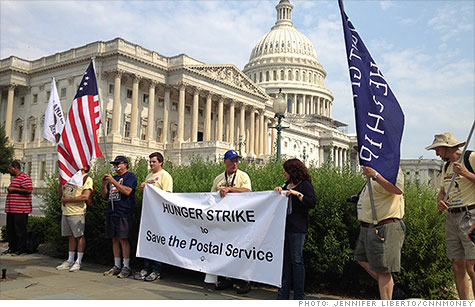
Postal Workers Hold Second Hunger Strike as House-Senate Negotiate Future of Postal Servce

Postal workers declare 'victory' after holding six-day hunger strike

Postal workers began a hunger strike Monday outside the Capitol. They're protesting cuts that could eliminate thousands of jobs and reduce postal service.

By Alicia M. Cohn
The Hill, December 23, 2012
    
A group of postal workers striking against proposed cuts to the U.S. Postal Service (USPS) declared a "people's victory" late Saturday after holding a fast for six days.
 
The small group of retired and active letter carriers, calling themselves the Communities and Postal Workers United (CPWU), had staged protests on the National Mall and Capitol Hill this week to raise awareness about proposed legislation that would reduce the USPS delivery week to five days. 
 
Cutting mail delivery to five days will eliminate 80,000 postal jobs, according to postal unions. 
“We will not stand by as our beloved postal service is destroyed,” Tom Dodge, a postal worker from Baltimore, said in a statement from the CPWU.
 
 
The USPS is bleeding millions every day. The agency lost $16 billion in fiscal year 2012, and needs to cut around $22.5 billion from its annual budget by 2016. One proposed budget solution, that has been spearheaded by Rep. Darrell Issa (R-Calif.) and endorsed by President Obama, is to reduce the number of days the mail is delivered.
 
The strikers are calling on postal management to suspend cuts and closures of mail sorting plants. They suggest Congress fix the budgetary problems by repealing the prefunding mandate and refunding the pension surplus instead.
 
The USPS is required to prefund retiree health benefits but has defaulted on two separate prepayments already this year. The agency had also hoped that surplus payments to the Federal Employees Retirement Service could be used to help stabilize its financial situation, but the amount of projected overpayment is disputed.
 

Postal workers stage second hunger strike as House-Senate talks on legislation continue

By Lisa Rein
Washington Post, December 18, 2012 
 
As Senate-House negotiations continue for a possible year-end deal to help the financially struggling U.S. Postal Service, a small band of protesters plan  to launch their second hunger strike in six months on Tuesday.
 
The six former and current postal workers, who call themselves Communities and Postal Workers United, have set up an encampment on the Mall at Ninth Street NW. They say they are protesting an offer by Senate negotiators to put five-day mail delivery on the table, a change that could eliminate as many as 25,000 letter carrier jobs.  
 
“We’re declaring an emergency postal hunger strike to head off five-day delivery,” said Jamie
Partridge, a retired letter carrier from Portland, Ore. ”If we can turn up the pressure and prevent the lame-duck session from passing postal legislation, we will, because it’s bound to be a bad bill.” He said the hunger strike will continue until late Saturday.
 
A member of the Postal Workers Union holds a cup of coffee while participating in a hunger strike in front of the Rayburn House Office building, on June 26, 2012 in Washington, DC. Postal workers are fasting from June 25 to 28 in hopes of urging Congress to repeal the pre-funding mandate and refund the pension surplus for Postal workers.
 
House and Senate leaders have been unable in the 112th Congress to agree on legislation to help put the postal service, which is losing billions of dollars a year, on a path toward financial stability. A bill passed by the Senate last spring would put off a switch to five-day service for two years, transfer billions of dollars from a pension fund to allow the agency to offer buyouts to worker,s and extend the payment schedule for benefits the postal service must set aside for future retirees. 
 
A House bill proposed by Rep. Darrell Issa (R-Calif.) would give the agency more latitude to cut services, eliminating six-day service now, for example. It would put a panel in charge of overseeing postal finances and prohibit labor contracts that prevent layoffs, among other provisions.
 
But Issa did not have the votes to bring it to the floor, and an overhaul seemed unlikely to pass this year.
 
In November, retiring Sen. Joe Lieberman (I-Conn.), one of the sponsors of the Senate bill, offered to get talks moving by giving up Saturday delivery for letters, a change the postal service has sought for years but which has generated opposition in both parties. 
However, sticking points remain, say aides on House and Senate committees involved in the talks.
 
The Senate still opposes Issa’s proposal to restrict the postal service’s ability to negotiate labor agreements, and there is disagreement over how much payment for future health benefits should be reduced.
 
House and Senate aides said that lawmakers on both sides of Capitol Hill continue discussing the possibility of striking a deal, possibly as part of the broader plan to avert the “fiscal cliff.”  It’s expected that any deal would include changes to the mail delivery schedule and account for the postal service’s pension payment schedule, said the aides, who were not authorized to speak for attribution.
 
Any bill would likely be tacked onto legislation resolving the budget debate over taxes, spending and the federal deficit now consuming Congress. 
 
“If action isn’t taken soon, the postal service will go off its own fiscal cliff,” Emily Spain, a spokeswoman for Sen. Tom Carper. said.
 
Partridge was one of 10 activists who held a five-day hunger strike in Washington in June, declaring that Congress was “starving” the postal service by requiring the agency to set aside health payments. They met with Capitol Hill staffers but were turned back from a face-to-face meeting with Postmaster General Patrick Donahoe. Their highest-profile supporter is former representative Dennis Kucinich (D-Ohio), a champion of labor who is retiring from Congress.
In a statement, postal service spokesman David Partenheimer said, “We respect the right of our employees to engage in lawful public dialogue regarding postal issues.”
 
He said, however, that “it is critical for Congress to pass comprehensive postal reform legislation” before adjourning this year.
 
-Ed O’Keefe contributed to this story.


FBI Documents Reveal Secret Nationwide Occupy Monitoring

Partnership for Civil Justice
December 22, 2012

FBI documents just obtained by the Partnership for Civil Justice Fund (PCJF) pursuant to the PCJF’s Freedom of Information Act demands reveal that from its inception, the FBI treated the Occupy movement as a potential criminal and terrorist threat even though the agency acknowledges in documents that organizers explicitly called for peaceful protest and did “not condone the use of violence” at occupy protests.

 
The PCJF has obtained heavily redacted documents showing that FBI offices and agents around the country were in high gear conducting surveillance against the movement even as early as August 2011, a month prior to the establishment of the OWS encampment in Zuccotti Park and other Occupy actions around the country.
 
“This production, which we believe is just the tip of the iceberg, is a window into the nationwide scope of the FBI’s surveillance, monitoring, and reporting on peaceful protestors organizing with the Occupy movement,” stated Mara Verheyden-Hilliard, Executive Director of the Partnership for Civil Justice Fund (PCJF). “These documents show that the FBI and the Department of Homeland Security are treating protests against the corporate and banking structure of America as potential criminal and terrorist activity. These documents also show these federal agencies functioning as a de facto intelligence arm of Wall Street and Corporate America.”
 
“The documents are heavily redacted, and it is clear from the production that the FBI is withholding far more material. We are filing an appeal challenging this response and demanding full disclosure to the public of the records of this operation,” stated Heather Benno, staff attorney with the PCJF.
 
As early as August 19, 2011, the FBI in New York was meeting with the New York Stock Exchange to discuss the Occupy Wall Street protests that wouldn’t start for another month. By September, prior to the start of the OWS, the FBI was notifying businesses that they might be the focus of an OWS protest.
 
- The FBI’s Indianapolis division released a “Potential Criminal Activity Alert” on September 15, 2011, even though they acknowledged that no specific protest date had been scheduled in Indiana.
 
- The documents show that the Indianapolis division of the FBI was coordinating with “All Indiana State and Local Law Enforcement Agencies,” as well as the “Indiana Intelligence Fusion Center,” the FBI “Directorate of Intelligence” and other national FBI coordinating mechanisms.
 
- Documents show the spying abuses of the FBI’s “Campus Liaison Program” in which the FBI in Albany and the Syracuse Joint Terrorism Task Force disseminated information to “sixteen (16) different campus police officials,” and then “six (6) additional campus police officials.” Campus officials were in contact with the FBI for information on OWS. A representative of the State University of New York at Oswego contacted the FBI for information on the OWS protests and reported to the FBI on the SUNY-Oswego Occupy encampment made up of students and professors.
 
- Documents released show coordination between the FBI, Department of Homeland Security and corporate America. They include a report by the Domestic Security Alliance Council (DSAC), described by the federal government as “a strategic partnership between the FBI, the Department of Homeland Security and the private sector,” discussing the OWS protests at the West Coast ports to “raise awareness concerning this type of criminal activity.” The DSAC report shows the nature of secret collaboration between American intelligence agencies and their corporate clients - the document contains a “handling notice” that the information is “meant for use primarily within the corporate security community. Such messages shall not be released in either written or oral form to the media, the general public or other personnel…” (The DSAC document was also obtained by the Northern California ACLU which has sought local FBI surveillance files.)
 
- Naval Criminal Investigative Services (NCIS) reported to the DSAC on the relationship between OWS and organized labor for the port actions. The NCIS describes itself as “an elite worldwide federal law enforcement organization” whose “mission is to investigate and defeat criminal, terrorist, and foreign intelligence threats to the United States Navy and Marine Corps ashore, afloat and in cyberspace.” The NCIS also assists with the transport of Guantanamo prisoners.
 
- DSAC issued several tips to its corporate clients on “civil unrest” which it defines as ranging from “small, organized rallies to large-scale demonstrations and rioting.” It advised to dress conservatively, avoid political discussions and “avoid all large gatherings related to civil issues. Even seemingly peaceful rallies can spur violent activity or be met with resistance by security forces. Bystanders may be arrested or harmed by security forces using water cannons, tear gas or other measures to control crowds.”
 
- The FBI in Anchorage reported from a Joint Terrorism Task Force meeting of November 3, 2011, about Occupy activities in Anchorage.
 
- A port Facility Security Officer in Anchorage coordinated with the FBI to attend the meeting of protestors and gain intelligence on the planning of the port actions. He was advised to request the presence of an Anchorage Police Department official to also attend the event. The FBI Special Agent told the undercover private operative that he would notify the Joint Terrorism Task Force and that he would provide a point of contact at the Anchorage Police Department.
 
- The Jacksonville, Florida FBI prepared a Domestic Terrorism briefing on the “spread of the Occupy Wall Street Movement” in October 2011. The intelligence meeting discussed Occupy venues identifying “Daytona, Gainesville and Ocala Resident Agency territories as portions …where some of the highest unemployment rates in Florida continue to exist.”
 
- The Tampa, Florida FBI “Domestic Terrorism” liaison participated with the Tampa Police Department’s monthly intelligence meeting in which Occupy Lakeland, Occupy Polk County and Occupy St. Petersburg were discussed. They reported on an individual “leading the Occupy Tampa” and plans for travel to Gainesville for a protest planning meeting, as well as on Veterans for Peace plans to protest at MacDill Air Force Base.
 
- The Federal Reserve in Richmond appears to have had personnel surveilling OWS planning. They were in contact with the FBI in Richmond to “pass on information regarding the movement known as occupy Wall Street.” There were repeated communications “to pass on updates of the events and decisions made during the small rallies and the following information received from the Capital Police Intelligence Unit through JTTF (Joint Terrorism Task Force).”
 
- The Virginia FBI was collecting intelligence on the OWS movement for dissemination to the Virginia Fusion Center and other Intelligence divisions.
 
- The Milwaukee division of the FBI was coordinating with the Ashwaubenon Public Safety division in Green Bay Wisconsin regarding Occupy.
 
- The Memphis FBI’s Joint Terrorism Task Force met to discuss “domestic terrorism” threats, including, “Aryan Nations, Occupy Wall Street, and Anonymous.”
 
- The Birmingham, AL division of the FBI sent communications to HAZMAT teams regarding the Occupy Wall Street movement.
 
- The Jackson, Mississippi division of the FBI attended a meeting of the Bank Security Group in Biloxi, MS with multiple private banks and the Biloxi Police Department, in which they discussed an announced protest for “National Bad Bank Sit-In-Day” on December 7, 2011.
 
- The Denver, CO FBI and its Bank Fraud Working Group met and were briefed on Occupy Wall Street in November 2011. Members of the Working Group include private financial institutions and local area law enforcement.
 
- Jackson, MS Joint Terrorism Task Force issued a “Counterterrorism Preparedness” alert. This heavily redacted document includes the description, “To document…the Occupy Wall Street Movement.”
 
 
The PCJF filed Freedom of Information Act demands with multiple federal law enforcement agencies in the fall of 2011 as the Occupy crackdown began. The FBI initially attempted to limit its search to only one limited record keeping index. Recognizing this as a common tactic used by the FBI to conduct an inadequate search, the PCJF pressed forward demanding searches be performed of the FBI headquarters as well as FBI field offices nationwide.
 
The PCJF will continue to push for public disclosure of the government’s spy files and will release documents as they are obtained.
 
The Partnership for Civil Justice Fund (PCJF) is a not-for-profit constitutional rights legal and educational organization which, among other things, seeks to ensure constitutional accountability within police practices and government transparency in operations. The PCJF filed the class action suit challenging the NYPD's October 1 mass arrest of more than 700 protestors on the Brooklyn Bridge. It has brought class action cases in which more than 1,000 persons were falsely arrested during protests in Washington, D.C., resulting in settlements totaling $22 million and major changes in police practices. The PCJF previously brought the successful litigation in New York challenging the 2004 ban on protests in the Great Lawn of Central Park. It is counsel with the National Lawyers Guild in Oakland, CA challenging police mass arrest tactics. It won a unanimous ruling at the D.C. Circuit Court of Appeals finding the MPD’s unprecedented military-style police checkpoint program unconstitutional. The PCJF previously uncovered and disclosed that the D.C. police employed an unlawful domestic spying and agent provocateur program in which officers were sent on long-term assignments posing as political activists and infiltrated lawful and peaceful groups.
 
For more information go to: www.JusticeOnline.org.

Occupy Atlanta Claims City Deceived Court, Spied on Protesters


rsz_occupy_press_conf.jpg

By MATTHEW CHARLES CARDINALE
Alanta Progressive News, December 21, 2012
 
(APN) ATLANTA -- At a press conference at City Hall today, Friday, December 21, 2012, activists with Occupy Atlanta alleged that the City of Atlanta deceived them and the Atlanta Municipal Court with respect to eight hundred pages of documents that the activists say they subpoenaed months ago.
 
In addition, recent court proceedings have revealed a significant spying operation by the City of Atlanta in connection with other agencies including the federal Department of Homeland Security, on Occupy Atlanta.
 
All week long, over eighty Occupy Atlanta activists have been on trial, including 53 who were arrested during a massive arrest at Woodruff Park that occurred October 25 and 26, 2011.  Most of those were charged with being in the park between 11pm and 6am, a petty misdemeanor.
 
Other activists faced charges stemming from additional arrests that occurred on November 01, 2011, involving a protest that spilled out into the street; and from a later protest at a Chase Bank branch.  The latter arrestees are known as the Chase 8.
 
Some of the activists also faced charges of resisting arrest and obstruction of traffic.
 
Throughout the week, about twenty activists accepted a plea bargain in which they agreed to suspended sentence agreements, some which included a fine and/or hours of community service; however, if the activists do not get into legal trouble for a year they will not have to pay the fine or perform the hours of service.
 
The City of Atlanta arrested the activists late last year in a massive show of force that is estimated to have cost the City over one million dollars, including helicopters; dozens of officers on foot, horse, and motorcycle; and some apparent police brutality.  
 
The City took issue with the fact that activists were camping in the park after hours.  The Mayor had at first issued an executive order saying the protesters could stay, but then lifted the executive order, citing alleged public safety concerns.
 
Occupy Atlanta, one of hundreds of chapters of Occupy Together nationwide, had been protesting to bring awareness to what they refer to as the 99 percent, the vast majority of US residents who are suffering and who they say are being taken advantage of by a neoliberal capitalist system that has perverted our system of democratic governance.
 
The trial is before Chief Judge Crystal Gaines, who also heard the controversial Eagle Raid trial involving allegations that men were dancing at a bar in their underwear for tips.
 
Among those arrested with Occupy Atlanta include such progressive champions as State Sen. Vincent Fort (D-Atlanta), former Atlanta City Councilman Derrick Boazman (District 12), and veteran activist Joe Beasley.
 
Meanwhile, the charges against over thirty activists were dropped, seeing as how Atlanta Police Department (APD) officers could not identify many of the specific activists whom they arrested by name in court, when asked.
 
Currently, eight activists are still facing charges, including Beasley, Boazman, activist Tim Franzen, and Fort, as well as four activists--including Amy Barnes, Kimlee Davis, Diana Eidon, and a fourth person--who were removed from the main case into a separate trial process to accommodate their unique needs.
 
Attorney Mawuli Mel Davis held up a stack of 800 pages of documents on the steps of City Hall that he said “the City failed to turn over in subpoenas upon request.”
 
Attorney Alex Susor said they had subpoenaed the City of Atlanta earlier this summer for the production of certain records.  “We litigated these issues very early on in the case.”
 
“We served subpoenas on George Turner and Kasim Reed’s office.  The City Attorney’s office sent a motion to quash.  After we began the trial, an officer testified the documents existed under oath,” Susor said.
 
“They said they did not exist and they were too voluminous and there was no way to separate them out,” Susor said.
 
“That being said, we found out in the middle of the trial the activists were being infiltrated.  They denied that,” Susor said.
 
“Fire inspectors went out to the park.  No violations were found.  It is grotesquely unfair to keep that a secret,” Susor said.
 
Fort referred to the City’s actions as an “ongoing and pernicious cover-up.”
 
“It says something about the conduct of this Mayor.  He instructs the City Attorney.  When you hide and suppress evidence, you are guilty as sin,” Boazman said.
 
“Mayor Kasim Reed in his reasoning, stating this is going to be a safety hazard, and denying, documents they claimed did not exist [showing]... at Occupy Atlanta, they made the announcement for anyone with drugs or weapons... to leave immediately,” attorney Scott Dawkins said.
 
With the addition of the newly released documents, the record “shows no public safety hazard that the Mayor needed to rescind the Executive Order,” Fort said.
 
“We are in the position now of asking the City of Atlanta and Mayor Reed to stop the cover-up.  What do you have to hide?” Fort asked.
 
“I don’t trust [Senior Assistant City Attorney] Amber Robinson.  I’m concerned there are more documents,” Fort said.
 
Susor said that some of the newly revealed documents are now admitted in court and before Judge Gaines for her consideration.  He added that should the Defendants be found guilty, the documents, and the City’s withholding of the documents, can be considered on appeal.
 
Davis said they would also be considering pursuing sanctions against the City of Atlanta for withholding the documents.
 
Davis said that Occupy Atlanta had learned the Department of Homeland Security of the US was involved and helping coordinate the efforts between various agencies to spy upon and infiltrate the Occupy Atlanta movement.
 
“It’s shocking to find out our movement had been infiltrated at every level,” Franzen said.
 
Informants attended every General Assembly, the regular meetings of Occupy Atlanta, and gave daily, sometimes hourly reports back to an apparent consortium of agencies at the local and federal levels.
 
The legal defense team plans to make its closing arguments in January 2013.

100+ American Protesters Descend On Cayman

 
December 22, 2012
 
On 13 December 2012, over 100 Americans descended on the Cayman Islands to protest their tax policies and demand that American corporations pay their “fair share of taxes.”
 
They held signs saying “Bring our tax dollars home” and “We want our money back” and sang a parody song to Harry Belafonte’s “Day-O” with the refrain “Tax evaders time to bring the money home.”
 
The protest was organized by the US-based activist group CodePink. “The US deficit could be solved with the $150 billion a year that could be recovered from these offshore tax shelters,” said CodePink co-founder Jodie Evans.

Zapatista March: The Deafening Silence of Resurgence


End of Mayan Calendar Memorialized: Silent Marches of Tens of Thousands Remind 'We Are Here so Are Lack of Health Care, Education, Housing, Land, Food, Indigenous Rights, Women's Rights, Gay Rights, Dignity, and Justice'

By Tim Russo, Photos by Tim Russo    
Upside Down World, December 22, 2012
 
Only the resonating echo of rain pattering down on the cobblestone streets of Chiapas' colonial cities sounded as tourists from around the globe awaiting the end of the world in the center of the Mayan Civilization were surprised by the silent marches of more than 40,000 masked Mayan Zapatistas who descended on their apocalyptic misinterpretations of the Mayan 13 Ba´ktun. 
 
A faint sound of a baby's cry would occasionally emerge from a bundle beneath a plastic tarp on the back of a masked Zapatista in the endless lines of Mayan rebels who quietly held formation in the rain. They marched four file booted and bare-footed into the same cities they surprised on a cold new year's eve night 19 years ago, shouting their first YA BASTA! 
 
Yesterday's weapon, differing from the 1994 armed indigenous uprising, was the Zapatista silence, their moral authority, the echo of a unified and deafening silence that shouted YA BASTA! once again. A silence that in their massive presence in San Cristóbal de las Casas, Ocosingo, Altamirano, Las Margaritas and Palenque shouted without a word that the a new Mayan era has begun and the Zapatistas are present. A silence that was meant to remind Mexico's recently inaugurated President Enrique Peña Nieto and his PRI party that the root causes of the Zapatista struggle are as prevalent today as they were 19 years ago: lack of health care, education, housing, land, food, indigenous rights, women's rights, gay rights, dignity, and justice. A silence that reminded the returning PRI that there is a Mexico profundo, a Mexico jodido, a Mexico con hambre, and a Mexico dispuesto a luchar and in struggle. The Zapatistas and the EZLN need not say a word today, their actions and silence said enough. Aqui estamos!
 
As early as 4 a.m. the Mayan indigenous, Tzeltales, Tzotziles, Tojolobales, Choles, Zoques, and Mames began their mobilizations from their five cultural centers of resistance, known as Caracoles, emerging from the Lacandon jungle, the Chiapas Canyon lands, and the rain soaked highlands. They quietly moved along the mountainous, fog-bearing roads towards the same cities (plus Palenque) that they descended upon when these ill-equipped ragtag rebels launched their armed uprising on January 1st 1994, the day the North American Free Trade Agreement went in to effect.
 
Yesterday's marches by the Zapatista National Liberation Army comprised of Mexico’s Mayan indigenous peoples was the first mobilization since their May 7, 2011 march demanding an end to the widespread violence and impunity in Mexico. That march echoed Poet Javier Sicilia's movement for justice demanding the end to PANista President Felipe Calderon's US-backed War on Drugs that has claimed up to 80,000 lives over the last six years. Calderon, who departs Mexico leaving a bloodstained country, will follow his predecessor Ernesto Zedillo’s footsteps to a safe haven in US academia, entering Harvard and moving to Cambridge, a town ironically that has one of the world´s lowest per capita murder rates, contrary to a Mexico ranking in the world’s top 10 country’s with major violent death tolls. Today’s Zapatista march, explains award winning Mexican Journalist Jose Gil Olmos, marks a symbolic moment being December 21st  on the Gregorian calendar and 13 Ba´ktun, or the end of the 144,000 day Mayan long calendar, silently saying that this is beginning of a new calendar, a new era and the Zapatistas are present:
 
"The mere presence of the Zapatistas here today just as the new government of Enrique Peña Nieto is getting started and the return of the PRI is a message in and of itself that the EZLN exists and is here, that the EZLN is a social and political force and they are reminding the PRI that things are not good, That the voice of the voiceless and the faceless are saying listen up! There is a forgotten Mexico here, a Mexico that is starving and disparate and the march, a silent march is an emblematic message in and of itself."
 
There were no visible Zapatista Commanders in the marches, no words spoken, no chants could be heard, nor banners seen. Only two flags accompanied the thousands of Mayan rebels, a Zapatista five pointed red star on black and the Mexican flag. The same scenario could be seen in each of the five cities that the Zapatistas descended upon despite the unusual rains for the beginning of the Chiapas dry season. The Zapatistas arrived, marched on the city centers, built make-shift stages on top of cars and marched thousands of Zapatistas four by four, fists in the air, over the stages in front of their flags. Then, as quickly and quietly as they arrived, the Zapatistas disappeared into the fog and rain that camouflaged their arrival.
 
Late in the day a one-page communiqué signed by Zapatista rebel leader Sub-Comandante Marcos, El Sup, began to go viral on the internet. The communiqué simply read the following:
 
Did You Hear?
That is the sound of your world falling apart.
It is the sound of our resurgence.
The day that was the day, was night.
And night will be the day that will be the day.
Democracy!
Liberty!
Justice!


Tim Russo is a long time media activist, photographer and journalist. Russo has covered Mexico and Latin America for over twenty years.  He is on the Board of Directors of Free Speech Radio News www.fsrn.org, regularly contributes to KGNU in Boulder, Colorado and is active with the Red Mesoamericana de Radios Comunitarias, Indígenas y Garifunas.
assetto corsa mods

Urgent End Of Year Fundraising Campaign

Online donations are back! Keep independent media alive. 

Due to the attacks on our fiscal sponsor, we were unable to raise funds online for nearly two years.  As the bills pile up, your help is needed now to cover the monthly costs of operating Popular Resistance.

Urgent End Of Year Fundraising Campaign

Online donations are back! 

Keep independent media alive. 

Due to the attacks on our fiscal sponsor, we were unable to raise funds online for nearly two years.  As the bills pile up, your help is needed now to cover the monthly costs of operating Popular Resistance.

Sign Up To Our Daily Digest

Independent media outlets are being suppressed and dropped by corporations like Google, Facebook and Twitter. Sign up for our daily email digest before it’s too late so you don’t miss the latest movement news.