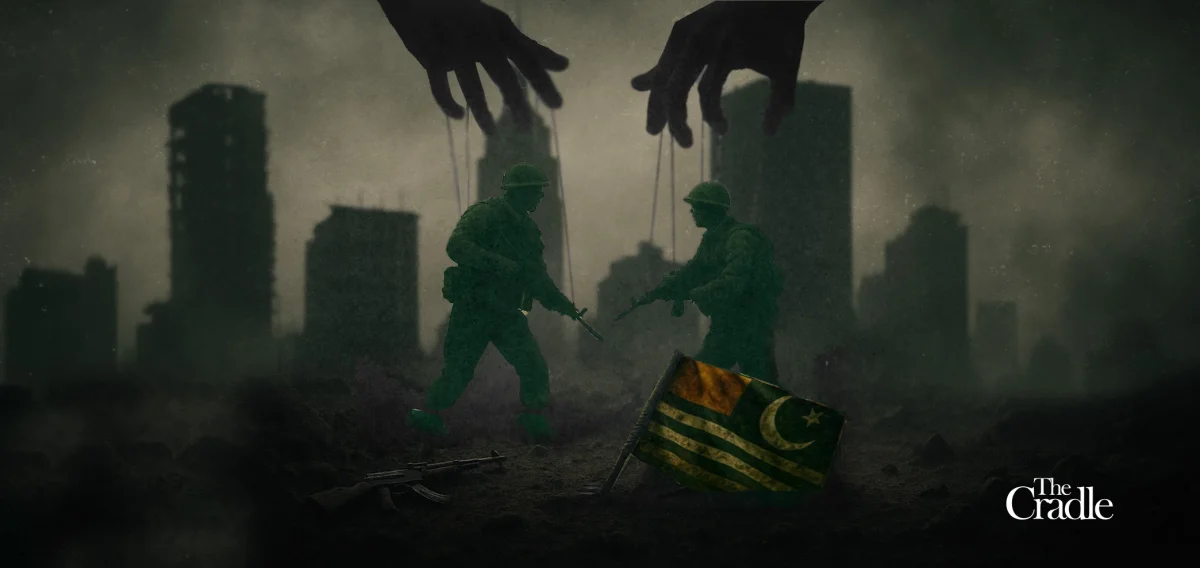
Amid escalating tensions between nuclear-armed India and Pakistan, a deadly attack by unknown forces in Kashmir has sparked a dangerous chain of events.
Drawing in global powers and pushing the region closer to the brink of war – raising questions about who stands to gain from the conflict.
In a region already on the brink, the latest violence in Indian-occupied Kashmir has intensified a decades-old conflict between nuclear-armed India and Pakistan. The attack, which targeted Indian tourists in the Pahalgam valley, killing 26, has quickly escalated into a diplomatic and military standoff.
With India and Pakistan trading accusations and retaliatory measures, the potential for full-scale conflict is growing – especially as external players like the US and Israel loom over the situation, each with their own interests in fueling or containing the crisis.
Kashmir: South Asia’s flashpoint
A web of conspiracy and suspicion has surrounded the incident in Kashmir, with missing links complicating the narrative. The Pahalgam assault raises questions about the timing of US Vice President JD Vance’s visit to India, which occurred while Indian Prime Minister Narendra Modi was in the Saudi Arabian Red Sea port city Jeddah – a visit that was cut short abruptly.
Experts warn that the only beneficiaries of this conflict will be the arms manufacturers, Pentagon lobbyists, and Wall Street investors. Their motives are clear: keep the dollar strong, prop up the struggling US economy, and importantly, maintain tension between India and China.
Equally concerning are the growing defense ties between India and Israel, which have intensified in recent years. While there is no conclusive evidence of Israeli military personnel being deployed in Kashmir, Tel Aviv’s strategic support for India – particularly in the realm of defense and military technology – has been well documented. As India strengthens its military capabilities, it has increasingly turned to Israeli-made weapons and defense systems, further aligning the two countries on key security issues.
In light of this, Senator Irfan Siddiqui of Pakistan’s PML-N opposition party, recently accused Indian Prime Minister Modi of following an Israeli-style policy in Kashmir. On 26 April, Siddiqui likened Modi’s approach to the repression of Palestinians in Gaza, claiming India was trying to transform Kashmir into “another Gaza.”
He criticized the Indian government for replicating the occupation state’s policies of control and suppression in Kashmir, particularly following the controversial revocation of Article 370 in 2019. This growing alignment between India and Israel, coupled with the increasing militarization of Kashmir, has far-reaching implications for the region’s security dynamics.
Abdullah Khan, managing director of the Pakistan Institute for Conflict and Security Studies (PICSS) in Islamabad, tells The Cradle that the militant group, The Resistance Front (TRF), which India claims is behind the attack, has denied involvement. It argues that the claim of responsibility was the result of a cyber intrusion by Indian intelligence agencies. According to Khan:
“The peace of South Asia is at stake, and a thorough independent investigation is needed to determine the real culprit. The term ‘military escalation’ is used in a diplomatic context, as India has not demanded a ceasefire agreement along the Line of Control [LOC] since 2021, and despite all jingoism in Indian media, New Delhi has not yet hinted at carrying out military strikes.”
The catalyst for escalation
On 22 April, the attackers infiltrated the Pahalgam valley, killing 26 Indian tourists after identifying their religious affiliations. The swift Indian response to blame Islamabad – without offering public evidence – has ignited a firestorm of diplomatic measures.
New Delhi has suspended critical agreements, including the Indus Water Treaty (IWT), downgraded diplomatic relations, and revoked visas for Pakistani citizens. Khan explains:
“Regarding the suspension of the Indus Water Treaty, the Indian demarche does not reference the IWT. Since 2021, the Indus Water Commissioners have not convened any meeting, resulting in a de facto suspension of the IWT. Nonetheless, should India implement tangible measures to halt the flow of water, it could potentially precipitate conflict, as Pakistan has unequivocally stated that such actions would be regarded as an act of war.”
Pakistan retaliated against Indian steps by revoking the visas of Indian nationals while referring to Indian actions as “irresponsible.” Islamabad ceased all trade deals with India, restricted Indian aircraft from accessing its airspace, and prohibited business transactions conducted through third countries.
New Delhi’s retaliatory steps, while severe, are also politically charged. These measures were designed not only to punish Pakistan but to send a message to both domestic and international audiences.
External forces amplifying the crisis
This attack – occurring as India and China were making strides toward reconciliation – adds fuel to a complex geopolitical fire. The evolving relations between the two Asian giants, already tense after the 2020 Ladakh border clash, now hang in the balance. The Pahalgam attack could further deepen divides, potentially sparking a regional shift.
The Israeli connection also complicates the issue. Reports of Israeli military presence in Kashmir suggest external actors are feeding the flames, potentially steering India’s military strategy. This is hardly a surprise given India’s growing defense ties with Israel, further fracturing the region’s fragile balance.
Prime Minister Modi had just recently commented on improving ties with Beijing – the first time in five years that an Indian statesman had spoken positively about China. In an interview, Modi said he was optimistic about India’s relations with its long-time adversary, and underlined the need for further cooperation between New Delhi and Beijing because of the recent developments in the disputed border issue, indicating remarkable progress. The relationship between the two countries, he said, was undergoing major structural changes.
However, the timing of the attack seems designed to derail those efforts. With the region’s stability at risk, the attack raises questions about who ultimately benefits from this escalating conflict.
India’s hardline response: Strategy or posturing?
India’s reaction to the Pahalgam attack was swift and decisive, though no direct evidence linked Pakistan to the assault. Prime Minister Modi, already dealing with diplomatic shifts, faces immense pressure to take a harder stance. Despite the absence of clear evidence, India has moved quickly, positioning itself as the regional power.
Analysts suggest that India’s aggressive rhetoric is less about military escalation and more about domestic posturing. India has a significant military advantage over Pakistan, but both states possess nuclear weapons, and a miscalculation could have devastating consequences for both.
Pakistan’s strength lies in its land-based power and geographic advantage, but in a direct conflict, India’s technological superiority would likely prove decisive.
The 2025 Global Power Index highlights the stark military disparities between India and Pakistan. India’s defense budget – $75 billion – vastly surpasses Pakistan’s $7.6 billion. India’s air fleet includes 2,229 aircraft, compared to Pakistan’s 1,399, and India boasts 4,201 tanks, while Pakistan has just 2,627. India also has a powerful naval fleet, including two aircraft carriers and 18 submarines.
Pakistan’s retaliation: A nation on edge
Pakistan, already reeling from internal challenges – militancy in Balochistan, economic struggles – has retaliated, revoking Indian visas and suspending trade deals. Despite this, experts such as Mansur Khan Masud of the FATA Research Centre believe Pakistan is unlikely to escalate further, he tells The Cradle:
“I don’t think they would open another front despite finding it difficult to address the existing ones, draining on the economy.”
Pakistan’s military, despite its strategic position, lacks India’s overwhelming air and naval superiority. This leaves Pakistan in a vulnerable position, relying more on political posturing than direct military confrontation.
He also asserts that it was incredible that the Kashmiri militant outfit, lying dormant for years, would suddenly reawaken and carry out a high-profile massive operation in a tourist resort:
“I am really at a loss to understand that Kashmiri resistance forces would have the potential and expertise to conduct such a sophisticated operation with precision and in a highly disciplined and expert manner.”
Khan thinks Baloch separatist forces could have carried out this operation. He claims the assault closely resembles the strategies employed by militant groups operating against Pakistan in Balochistan, including the Balochistan Liberation Army (BLA) and Balochistan Liberation Front (BLF).
Baloch militants’ modus operandi, Khan notes, was the identification and killing of people from outside the region; this pattern has been consistent. Yet it remains unclear whether the violence was a response to India’s alleged involvement in Balochistan or whether it was a component of a larger game to apply pressure on Pakistan from all sides.
As tensions between India and Pakistan escalate, the true beneficiaries may not be the countries directly involved, but the external powers with vested interests in the region.
The US, Israel, and other global actors stand to profit from prolonging instability – either through a lucrative arms trade or by leveraging the crisis to advance their own strategic agendas.
The future of South Asia hangs in the balance. Whether the region is pushed toward further conflict or whether cooler heads prevail will not only shape the fate of the subcontinent but could have profound implications for global stability.