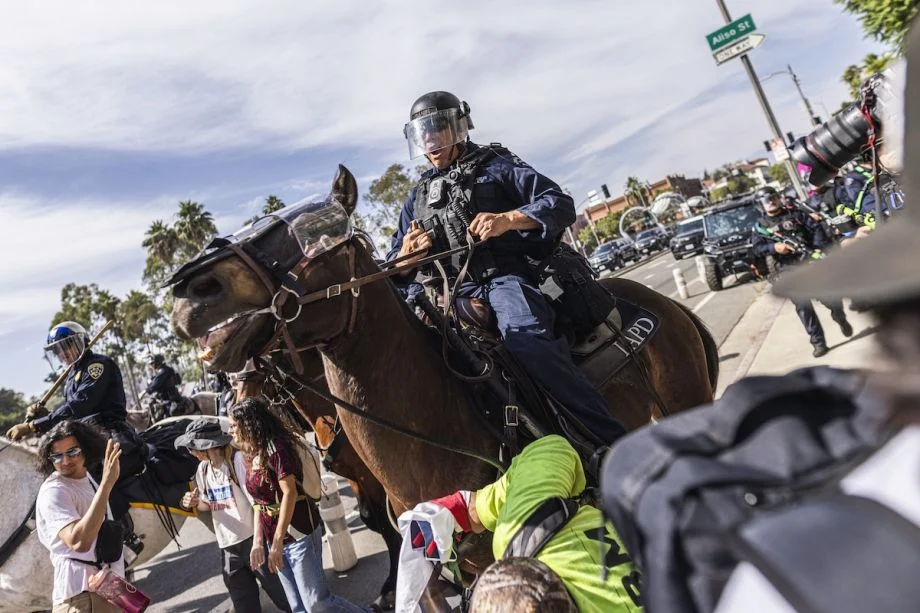
Above photo: The LAPD charges at peaceful protesters following the ”No Kings” protest in Downtown Los Angeles, United States, on June 14, 2025. J.W. Hendricks/NurPhoto via AP.
Cities have a rare opportunity to absorb the civic energy from one of the largest protests in our nation’s history.
And translate it into something lasting.
Mayor Karen Bass warns that Los Angeles is being used as a “test case” for undermining state sovereignty and consolidating federal power. In the wake of immigration raids and the deployment of the National Guard and Marines — all without state consent — the warning feels urgent, not rhetorical. These actions are stress tests probing the limits of democratic resilience in the spaces where the government is closest to the people: our cities.
We’ve seen that federal overreach in Los Angeles precipitated massive collective action, but equally important is how Mayor Bass and municipal governments across the country absorb this energy to build more democratically resilient cities.
At home and abroad we’ve seen this before — when protests are framed as security threats, when military force is used to override local authority, and when federal funding is used to intimidate. And, we have also seen a wellspring of tools to help cities win against contemporary authoritarian tactics. During my time as a democracy expert overseas, I saw a range of strategies used by civil society and governments to resist authoritarian backsliding. From them, we should take inspiration.
The energy in Los Angeles is not just resistance. It’s an opportunity to redefine how we engage with our neighbors, how we structure power locally and how we practice democracy beyond the ballot box.
In cities across the country, municipal governments and communities must design public processes that honor the full spectrum of civic obligation — not only the right to participate, but the responsibility to connect, to build trust and to co-create. We must nurture the habits of democratic life at the neighborhood level: through planning meetings, budget decisions, park designs, meaningful metrics and everything in between.
Immediate Steps Cities Should Take
To meet this moment, cities must act quickly and with clarity.
First, city governments should institutionalize civic engagement by funding and embedding citizen assemblies and participatory budgeting into long-term governance strategies — not as pilot projects, but as recurring, charter-enshrined practices. These models create space for deeper deliberation and reduce the influence of loud minority voices that often dominate traditional public forums.
Second, planning departments should shift from transactional engagement to relational engagement. This means allocating staff time and resources toward community liaisons, neighborhood conveners, and facilitators who can build long-term trust across lines of difference.
Third, cities should adopt and publicly report on democracy-centered metrics. Equity dashboards should include not only housing and transit indicators, but trust measures: Are residents attending city meetings? Do they understand how decisions are made? Do they see their ideas reflected in final plans?
Finally, city leadership should collaborate with civic organizations, academic institutions, and the media to elevate stories of democratic innovation at the local level. Celebrating success not only sustains morale but encourages replication and learning across cities.
Let’s take a closer look at these strategies.
Deliberation, Metrics And Trust-Building
Municipal governments and communities have a rare opportunity to absorb this civic energy from one of the largest protests in our nation’s history and translate it into something lasting.
Oregon’s Citizen Assembly pilot offers a model of durable deliberative infrastructure that makes governing more participatory. Randomly selected residents deliberated over state Covid-19 responses with care, depth and legitimacy. These processes aren’t flashy, but they make it harder for authoritarian power and associated narratives to fill a vacuum of participation.
But deliberation is only part of the puzzle. We also need better ways of measuring success. If we’re serious about building democratic resilience, we need to start with how people perceive each other.
Research from Beyond Conflict shows that Americans wildly overestimate how much members of the “other side” dislike or dehumanize them. These misperceptions, termed meta-perceptions, fuel polarization, undermine trust, and make communities more susceptible to authoritarian narratives.
Luckily, it turns out these distorted views are reversible. When participants in a national study were shown how inaccurate their assumptions were, support for political violence and anti-democratic practices dropped, while openness to engagement increased. The correction worked across partisan lines.
This isn’t just psychology — it’s public infrastructure for democratic resilience.
City leaders should treat these findings as a wake-up call. Just as we measure housing affordability or transit ridership, we should be measuring the civic “temperature” of our communities. Do residents believe they’re heard? Do they assume the worst of their neighbors? Are they aware of how much common ground exists?
Urban development efforts often focus on visible outputs like housing units built, dollars invested, or business licenses issued as proxies for progress. While important, these economic indicators tell us little about how communities experience inclusion, legitimacy, or agency.
Cities should be incorporating trust- and belonging-based indicators into the evaluation of city planning efforts. Like what the GovLab’s recently published “Framework for Measuring Trust” emphasizes, trust in institutions is shaped by perceptions of competence, fairness, integrity, and empathy. Cities should design metrics that track whether residents feel listened to, whether they understand city processes, misperceive each other, and whether they believe public institutions act in their interest.
These indicators can shift how cities allocate resources, engage communities, design policies and ultimately fight polarization. A community may show rising property values and job creation, but if trust in local institutions is falling, the foundation is weakening. Real democratic resilience requires both.
Planning As Democratic Practice
We know urban planning is not just about zoning or infrastructure. It’s about shaping whose voices count, building cohesive communities and delivering on the promise that government is for all people.
In this moment, then, how do cities capture Americans’ desire to mend the fracturing of our democracy?
The good news: We don’t need to start from scratch. As highlighted in a recent Next City article by Runit Chhaya and Sapna Advani, urban designers are already borrowing lessons from political organizers: building trust, shifting timelines to prioritize listening, and empowering communities with accessible storytelling tools. Their work in New York’s Jefferson Houses exemplifies how design and trust-building can proceed hand in hand, even amid bureaucratic constraints.
Recent reflections by Daniel Yudkin of the Beacon Project suggest that Americans are ready for more meaningful civic engagement. In a recent survey, Yudkin and his team found that while national discourse is dominated by appeals to individual rights, the public still strongly values civic responsibilities. Americans across the political spectrum cited duties like obeying the law, protecting the environment, and fighting for others’ rights as ethical imperatives.
These findings underscore that, contrary to dominant polarization narratives, the American public holds a nuanced and duty-oriented view of citizenship — one that includes care for others and shared obligations.
Yudkin terms this mindset “connective responsibility,” the belief that engaging across lines of difference is not just beneficial but a moral and civic obligation. With seven out of every 10 Americans agreeing that they have a duty to engage with people unlike themselves, there’s a strong foundation on which to build participatory local institutions.
This moment isn’t just about top-down authoritarian overreach, it’s about bottom-up democratic potential. Cities can harness this untapped civic energy by embedding deliberative processes, inclusive planning and metrics of trust into everyday governance. The demand is there. Now cities must meet it.