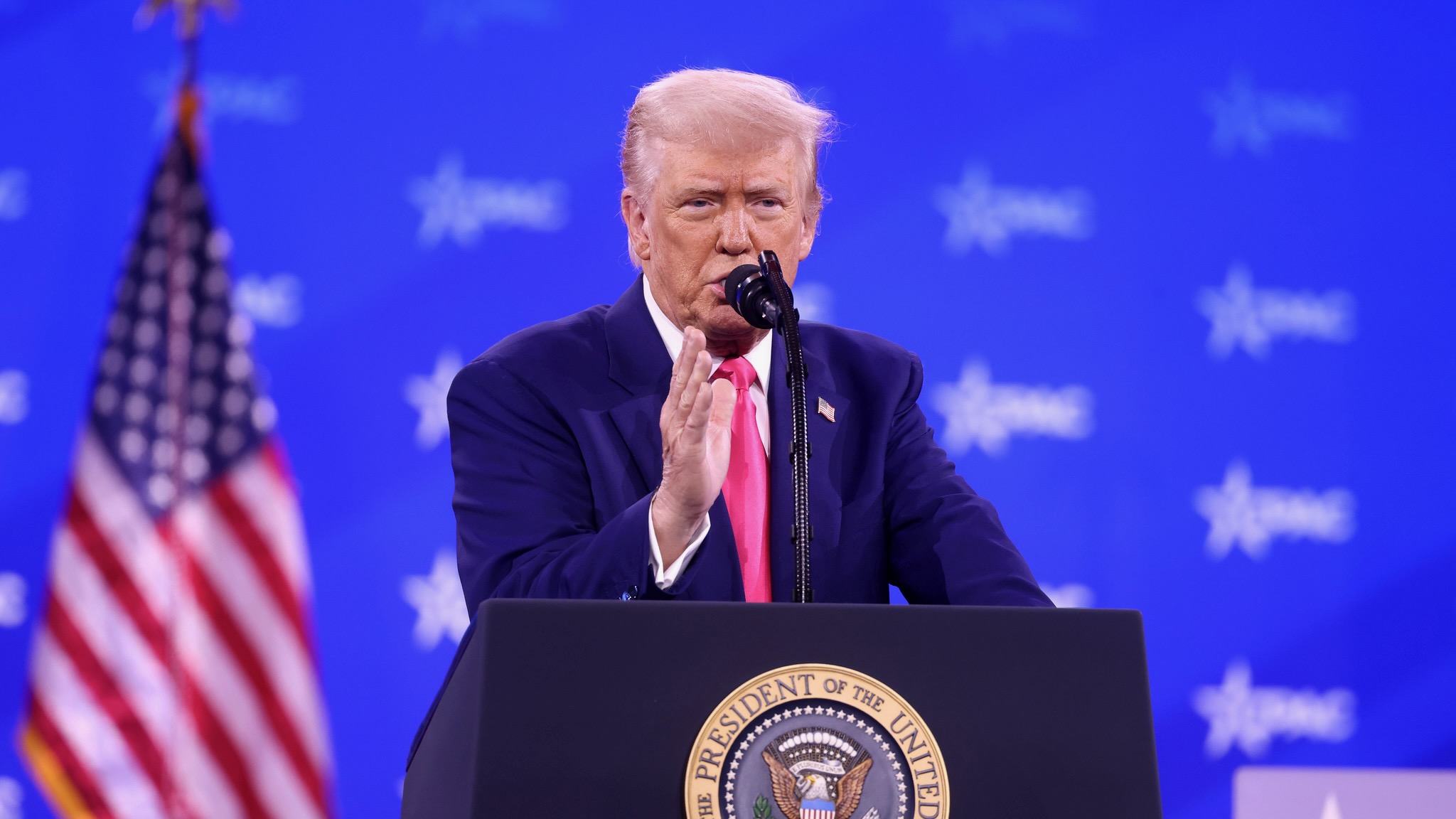
Above photo: President of the United States Donald Trump speaking at the 2025 Conservative Political Action Conference (CPAC) at the Gaylord National Resort & Convention Center in National Harbor, Maryland. Gage Skidmore/flickr.
Tariffs, Threats, And Economic Sanctions.
Trump’s approach to Latin America is an intensification of his first term approach to the region, which is now dominated by progressive-leaning heads of state.
The second term of US President Donald Trump has been full of commentary about other nations – both official and unofficial – that often signals the administration’s intentions, even without formal policy declarations. In turn, when Trump has thrown darts at certain governments, his statements immediately become headlines that spark debates – and at times uncertainties – in the countries he addresses.
Latin America has been one of Trump’s favorite targets. One need only recall that during his first election campaign, he said that Mexico, Guatemala, El Salvador, and Honduras were breeding grounds for criminals. Likewise, he called Cuba, Venezuela, and Nicaragua “the troika of tyranny”. In addition, he increased pressure on Havana by tightening the economic blockade.
Now in his second term, his diplomatic strategy towards Latin America and the Caribbean has remained consistent. The spirit of this approach can be summed up best by the US president himself. On January 22, 2025, Trump said of the region: “They need us much more than we need them. We don’t need them. They need us – everybody needs us.”
However bigoted Trump’s rhetoric may appear, it should not be mistaken for indifference. Analysts have pointed out that the far-right president’s engagement with Latin American and Caribbean leaders shows that Trump is intensifying his diplomatic approach in his second term, and that the region remains as important as ever to US geopolitical interests.
Panama
On January 20, during his swearing-in speech, the far-right president announced his intention to retake control of the Panama Canal: “We didn’t give it to China. We gave it to Panama, and we’re taking it back.”
These statements, which some considered comical, proved to be concrete policy objectives when the recently inaugurated administration began applying heavy pressure on the Panamanian government. The US pushed Panama to annul the economic agreements it had signed with China and accept more intensive intelligence exchanges with the US government; not to mention the proposal to install four US military bases in the Central American country.
Cuba
A fact that did not come as a surprise was the reincorporation of Cuba onto the US state sponsors of terrorism list, which has serious consequences for the countries included therein, since any company that trades with them may be considered partners with sponsors of terrorism. Trump, an ally of anti-communist Cubans living in the United States, celebrated the decision. It was only a week after the outgoing Biden administration removed Cuba from the list.
Hope for improved diplomatic relations with Havana was quickly dashed when Trump announced the measure, along with other decisions tightening the blockade, such as an enhanced financial blockade, affected remittances, and sanctions on “restricted entities”.
Mexico
Trump has also publicly exchanged strong words with the president of Mexico, Claudia Sheinbaum. The US president seeks to pressure Mexico to increase immigration control. While antics like the renaming of the Gulf of Mexico to the “Gulf of America” received a lot of attention, the deeper goal seems to be to exert pressure on Mexico’s internal politics.
In January 2025, Trump declared that Mexican cartels were “foreign terrorist organizations”, which, according to several analysts, would empower the US president to order attacks against these groups even in Mexican territory: “Under the orders I sign today … we will also be designating the cartels as foreign terrorist organizations.”
In response to these statements, Sheinbaum demanded that Mexican sovereignty be respected. But the controversy did not end there. In February 2025, Trump threatened to impose tariffs of 25-30% on Mexican products if Mexico did not reduce the flow of fentanyl across the border, as well as increase immigration control on its side of the border.
Ultimately, during that back and forth, the tariffs were not imposed following a telephone conversation between the leaders, during which Sheinbaum committed to increasing the number of National Guardsmen on the border by 10,000. Yet this week, Trump announced 30% tariffs on Mexico.
Venezuela
Trump has also aimed his commentary against the Chavista government of Venezuela. Not only did he recognize Edmundo González as the winner of the July 28, 2024 presidential elections – tacitly ignoring Maduro’s government, which, according to the National Electoral Council, triumphed over the right-wing candidate – but he also imposed new economic sanctions against Caracas.
The US government also decided not to renew Chevron’s license to operate in Venezuela. “We are denying Venezuela any funds that could lead to the oppression of the Venezuelan people,” said Mignon Houston, spokeswoman for the US State Department.
In addition, the Trump administration decided to withdraw travel permits for and impose sanctions against several senior leaders of the United Socialist Party of Venezuela (PSUV), as well as several close family members.
Also, Venezuela continues to demand the repatriation of more than 200 Venezuelans who were deported from the United States and are currently incarcerated (without a trial or firm conviction) in a Salvadoran maximum-security prison, following an agreement reached by the government of San Salvador – closely aligned with Trump’s foreign policy – and Washington. The latter continues to claim that the incarcerated Venezuelans are terrorists, although Caracas strongly denies the accusation.
Colombia
Indeed, Trump’s immigration policy has caused much discomfort for several progressive Latin American governments. Colombia denounced the treatment of the hundreds of deportees that the Trump administration was celebrating expelling from their country.
Thus, the government of Gustavo Petro announced that it would not receive Colombian deportees under such conditions that, according to Bogotá, were inhumane. Trump immediately threatened to increase tariffs on Colombian products to 25% if Petro’s government refused to receive his countrymen. In the end, the conflict was settled by the US authorities’ commitment not to handcuff the deported Colombians, and then Bogotá accepted the flights from North America.
However, tensions took on the tone of a diplomatic crisis in July 2025 when the Spanish newspaper El País claimed that the former foreign minister of Colombia, Alvaro Leyva, had met with Mario Diaz-Balart, a US Congressman, to plan the “early exit” of Petro’s government. The Colombian government demanded answers to these accusations but the US State Department decided to temporarily withdraw its chargé d’affaires in Colombia. Petro responded by withdrawing his US chargé d’affaires.
In addition, it should be noted that after the assassination attempt on right-winger Miguel Uribe Turbay in Colombia, Secretary of State Marc Rubio said that the event was the result of, among other things, “violent leftist rhetoric” coming from the “highest levels of the Colombian government”. The statement caused much indignation among the Colombian administration. It is the first time in decades that relations between the two countries have been so affected.
Brazil
Another country that has recently had problems with Trump is Brazil. In the middle of a BRICS meeting in São Paulo, Trump issued a statement denouncing what he called judicial persecution of his personal friend, the ultra-right-wing Brazilian ex-president Jair Bolsonaro, who is currently accused by the Brazilian prosecution of having been part of a plot that sought to prevent the assumption of office of Lula da Silva – who defeated Bolsonaro in a very tight election. Thousands of Bolsonaro supporters invaded the buildings of the three political powers in Brasilia, sparking the declaration of a state of emergency.
Trump called the process a “witch hunt” and threatened to increase tariffs to 50% if the trial against Bolsonaro was not stopped. Bolsonaro has gleefully accepted the support of the US president. Lula responded that Brazil’s sovereignty and judicial decisions must be respected. He also stated that if the United States decides to increase tariffs by 50%, Brazil will respond with the same measure under the law of reciprocity.
A New Model Of Diplomatic Pressure?
Critics of the Trump administration’s approach say that the consistent objective across all of his engagements is to align Latin American and Caribbean countries behind the geopolitical interests and ambitions of the US. The question is how far the US government is willing to go to achieve that.
For now, no military intervention has taken place, although it is impossible not to consider Washington’s proposal to add military bases in the region to the already existing ones. The most illustrative examples of this currently are Panama and Ecuador.
The threat of tariffs has also become a recurring tactic, with China criticizing the US for using this method to punish and isolate its so-called adversaries. On the other hand, Brazil is being summoned to the negotiating table under the threat of a 50% tariff.
For now, despite the abrasiveness of Trump’s approach, it seems that most governments in Latin America favor reaching agreements that will resolve any diplomatic or economic crises quickly.
But, how long can this model of diplomacy last without deeply damaging US-Latin American relations? This is a gamble that Trump is still risking, and it is still uncertain.