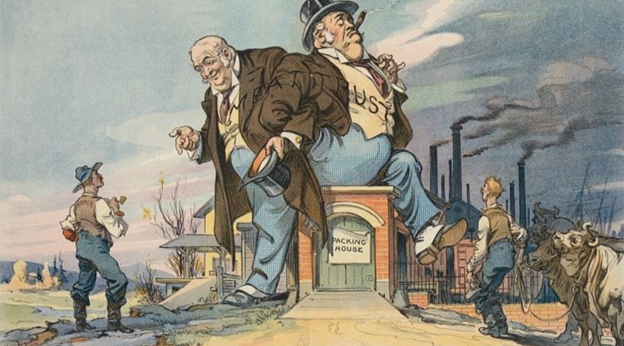
It’s time to choose your “–ocracy,” the one you think best fits a US society and system in free fall. There are some choices to suggest. We live not only in a plutocracy, it is also at the same time both a kakistocracy and a thanatocracy. What it isn’t any longer is a democracy, and it hasn’t been one for some time now. Our efforts should thus be directed at making it the kind of democracy it’s supposed to be.
Let’s explain these terms so that you can make an informed choice. In doing so, let’s start with plutocracy because it’s the one getting the most attention lately, and it’s the one some people are already somewhat familiar with, though that familiarity is usually because of the similar term “oligarchy” that many people and public figures—Bernie Sanders, Robert Reich, and Ralph Nader among the many—have been using. (The word “oligarchy” has caught on, which is a good sign considering that there was a time not too long ago when people were afraid to use the word. In common parlance, “plutocracy” and “oligarchy” are used almost interchangeably.)
Plutocracy
“Plutocracy” is defined as “rule by the wealthy,” which is undeniably the case in the US. (An “oligarchy” is defined as “a small group of people having control of a country, organization, or institution.” It is usually used in reference to a small group of extremely wealth people.)
This is undeniable for several reasons. We look around and see corporations buying legislators and members of the executive branch—and even the Supreme Court, as we now know from revelations about lucrative gifts received by Clarence Thomas and others on the bench—especially since the abomination that was the Citizens United ruling. The lobbyists it has unleashed like a pestilence to buy politicians are often the ones who write the very legislation that members of Congress bring to a vote. These reasons are all obvious to anyone with eyes and ears, but two scholars went beyond the eye and ear tests to quantify scientifically that the members of Congress conduct themselves and their votes so as to further the interests of the wealthy as often as possible. This landmark study released in 2014 is called “Testing Theories of American Politics: Elites, Interest Groups, and Average Citizens,” by Martin Gilens and Benjamin Page, professors—respectively–of Politics and Decision Making at—respectively—Princeton University and Northwestern University. You can find it here.
The conclusion of this study, based on extensive and sophisticated statistical analysis of the expressed interest of the majority of citizens compared to the expressed interest of the small minority of economic elites is that in the US political system, policy predominantly reflects the interest of the elites: “In the United States, our findings indicate, the majority does not rule—at least not in the causal sense of actually determining policy outcomes. When a majority of citizens disagrees with economic elites or with organized interests, they generally lose. Moreover, because of the strong status quo bias built into the U.S. political system, even when fairly large majorities of Americans favor policy change, they generally do not get it . . . Analyses suggest that majorities of the American public actually have little influence over the policies our government adopts.” Their analysis showed that the wishes of the majority of the citizenry were ignored at least 82% of the time.
It is easy to understand why the results of this vital study received so little attention in the media. The media is controlled by corporations, whose interests are not served by the views and desires of the majority. Quite the contrary. (90% of all the media outlets in the US are owned by just six corporations. I wonder how many Americans know that.) The report was buried, even though it reveals things that every American should know. Its results remind me of the famous saying most often attributed to Mark Twain: “If voting made a difference, it would be illegal.”
Kakistocracy
Our next “-ocracy” is kakistocracy. “Kakistocracy” means rule by the corrupt and incompetent. It’s hard to imagine a time in the US when this word is a better fit than now. Almost every cabinet employee in the current regime has been blatantly unqualified for his/her position. We have a former WWE executive heading the Department of Education, a man with no medical training heading the Department of Health and Human Services, a man with no military leadership experience whose limited management experience was running a veterans organization into the ground while drinking to excess and committing sexual assault (often simultaneously) serving as Secretary of Defense, and an FBI director with prosecutorial experience but no law enforcement experience, and an FBI deputy director who was merely a Fox network podcaster. These are only some of the many examples. In fact, those nominated by this regime—and approved by its craven boot-lickers in Congress—who have appropriate experience and competence are so rare as to be practically non-existent.
At the same time, the corruption is out of control, even more than usual, from a $400 million airplane illegally accepted by the resident of the White House, who has also used his position to promote his crypto currency scam, to his building a hotel in Saudi Arabia, and on and on and on. Many organizations and analysts have commented strongly on this, such as the Committee for Responsibility and Ethics in Washington, which called him “the most corrupt president of all time.” In addition, we have the corruption of members of both major parties in Congress, some of whom have made a fortune through insider trading on the stock exchange, including those who made a killing in the stock market by buying low when the tariffs tanked the market and then selling high when the White House backed off on the foolish, ignorantly conceived tariffs and the market rebounded (and who laughed and bragged about it in the Oval Office with the lifelong criminal who is its occupant). It would take hundreds of pages to delineate all the corrupt acts committed by both major parties, though one party seems to be taking a big lead in that competition. These problems manifest also at the level of state and local government; former New York mayor Eric Adams could be considered Exhibit A in these categories. And let’s not even get started on the corruption behind giving massive tax breaks to the wealthy and corporations that are financed by taking money away from the few programs that help our poor and elderly simply survive from day to day.
Thanatocracy
Let’s take a look at “thanatocracy” next. This is probably the least used and least familiar of the “-ocracies” to most people, a term that has recently received more attention from the historians Robin D.G. Kelley and Peter Linebaugh. Linebaugh brought the term into the spotlight and Kelley has taken it and really run with it, to the edification of us all. “Thanatocracy” at its most literal level is defined as “rule by death.” Kelley goes further to tell us that it means that a government that employs tools of death or the threat of death as ways to control its citizens and even those beyond its own borders. How is this the case in the US?
To begin with, the US is one of very few so-called advanced countries that still uses death as a criminal punishment, i.e. the death penalty. This is an obvious example. But thanatocracy manifests itself in other ways, both obvious and subtle. There has also long been the constant threat to the non-white and the poor of all ethnicities that they will be killed unjustly, often while unarmed, by law enforcement. Now we have the burgeoning threat of the deranged and unconstitutional deportation program, which controls people of color, including those with no criminal record, through the risk of detention and deportation to prisons that torture and kill, and already some people who have been seized by this irrational, cruel program have died in custody. Death in custody is also not uncommon inside our mass incarceration system, the world’s largest, which also targets people of color, and the threat even extends to schoolchildren through the school-to-prison pipeline. Especially now there is in addition the threat of death from illness, disease, or injury because of policies and legislation that increase mortality rates by taking away health insurance, food programs, and affordable housing from the country’s most vulnerable people.
But it is not only Americans who are controlled and affected by the thanatocracy that is the US. This thanatocracy threatens the whole world, eschewing negotiation in favor of shows of military might, whether in the form of bombs and drones or armed troops. For instance, our possession of most of the world’s nuclear weapons is an ongoing death threat to the people of the globe. We have reached a point where we too often see military attacks as the first option rather than the last, and a world that knows this is thus adversely pressured and frightened by the large thanatocracy that we are. On occasion, we impose sanctions instead, which kill thousands in other countries by denying their ordinary citizens food, medicine, and other means of survival. Around the world, the thanatocratic tolls mounts.
Choose your ‘ocracy’
All these “-ocracies” are eminently suited as labels for the US’s political system. Perhaps you could pick from the three above the “-ocracy” that you think fits best. But one option you can’t choose, one that is conspicuously absent in the preceding paragraphs, is “democracy.” We can’t have a democracy when the will of the majority is consistently ignored. When gerrymandering denies people the basic right to vote. When the outdated Electoral College enables a person to be elected president while losing the popular vote. When Citizens United enables the rich and their corporations to control everything by buying elections, buying politicians, and buying legislation. We can become a democracy if we choose to, but it will take effort, intelligence, cooperation, and courage. Note that I say “become a democracy” and not “reclaim our democracy.” That is because one could argue that the US has never been the democracy it purported to be in the first place. It was founded by wealthy white men mostly to protect and promote their own interests, and many other kinds of people (the enslaved, those who own no land, women, et al) were left out. It tried to stay that way whenever it could, as long as it could. All this is true despite the fact that one of our founding documents, the Declaration of Independence, tells us that the power in a representative government should be derived from “the consent of the governed.” But if we consider what Gilens and Page’s study, cited above, conclusively tells us, we see that this country is not ruled at all by the consent of the governed. How could it be when the power elite don’t even know what the consent of the governed is because they completely ignore it?
If we’re to be a democracy, we need to change many features of our system. Just for starters, we should eliminate the Electoral College, strongly outlaw gerrymandering, and repeal/abolish Citizens United. But that’s just a start, and those things are mainly voting-related. Democracy is much more than voting. If voting were all democracy was, we wouldn’t be in the huge mess we’re in. (Remember Twain’s words, already quoted heretofore: “If voting made a difference, it would be illegal.”) To create democracy, we need to be more than just residents of the US, we need to be citizens of the US, informed, intelligent—that’s where a revamped, propaganda-free education system that truly teaches critical thinking, rather than only claiming to, comes in–determined, courageous citizens.
We all must do more than vote to be effective citizens. We need to protest. We need to unionize. We need to speak out. We need sometimes to go door to door to get other citizens on board. We need to join organizations of concerned citizens and go to their meetings. We need to call our representatives or visit their offices. We need to get involved in local government in one of the many ways that are open to us.
All that being said, we see that there are several “-ocracies” to choose from, and none of those that currently apply to the US are palatable or desirable. We have to recognize and own up to that, being honest with ourselves. Once we do that, together we can all become an embodiment of the best “-ocracy” out there, democracy.
Peter Greenhill is a philosopher and social justice/human rights activist as well as the retired longtime director of the Iolani Peace Institute at Iolani School, Honolulu, Hawai’i.