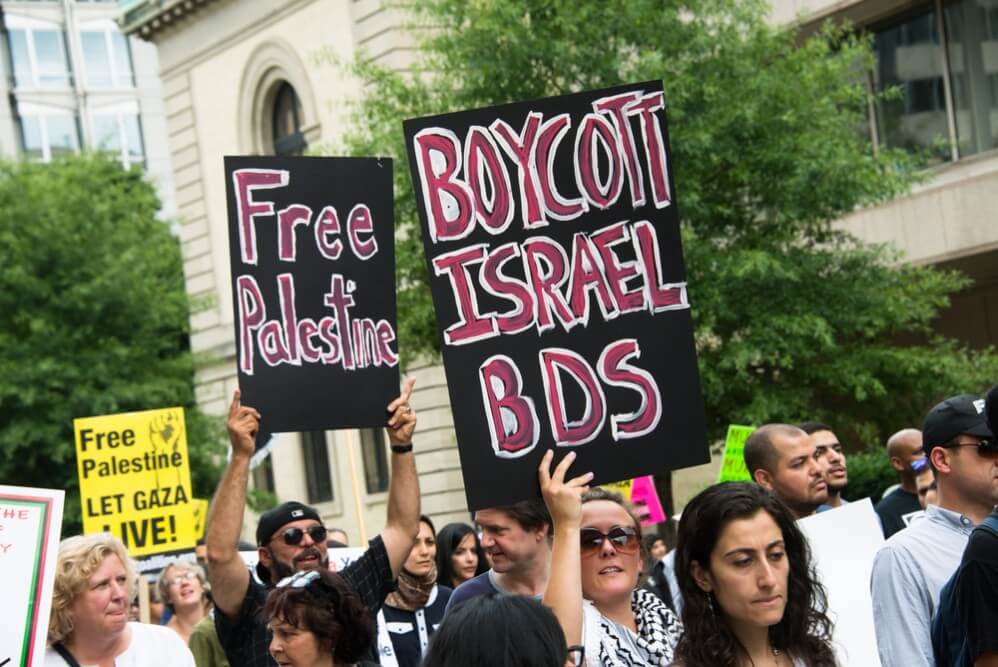
Above photo: Activists call for boycotting Israel. BDSMovement.net.
Over refusal to condemn genocide.
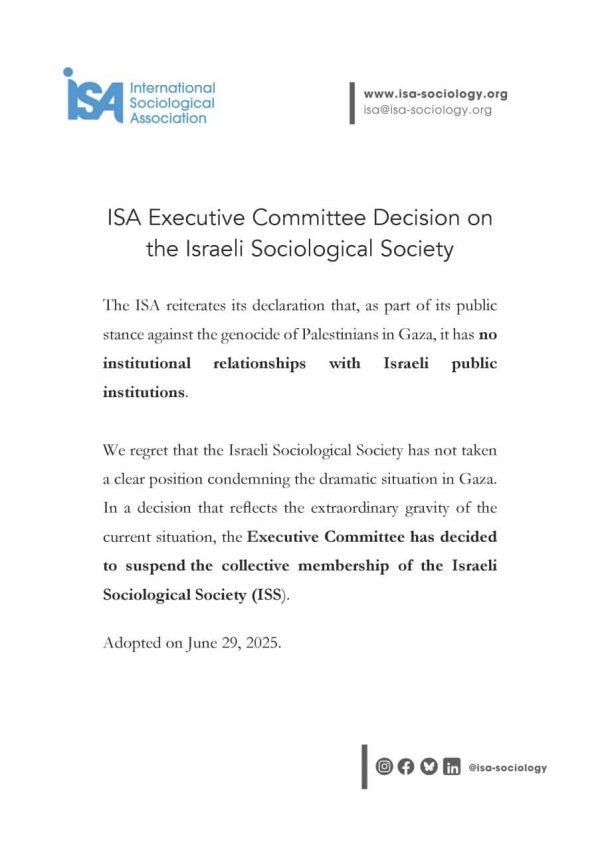
The suspension of the Israeli Sociological Society by the International Sociological Association marks a significant milestone in the international academic boycott of Israel.
Global Sociologists for Palestine (GS4P) applauds the successful boycott, divestment and sanctions (BDS) mobilization for justice in Palestine spearheaded by its members at the International Sociological Association (ISA) Forum held in Rabat, Morocco, in July 2025.
At the international level, the BDS mobilization represents a landmark achievement in the global social science academic landscape. It was the first major successful BDS campaign at an academic sociological association, as realized through the suspension of the Israeli Sociological Society (ISS) by ISA due to pressure from its membership. The suspension of the ISS was an effective way of holding an institution accountable for its silence in a time of genocide and enforced famine, as well as its documented complicity through the Israeli state-military apparatus.
At the regional Arab level, this was the first successful academic anti-normalization campaign in the aftermath of the US-sponsored Abraham Accords. Rather than disengage or allow the Forum to become a vehicle for the normalization of Zionism in the Arab region, a BDS campaign was successfully coordinated to challenge the participation of Israeli institutions complicit in apartheid, settler-colonialism, and genocide. This included a principled call and commitment to boycott panels featuring such institutions and their representatives, and a call to individual Israeli scholars to publicly condemn these ongoing violations.
GS4P believes that knowledge production is deeply political, and that academics are not disconnected from the social realities of their societies. Freedom of expression and dialogue do not exist outside of structural power relations, and cannot be used to justify the inclusion of institutions and voices that are complicit in systematic and mass state violence. Notably, the ISS membership took a collective decision to not attend the Forum, with open boycott calls following the ISA suspension of the ISS. The ISS’s refusal to take an ethical position on the current genocide in Gaza speaks to an alarming normalization of mass state-violence against Palestinians in Israeli society, where adult men and women are subject to a military draft and reserve duty in a settler-colonial army deploying unprecedented genocidal violence against the indigenous population. This BDS campaign sets an important precedent for future international academic gatherings in the Arab region and the world, and affirms that scholarly spaces must be rooted in political and ethical responsibility, and especially in the contexts in which they take place. GS4P understands that as sociologists, our work is deeply embedded within our societies and in dialogue with the civil society actors who lead efforts toward justice in our respective regions. We applaud the Palestinian Campaign for the Academic and Cultural Boycott of Israel (PACBI), and Moroccan Campaign for the Academic and Cultural Boycott of Israel (MACBI) for playing a key role in issuing the initial boycott call.
Given this BDS mobilization at a sociological association meeting, the Forum ultimately served as an important opportunity to reframe the conversation around Palestinian national liberation and the return to their homeland, to center an analysis of Zionist settler-colonialism, and to amplify the voices of scholars who advocate for justice in Palestine. Over the course of five days and across multiple panels, scholars shifted the focus from abstract notions of “peace” toward concrete discussions centered on social justice, national liberation and the dismantling of settler-colonialism and apartheid. The Forum became a space where global sociologists enacted a model of how the academic community can contribute to the advancement of justice in Palestine and foster greater academic engagement with the ongoing struggle for Palestinian national liberation.
We call on all scholars to build on this successful experience and to continue the struggle within academic spaces in support of Palestine. Sociologists cannot – and will not- remain silent in times of genocide.
The struggle for a free Palestine continues, and we call on all scholars to join us.