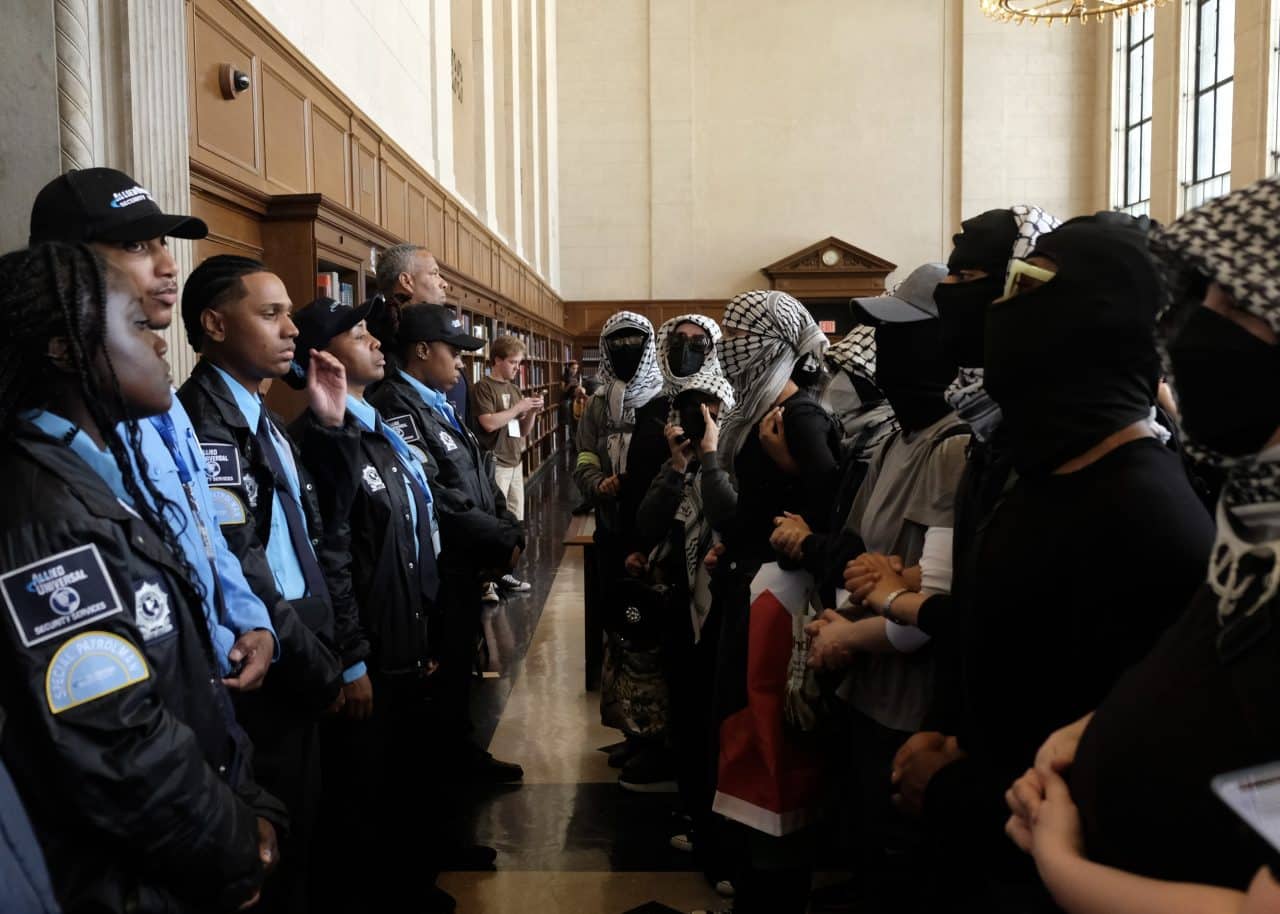
Above photo: Activists stand face to face with security guards in Columbia University’s Butler Library on May 7, 2025. Tamara Turki.
Columbia University’s recent suspension and expulsion of more than 70 students for a Palestine demonstration is the latest sign the school’s crackdown on activism is not simply about campus conduct.
But appeasing political pressure from Washington.
Over the past two years, Columbia University has become a case study in the growing battle between grassroots movements in the U.S. and the institutions determined to silence them. What began as a student-led call for divestment from Israel escalated into a high-stakes confrontation between students, university leadership, and, eventually, the U.S. president.
That battle now appears to have reached a grim turning point. In trading student rights to free speech and protest for federal funding, Columbia, once known as the “activist Ivy,” has signaled the end of an era of American higher education nurtured political dissent and the beginning of a new one, marked by increased surveillance, censorship, and punishment.
Columbia University announced on July 22 that it had suspended, expelled, and revoked the degrees of more than 70 students for their participation in a pro-Palestine demonstration inside a campus library in May.
“In a sense, I feel free from this university,” said Sarah, a Barnard College undergraduate student, who spoke to Mondoweiss on the condition of anonymity. She described feeling a sense of closure when she received the university’s letter notifying her of her expulsion.
Sarah also expressed a sense of relief, saying she no longer feels she is contributing materially or financially to Columbia University. “It comes after over a year of watching as the tuition dollars I give to the university are sent to the Zionist entity, used to orchestrate a brutal, unfathomable genocide against the Palestinian people.”
She added, “It’s an honor to be expelled for Palestine.”
The disciplinary sanctions were issued two days before Columbia announced a $200 million settlement agreement with the U.S. government in a bid to restore its federal funding, which was revoked in March.
The timing, some students and faculty say, underscores what they’ve long suspected: that Columbia’s crackdown on pro-Palestine activism is not simply about campus conduct, but about appeasing political pressure from Washington.
Basel al-Araj Popular University
The university says the recent expulsions are in response to a demonstration on May 7, where around 100 student activists entered the main reading room of Butler Library. Chanting pro-Palestine slogans, they held a teach-in condemning Israel’s war on Gaza, which human rights experts have called a genocide.
The students, fully masked and wearing the keffiyeh scarf, renamed the space the Basel al-Araj Popular University, in honor of the Palestinian activist and writer who was killed by Israeli forces in Ramallah in 2017.
Minutes later, campus security shut the room’s entrances and threatened to call the New York Police Department if the students did not disperse. After about 15 minutes, the student group agreed to leave but was blocked by campus police, who refused to let them exit unless they showed identification and accepted that doing so would lead to disciplinary consequences.
The standoff escalated into a four-hour confrontation, during which students pleaded for release, chanting “let us go.”
Students attempted to push through the blocked exits but were shoved by campus security. Several students were knocked to the ground, and some later reported symptoms of concussions, requiring them to be escorted from the room on stretchers.
By evening, NYPD officers entered and arrested the protesters. The students were immediately placed on interim suspension. This marked the third instance of mass arrests on Columbia’s campus over a pro-Palestine protest since March 2024.
‘Insane cognitive dissonance‘
The recent sanctions have brought the total number of students suspended, expelled, or had their degrees revoked for participating in pro-Palestine activism since the March 2024 student encampments to over 100. For those not expelled, suspensions range from one to three years.
“We’ve sacrificed so much,” said Noor (pseudonym), a Columbia undergraduate who was given a suspension of two years.
Noor, who had never faced discipline before, was shocked by the severity of the punishment for a first-time offense. She described a sense of deep uncertainty about the next two years of her life.
With her housing situation unresolved and her on-campus job lost, she faced the added worry that no other institution could offer the same financial aid or scholarships.
She voiced her frustration that despite students’ sacrifices, “the genocide is continuing in full force, and worse than I’ve ever seen, and Columbia still decided to escalate its sanctioning process.
“It’s just this insane cognitive dissonance that we’re watching babies’ stomachs eat themselves from starvation in Gaza, and Columbia students are the ones on trial.”
Meanwhile, Sarah, the first in her family to attend college, explained that Columbia’s crackdown on pro-Palestine activism over the past two years had cost her education, housing, employment, and relationships with friends and family.
She had been suspended and evicted from campus housing in March 2024 for participating in campus encampments that called on Columbia to divest from companies selling weapons to Israel. The suspension strained her relationship with her father, who has not spoken to her in nearly a year.
“I’m grappling with how to explain to my family that I might not be able to go to a university in this country, that protesting a genocide has made it that much more difficult for me to become the first person in our family to earn a degree,” Sarah said.
Columbia bows to Trump
The recent disciplinary sanctions were issued by the University Judicial Board, which was restructured by the Board of Trustees in March to remove student representation from the five-member panel and eliminate faculty oversight of protest-related disciplinary cases.
This move followed in response to demands from the Trump administration and the federal government’s decision to cut $400 million in funding over accusations of the university’s failure to address “antisemitism” on campus.
The restructuring was codified last week as part of Columbia’s formal agreement with the federal government. Under this agreement, the university will pay the $200 million settlement over three years.
Columbia also agreed to pay $21 million to settle investigations by the U.S. Equal Employment Opportunity Commission intended to compensate Jewish employees who “may have experienced antisemitism” on campus after October 7, 2023.
The agreement enshrines a number of controversial policies the university introduced in March, while adding new terms. These include a campus-wide ban on masks, the hiring of 36 “special officers” authorized to remove or arrest students, and placing the Department of Middle Eastern, South Asian, and African Studies and the Center for Palestine Studies under the oversight of a university administrator with authority over curriculum and non-tenure faculty hiring.
Notably, the agreement also states that Columbia must provide the federal government, upon request, with all disciplinary records involving student visa-holders that result in suspension or expulsion, along with any arrest records the university is aware of. The move has raised concerns among advocates, especially given the Trump administration’s heightened deportations of pro-Palestinian students who are not U.S. citizens.
Mahmoud Khalil, a Palestinian activist and recent Columbia graduate who was detained by ICE in March, accused the university of laying “the groundwork for my abduction.”
He added, “Columbia has suppressed student dissent under the auspices of combating antisemitism. Last year, Columbia turned over student disciplinary records to Congress and created the Task Force on Antisemitism that broadly categorized anti-Israel sentiment as hate speech to condemn protests.”
“Columbia has a long and storied and celebrated history of activism and protest and dissent,” Michael Thaddeus, a Columbia mathematics professor, underscored the shift in the university’s approach to activism. “In ordinary times, the school celebrates that. Now we’re sort of trying to pretend that’s not the case.”
Thaddeus described the university’s crackdown on student activism as “draconian,” warning that the focus on Palestine could expand to undermine civil rights in broader political debates. “We have to take seriously the idea that the way we draw up the terms of debate is really, really important,” he said.
On July 15, Columbia announced that it would formally adopt the International Holocaust Remembrance Alliance (IHRA) definition of antisemitism, which encompasses several forms of criticism of Israel.
Historian Rashid Khalidi, the Edward Said Professor Emeritus of Modern Arab Studies at Columbia University, announced on Friday that he has canceled plans to teach this fall in response to the university’s recent agreement with the Trump administration.
In an open letter published in the Guardian, Khalidi stated that Columbia’s adoption of the IHRA definition of antisemitism made it “impossible with any honesty to teach” his course on the history of the modern Middle East.
The university additionally announced partnerships with organizations such as Project Shema, the Foundation to Combat Antisemitism, Kalaniyot, and the Anti-Defamation League (ADL)—a group that has surveilled left-wing Jewish groups, Black Lives Matter activists, and Palestinian rights organizations, according to a Guardian investigation.
In March, ADL CEO Jonathan Greenblatt appeared on MSNBC’s Morning Joe, where he publicly compared the Palestinian keffiyeh to the Nazi swastika.
Yasmine, an undergraduate who received a two-year suspension, said she felt that most faculty had abandoned disciplined students, despite many of them teaching the theories and frameworks that informed her activism.
“It was the practical application of many of their lesson plans that led me to participate in the Basel al-Araj Popular University,” said Yasmine (pseudonym), who requested anonymity.
Since her suspension, Yasmine has reflected on how her future will be affected without a bachelor’s degree or a steady income. She also shared her sadness about being denied from continuing her education.
“I loved my classes. I loved engaging in material and feeling my mind expand,” she added.
Her grief, however, is tempered by a broader sense of perspective. She pointed to the destruction of every university in Gaza by Israeli forces, and the thousands of Palestinian students who were killed and will never be able to complete their degrees. For her, being suspended in solidarity with them is an honor.
Yasmine denounced Columbia’s reputation as an “activist Ivy”, calling it it a “farce” that conceals a long history of political repression on campus
Despite the well-documented consequences faced by pro Palestine students, including over a hundred arrested, suspended, expelled, or stripped of their degrees in the last two years, Yasmine remained committed to her activism and participated in the Basel al-Araj Popular University regardless.
“We knew the risks. We were not reckless, nor stupid,” she said.
Despite the punishment, she argued Columbia continues to benefit from the image of student resistance. “The institution takes credit for the bravery of its students over and over again.”
“At this moment, Columbia is exhausting all possible options to maintain its investment in genocide,” she added. “These sanctions are a good reminder that the Ivy League is a corporate scheme focused on asset retention, not students.”
*The names of the students in this story have been changed to protect sources who feared doxxing and academic retaliation.