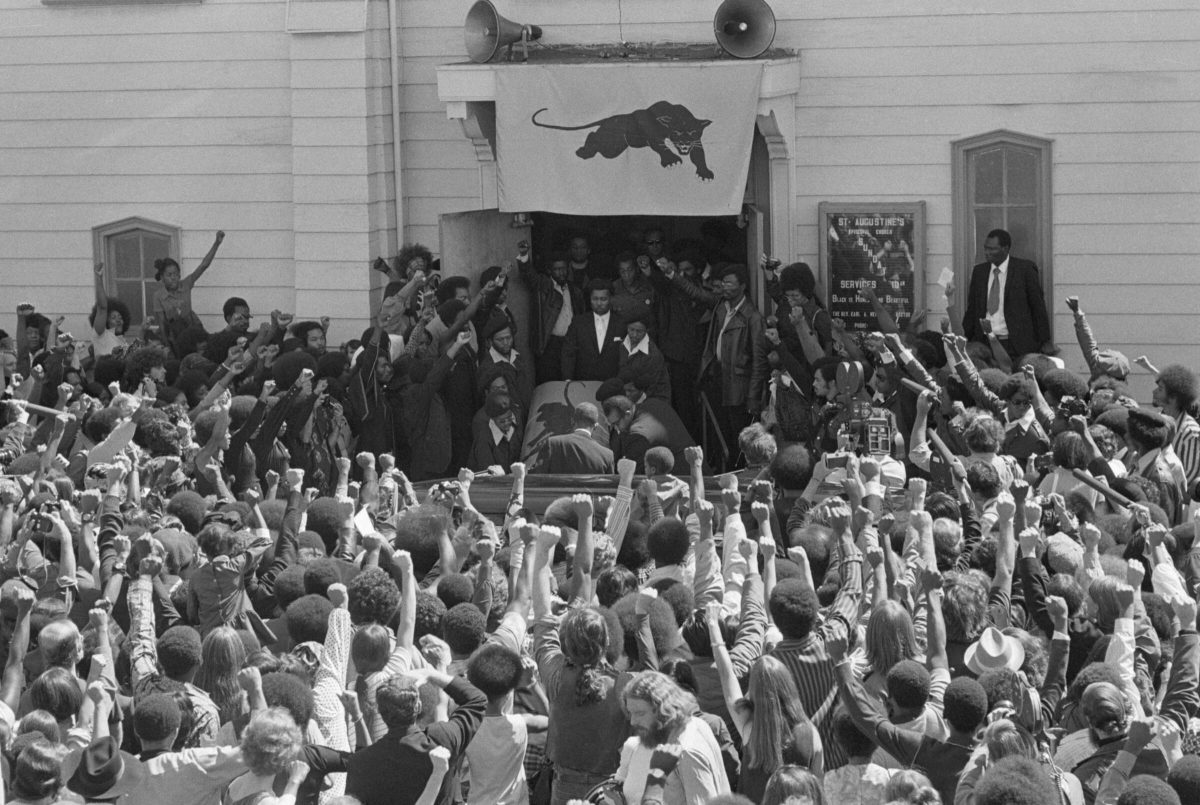
Above photo: Mourners give the Black Panther salute as the casket of George Jackson is carried from St. Augustine’s Church in Oakland, California. Jackson, a Black Panther, was killed on August 21, 1971, by guards at San Quentin Prison. Bettman / Getty Images.
This is not just a month of mourning.
It’s a time for mobilization and recommitment to prison abolition.
The concrete tomb they built to bury our revolution has become the very ground from which it grows. From behind these concrete walls and steel bars, where time moves differently and hope becomes a revolutionary act, I write to you about Black August — a month that prison administrators would rather see forgotten, but which burns eternal in the hearts of those who understand that freedom is not a privilege to be granted, but a right to be seized.
To understand why this resistance continues, we must first understand its origins. Black August, observed each August since 1979, commemorates the deaths of Black liberation fighters who died in prison. Particularly, Black August pays homage to Jonathan Jackson, who was killed on August 7, 1970, while attempting to liberate his brother George Jackson and other prisoners; and George Jackson himself, who was assassinated by guards at San Quentin on August 21, 1971. This month of remembrance and resistance was born from the recognition that the same forces that murdered our ancestors continue to operate within these walls, using solitary confinement as a weapon of psychological warfare against those who dare to organize, educate, and resist.
The tools of oppression have been passed down like heirlooms from one generation of torturers to the next. The iron fist of solitary confinement that crushes spirits today is the same instrument of torture that crushed George Jackson. It was during his seven and a half years in solitary confinement at San Quentin that George Jackson wrote, “The ultimate expression of law is not order — it’s prison.” Jackson understood that solitary confinement was not merely punishment for rule infractions, but a deliberate strategy to break the will of those who possessed the audacity to challenge an inherently unjust system. His words echo through the RHU (Restrictive Housing Unit) cells where I have watched brilliant minds deteriorate, where individuals who dared to educate themselves and others about their conditions are buried alive for years, sometimes decades.
What George Jackson identified decades ago has only been perfected and expanded in our time. The conditions that created the necessity for Black August — the systematic dehumanization of Black bodies, the use of isolation as a tool of control, the denial of basic human dignity — have not only persisted but have been refined into a science of suffering that would make the architects of chattel slavery proud. Angela Davis, who spent months in solitary confinement before her 1972 acquittal, observed that “the prison has become a black hole into which the detritus of contemporary capitalism is deposited.” Nowhere is this more evident than in the modern solitary confinement units that house a disproportionate number of Black and Brown bodies.
The language may have changed, but the violence remains identical in its purpose and effect. The same racist logic that justified the slave plantation now justifies the concrete plantation, where isolation is sold as “administrative segregation” and psychological torture is rebranded as “protective custody.” I have witnessed adults who entered these units as teenagers emerge as broken shells of themselves, their minds fractured by years of sensory deprivation and social isolation. The continuity between the violence of slavery and the violence of solitary confinement is not metaphorical — it is literal, measurable, and intentional, designed to produce the same result: a population so traumatized and demoralized that resistance becomes unthinkable.
But the spirit that George Jackson embodied refuses to be crushed, no matter how sophisticated the machinery of oppression becomes. Resistance persists, because as Assata Shakur wrote, “It is our duty to fight for our freedom. It is our duty to win. We must love each other and support each other. We have nothing to lose but our chains.” These words, written from her own experience with solitary confinement, remind us that Black August is not merely a month of mourning, but a month of mobilization.
Our commemoration of Black August transforms these spaces of intended destruction into laboratories of liberation. Within these walls, we honor Black August by refusing to allow the state to divide us, by sharing resources and knowledge, by maintaining our humanity in the face of systematic dehumanization. We fast to remember those who died fighting for our freedom, we study to understand the connections between past and present struggles, and we organize to ensure that their deaths were not in vain.
The very existence of our organized remembrance exposes the lie that this system tells about itself. The continuation of Black August observances terrifies those in power because it connects the dots between historical resistance and contemporary struggle, revealing that the same forces that murdered Fred Hampton and tortured George Jackson are still operating under different names and newer technologies. The current administration’s escalation of repressive measures within the prison system — from the expansion of solitary confinement to the censorship of books and correspondence — demonstrates exactly why Black August must not be forgotten.
Those who hold the keys to these cages understand exactly what they fear losing. Prison officials understand that knowledge is power, and they particularly fear the power that comes from understanding our history of resistance. They know that when we remember Jonathan Jackson’s courage, George Jackson’s intellectual development despite isolation, and the countless others who chose death over submission, we are less likely to accept our current conditions as inevitable. The state’s investment in forgetting is matched only by our investment in remembering, because memory is the foundation of resistance, and resistance is the foundation of freedom.
Now, as the walls that confine our bodies bear witness to the unbreakable nature of our spirits, I issue this call. From these cells where the echoes of George Jackson’s footsteps still resonate, I call upon everyone who believes in human dignity, in the right to education, in the possibility of transformation, to remember Black August not as ancient history but as present reality. The conditions that created the need for Black August — racist policing, unjust sentencing, brutal prison conditions, and the use of solitary confinement as torture — persist today, which means our obligation to remember and resist persists as well.
The choice before us is simple: become accomplices to our own destruction through silence, or become architects of our liberation through action. We must remember — because forgetting is complicity, because silence is violence, and because the same system that murdered our ancestors will continue to murder our descendants until we find the courage to tear it down and build something worthy of our humanity.