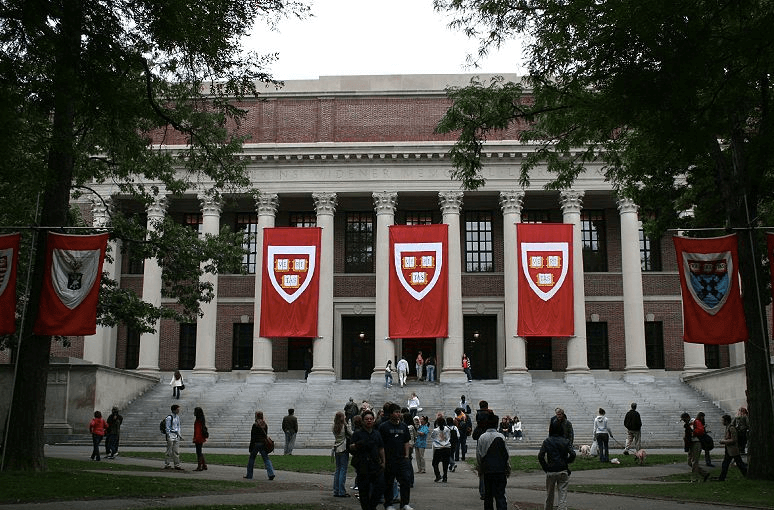
Above photo: Harvard University Widener Library. Wikimedia.
Stop Censoring Palestine.
Hundreds of scholars, educators, and education practitioners condemn Harvard Educational Review’s cancellation of a special issue on Palestine, saying it aims to silence discussion of the genocide and dehumanization of the Palestinian people.
Editor’s Note: Over 700 education scholars and practitioners from over 30 countries and 160 universities have signed the open letter below are calling out censorship by the Harvard Education Publishing Group in response to their recent cancellation of a special issue of the Harvard Educational Review on Palestine and Education. Initial signatories include some of the leading educational scholars, academics and practitioners in the U.S. and globally — including Sara Ahmed, Henry Giroux, Eve Tuck, Michael W. Apple, Zeus Leonardo, Nancy Stern, and Karma Nabulsi. Add your signature here.
We, the undersigned scholars, educators, and education practitioners write to express our alarm at the Harvard Education Publishing Group’s (HEPG) cancellation of a special issue on Palestine and Education in the Harvard Educational Review (HER). Such censorship is an attempt to silence the academic examination of the genocide, starvation and dehumanisation of Palestinian people by the state of Israel and its allies.
As reported by The Guardian, contributing authors of the special issue were informed late into the process that the publisher intended to subject all articles to a legal review by Harvard University’s Office of General Counsel. In response to this extraordinary move, the twenty-one contributing authors submitted a joint letter to both HEPG and HER, protesting this process as a contractual breach that violated their academic freedom. They also underscored the publisher’s actions would set a dangerous precedent not only for the study of Palestine, but for academic publishing as a whole. The authors demanded that HEPG honour the original terms of their contractual agreements, uphold the integrity of the existing HER review process, and ensure that the special issue proceed to publication without interference. However, just prior to its release, HEPG unilaterally cancelled the entire special issue and revoked the signed author contracts, in what The Guardian notes as “a remarkable new development in a mounting list of examples of censorship of pro-Palestinian speech”.
These events reflect what scholars have termed the ‘Palestine exception‘ to free speech and academic freedom. It exemplifies anti-Palestinian discrimination, obstructing the dissemination of knowledge on Palestine at the height of the genocide in Gaza—precisely when Palestinian educators and students are enduring the most severe forms of ‘scholasticide’ in modern history. Originated by Palestinian scholars, the term scholasticide describes Israel’s deliberate and systematic destruction of Palestine’s educational system, targeting not just institutions but the intellectual and cultural foundations of the Palestinian people. Since October 2023, this has escalated from systematic devastation to the near-total annihilation of education in Gaza. These horrific developments are also amplified by scholasticide at a global scale, which takes the form of silencing and censoring knowledge about anti-Palestinian violence within educational institutions worldwide.
In addition to research on scholasticide, authors in the HER special issue explored the histories and conditions of Palestinian education through various topics, including: the erasure of Palestine in Israeli school textbooks; the ethical and educational responsibilities of English language teachers in the West Bank; the history of Palestinian teachers in Lebanon during the revolution; and the impact of crackdowns on dissent on teaching about Palestine in US higher education institutions. Censoring their contributions in effect silences an esteemed group of colleagues, comprised of a Dean from one of Gaza’s leading universities, who is a survivor of the genocide; the lead organizer of the Palestinian Right to Education Campaign; representatives of the Emergency Committee of Universities in Gaza; several renowned Palestinian scholars; and prominent academics from Black, Asian, Arab, and other racialised backgrounds. Several authors were also writing at a time when their colleagues, students, families, and friends were – and continue to be – bombed, starved, or killed.
The decision by HEPG to abandon their own institutional mission – as well as the responsibilities that their world-leading stature demands – is scholasticide in action. It is unconscionable that HEPG have chosen to publicly frame their cancellation of the special issue as a matter of academic quality, while omitting key publicly-reported facts that point to censorship. Perhaps most disturbingly, HEPG leadership has sought to displace responsibility for their actions onto the authors and graduate student editors of the journal, calling into question the integrity of the journal’s long-standing review processes, and dismissing the articles as “opinion pieces” unfit for publication. The latter claim ignores that HER explicitly welcomes ‘experiential knowledge’ and ‘reflective accounts’ through their Voices submission format. When genocide is ongoing, personal reflections and testimonies are not only valid but vital. Dismissing such contributions as lacking scholarly merit reflects an exclusionary view of “whose knowledge counts”—valuing western and external academic perspectives over lived experiences of violence and oppression.
We, the undersigned, stand in solidarity with the authors and graduate student editors of the special issue, who are facing and confronting censorship and discrimination. Given the serious implications of its actions, we call for HEPG to be held accountable.
In this light, we issue the following demands to HEPG:
• Public Acknowledgement of the Violation of Academic Freedom and Perpetuation of Anti-Palestinian Discrimination: HEPG must issue a public statement recognising that the cancellation of the special issue constituted a breach of academic freedom and discrimination of Palestinians and their allies.
• Safeguards for Future Editorial Independence: HEPG must implement and publicise clear policies that protect editorial independence, ensuring that HER’s review process is not subjected to external legal or political pressures that compromise academic freedom.
• Commissioning a New Special Issue on Palestine and Scholasticide: As a step toward repairing the harm caused, HEPG must commit to commissioning and publishing a new special issue dedicated to Palestine and scholasticide.
• Remedies for Affected Authors: HEPG must provide remedies to the contributing authors whose contracts were revoked, including formal apologies and acknowledgment of their work.
Until these terms are met, we also issue the following calls to action from scholars, educators and educational professionals, as well as organizations and institutions in our field:
• Scholarly refusals: To refrain from supporting HEPG in any way, including both its imprint, Harvard Education Press (HEP), and its journal, HER by: declining to review, edit or publish with HEP and HER; and, refraining from citing or purchasing new and future work published by HEP and HER. These refusals should be enacted until HEPG demonstrates full accountability for the cancellation of the special issue.
• Sector-wide reconsiderations: We urge academic associations, presses, libraries and journals currently collaborating with HEPG to re-evaluate those relationships unless and until HEPG provides clear and public accountability.
These demands respond to Palestinians’ broader calls for academic solidarity; to ‘mobilise whatever resources are at our disposal to build institutional ties with Palestinian scholars and universities’, and to hold accountable entities complicit in their silencing and suffering. Assaults on academic freedom and the right to dissent cannot be tolerated. As scholars, educators, and members of the global academic and educational community, we have a responsibility to defend these principles and to stand with those whose voices are being suppressed.
We hope this open letter serves not only as a statement of protest, but as an amplification of the reality our colleagues in Gaza are enduring; resisting scholasticide by every possible means, continuing to teach, learn, and uphold educational life under horrific conditions.
Please note that, unless they have signed on as individuals, this letter should not be taken as representative of the opinions or perspectives of the contributing authors and/or graduate student editors of the HER special issue cancelled by HEPG.
INITIAL SIGNATORIES
There are over 120 initial signatories of this letter, listed alphabetically atop. These individuals are among leading academics in the field of education from more than 55 universities across the world. They include field-defining scholars, editors of esteemed journals of education, and directors of prominent research centres.
Alison Phipps, UNESCO Chair, University of Glasgow
Ameena Ghaffar-Kucher, Advanced Senior Lecturer, University of Pennsylvania
Amilcar Pereira, Associate Professor of History Education, Universidade Federal do Rio de Janeiro, Brazil
Andre Keet, Professor of Higher Education Studies, Nelson Mandela University
André Mazawi, Professor of Educational Studies, University of British Columbia
Andrea Dyrness, Associate Professor of Education, University of Colorado Boulder
Angeline M. Barrett, Professor of Education, University of Bristol
Ann Phoenix, Professor of Psychosocical Studies, UCL
Arathi Sriprakash, Professor of Sociology and Education, University of Oxford, President of British Association of International and Comparative Education
Audrey Bryan, Professor, Dublin City University
Azeem Badroodien, Professor of Education, University of Cape Town
Basma Hajir, Co-director of Centre for International and Comparative Education (CIRE), University of Bristol
Ben Williamson, Co-Director of the Centre for Research in Digital Education, University of Edinburgh, and Editor of Learning, Media and Technology
Carey Jewitt, Professor learning and technology, Institute of Education, University College London
Catherine Burgess, Professor Community-led Education, University of Sydney
Catherine Montgomery, Professor of Education and Editor of Compare Journal, Durham University
Celia Oyler, Professor emerita, Teachers College, Columbia University
Chaumtoli Huq, Professor of Law, CUNY School of Law
Chris Jadallah, Assistant Professor, UCLA
Crain Soudien, Emeritus Professor, University of Cape Town, University of Cape Town
Dalila Andrade Oliveira, Emeritus professor at Federal University of Minas Gerais, Brazil, UFMG
David Gillborn FBA, Professor of Critical Race Studies and Editor-in-Chief of Race Ethnicity and Education, University of Birmingham, UK
David Mills, Director, Centre for Global Higher Education, University of Oxford
Derron Wallace, Associate Professor of Education Policy and Africana Studies, Brown University
Dina Kiwan, Professor in Comparative Education, University of Birmingham
Elaine Chase, Professor of Education and Wellbeing, University College London
Enver Motala, Research Associate, Nelson Mandela University
Erica Burman, Professor, Institute of Education, University of Manchester
Eve Tuck, Professor, New York University
Fazal Rizvi, Emeritus Professor, University of Melbourne
Fida Adely, Associate professor, Clovis and Hala Maksoud Chair in Arab Studies, Georgetown University
Florin Salajan, Professor of Education and Co-Editor-in-Chief of Comparative Education Review, North Dakota State University
Francine Menashy, Associate Professor, Education at the Ontario Institute for Studies in Education (OISE), University of Toronto
Frank Coffield, Emeritus Professor of Education, UCL Institute of Education, London University
Gert Biesta, Professor of Public Education, Centre for Public Education and Pedagogy at Maynooth University, Ireland
Handel Kashope Wright, Professor of Education, Director – Centre for Culture, Identity & Education, University of British Columbia
Heath Rose, Professor of Applied Linguistics, The University of Oxford
Helen Proctor, Former Editor of History of Education Review, Professor of Education, The University of Sydney
Henry Armand Giroux, Professor and Chair of Scholarship in the Public Interest, McMaster University
Hilary Cremin, Professor of Education, University of Cambridge
Ian Cushing, Reader in Critical Applied Linguistics and Editor of Critical Studies in Education, Manchester Metropolitan University
Iveta Silova, Professor, Arizona State University
Jane Kenway, Emeritus Professor, Monash University
Jason Arday, Professor of Sociology of Education, University of Cambridge
Jason Beech, Associate Professor, Faculty of Education, University of Melbourne
Jason Todd, Senior Departmental Lecturer, University of Oxford
Javier Campos-Martinez, Assistant Professor, Universidad Austral de Chile
Jill Blackmore AM, Distinguished Professor, Deakin University, Fellow, Academy of Social Sciences
Jo-Anne Baird, Professor, University of Oxford
Joanne Dillabough, Professor, University of Cambridge
Jennifer Keys Adair, Professor, The University of Texas at Austin
Julia Paulson, Professor of Education, University of Saskatchewan and Co-editor of Compare: A journal of Comparative and International Education
Julie McLeod, Professor, University of Melbourne
June Bam-Hutchison, Professor and Director, Centre for Education Rights and Transformation, University of Johannesburg
Karen Wells, Professor, Birkbeck, University of London
Karl Kitching, Professor of Public Education, University of Birmingham
Karma Nabulsi, Professor, Senior Research Fellow, St Edmund Hall, University of Oxford
Kathryn Moeller, Associate Professor, University of Cambridge
Keita Takayama, Professor of Comparative Studies in Education, Centre for Research in Educational and Social Inclusion
Keri Facer, Professor, University of Bristol
Kevin Myers, Professor in History and Education, University of Birmingham
Krystal Strong, Associate Professor of Black Studies, Rutgers University-New Brunswick
Laila Kadiwal, Associate Professor, UCL Institute of Education
Laura Valdiviezo, Professor, University of Massachusetts-Amherst
Leigh-Ann Naidoo, Adult and Community Education, University of Cape Town
Leila Kjaee, Professor, University of Johannesburg, South Africa
Leon Tikly, Professor in Education, University of Bristol
Lesley Bartlett, Professor, Educational Policy Studies, University of Wisconsin-Madison
Leslie G. Roman, Retired Professor of Educational Studies, UBC-Vancouver
Linda Chisholm, Professor Emeritus, University of Johannesburg
Lizzi O. Milligan, Professor of Education and Global Social Justice, University of Bath, UK
Lisa Lucas, Associate Professor of Higher Education, Co-Director, Centre for Higher Education Transformations, University of Bristol
Lyn Yates, Emeritus Professor of Education University of Melbourne, University of Melboune
Maha Shuayb, Director, Centre for Lebanese Studies
Mario Novelli, Professor in the Political Economy of Education, University of Sussex
Mark Ginsburg, Senior Visiting Researcher, University of Maryland-College Park
Maya Wind, Postdoctoral Fellow, University of California Riverside
Mezna Qato, Director, Margaret Anstee Centre, University of Cambridge
Michael W. Apple, John Bascom Professor Emeritus of Curriculum and Instruction and Educational Policy Studies, University of Wisconsin, Madison
Michelle Fine, Distinguished Professor Critical Psychology and Urban Education, Graduate Center CUNY and University of South Africa
Myriam Feldfeber, Profesora Consulta, Universidad de Buenos Aires
Nancy Stern, Professor, The City College of New York and Graduate Center, CUNY
Nazreen Dasoo, UNESCO/UNITWIN CHAIR, Values Education, University of Johannesburg
Pablo Martinis, Dean, Faculty of Humanities and Education Sciences, University of the Republic, Uruguay
Pam Christie, Professor Emeritus of Education, University of Cape Town
Paul Warmington, Professor, Centre for Race, Education and Decoloniality, Leeds Beckett University
Pauline Rose, Professor, Faculty of Education, University of Cambridge
Rachel Rosen, Professor of Sociology, University College London
Rachel Thomson, Professor of Childhood & Youth Studies, University of Sussex
Rafael Mitchell, Senior Lecturer in Comparative and International Education, University of Bristol UK
Rebecca Tarlau, Associate Professor of Education, Stanford University
Remi Joseph-Salisbury, Reader in Sociology of Education, University of Manchester
Reva Jaffe-walter, Associate Professor, Montclair State University
Reza Gholami, Professor of Sociology of Education, University of Birmingham
Ricardo Sabates Aysa, Professor of Education and International Development, University of Cambridge
Richard Hall, Professor of Education and Technology, De Montfort University UK
Rob Gruijters, Director, Centre for Comparative and International Research in Education (CIRE), University of Bristol
Robert Lingard, Emeritus Professor of Education, The University of Queensland
Robin Shields, Professor of Education, The University of Queensland
Saleem Badat, Research Professor, University of the Free State
Salim Vally, Professor, Faculty of Education, University of Johannesburg, South Africa
Sam Sellar, Professor of Education Policy, University of South Australia, Lead Editor of Discourse: Studies in the Cultural Politics of Education
Sangeeta Kamat, Professor, University of Massachusetts, Amherst
Sara Ahmed, Independent Scholar
Sharon Stein, Associate Professor and Professor of Climate Complexity and Coloniality, University of British Columbia
Shirin Vossoughi, Associate Professor, Learning Sciences, Northwestern University
Simon Marginson, Professor of Higher Education, University of Bristol and University of Oxford, Joint Editor in Chief of Higher Education
Sophie Rudolph, Senior Lecturer in Education, University of Melbourne
Spyros Spyrou, Professor, European University Cyprus
Stephen Roddy, Professor, University of San Francisco
Steve Strand, Professor of Education, Co-Editor of Oxford Review of Education
Steven Friedman, Research Professor, Humanities Faculty, University of Johannesburg
Stewart Riddle, Professor (Curriculum and Pedagogy) and Editor-in-Chief of the Australian Educational Researcher, University of Southern Queensland, Australia
Stuart Tannock, Associate Professor in Sociology of Education, University College London
Susan Lee Robertson, Professor, University of Manchester
Stephen J Ball, Emeritus Professor of Sociology of Education, University College London
Subini Annamma, Associate Professor of Education, Stanford University
Tatyana Kleyn, Professor, The City College of New York
tavis d. jules, Professor of Education & Co-Editor-In-Chief of Comparative Education Review, Loyola University Chicago
Tejendra Pherali, Professor of Education, Conflict and Peace, University College London
Tyler Denmead, Executive Editor, Cambridge Journal of Education
Veronica Pacini-Ketchabaw, Professor, Western University
Yasmin Gunaratnam, Professor, King’s College London
Yusuf Sayed, Professor of Global Education Policy and Equity, Faculty of Education, University of Cambridge
Zeus Leonardo, Professor of Education, UC Berkeley