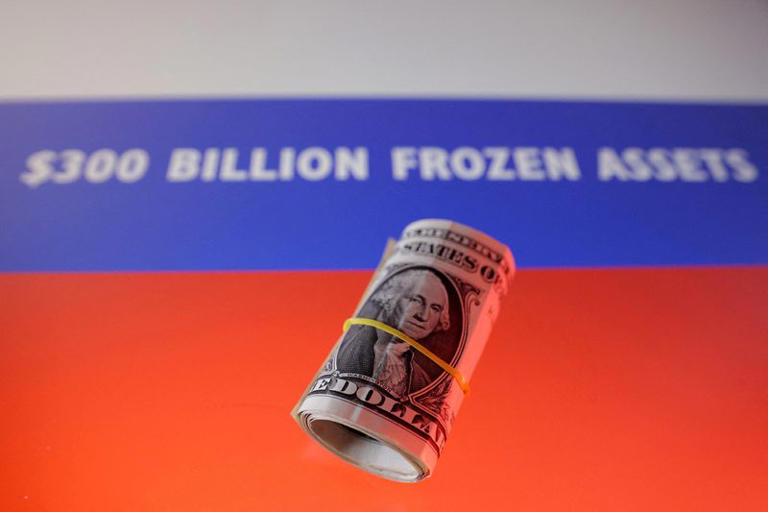
Above photo: U.S. dollar banknotes and Russian flag with words “$300 billion frozen assets” are seen in this illustration taken, February 21, 2025. Reuters/Dado Ruvic/Illustration.
Make EU Taxpayers Pay For It.
The war hawks have long tried to steal Russian assets held in West to then use the money to finance the proxy war against Russia. The sums involved are serious:
Nearly three years after the start of Russia’s invasion of Ukraine, Belgium holds €258 billion in frozen or immobilised Russian assets.
The General Administration of Treasury at the Ministry of Finance confirmed the figures on Wednesday to La Libre and De Tijd.
Some of these assets belong to institutions not sanctioned by the European Union. Frozen assets amount to €65 billion, with an additional €193 billion in immobilised transactions, primarily from the Central Bank of Russia.
The money is not really held by Belgium but by the Belgium company Euroclear which acts as depository for international central bank assets denominated in Euros.
Currently the EU is confiscating the interest, not the principal, of that money to distribute it to Ukraine. That step is likely already illegal and Russia will certainly use the courts to get it back.
There were also talks to invest the Russian assets in junk bonds with aim of achieving a higher yield:
Euroclear chief executive Valérie Urbain told the Financial Times that European Union plans to raise additional revenue from frozen Russian assets by investing them in higher-risk securities would amount to “expropriation.”
Urbain also warned that such a move could prompt “Russian retaliation in all sorts of forms,” as well as damage Euroclear’s reputation.
The majority of Russian assets frozen after Moscow’s full-scale invasion of Ukraine are currently held at Euroclear.
The E.U. has reportedly been discussing the possibility of transferring these assets to a special E.U.-administered fund that would make higher-risk investments. The goal is to generate greater returns to support Ukraine.
That move was blocked as no one was ready to accept the potential liability for it. Not only Belgium, but also Germany and other fiscal conservative states, have warned that such a move would endanger their own assets. Russia has announced that it will retaliate against any confiscation of its money. It threatens to confiscate whatever European companies own or hold in Russia. Those companies would then have to sue their own governments for cover of their losses.
Now a new idea has crept up. How it is supposed to work is not clear to me but it seems to have the support of the German Chancellor Friedrich Merz.
In a Financial Times op-ed Merz claims (archived):
Germany has been, and remains, cautious on the issue of confiscating the Russian central bank’s assets that are frozen in Europe, and with good reason. There are not only questions of international law to consider, but also fundamental issues concerning the euro’s role as a global reserve currency. But this must not hold us back: we must consider how, by circumventing these problems, we can make these funds available for the defence of Ukraine.
In my view a viable solution should now be developed whereby — without intervening in property rights — we can make available to Ukraine an interest-free loan of almost €140 billion in total. That loan would only be repaid once Russia has compensated Ukraine for the damage it has caused during this war. Until then, the Russian assets will remain frozen, as decided by the European Council.
Such extensive assistance will require budgetary guarantees from member states. Those bilateral guarantees should, as soon as the next Multiannual Financial Framework is in place in 2028, be replaced by collateralisation under the EU’s long-term budget.
What sounds like AI slop is not Merz’ own idea but a plan that had been proffered earlier by the EU commission. But no one seems to understands how its is different from an outright confiscation of those assets:
Frustration has been building in EU capitals around the lack of details surrounding the so-called reparations loan, which Commission President Ursula von der Leyen first pitched in her State of the European Union speech Sept. 10.
The bulk of the Russian assets are held by the Brussels-based financial firm Euroclear and are invested in Western government bonds that have matured into cash. The cash is sitting in a deposit account with the European Central Bank.
The idea is for the EU to redirect the cash to Ukraine and “enter into a tailored debt contract with Euroclear at 0 percent interest,” according to the note.
Euroclear holds €185 billion in cash balances linked to the Russian assets, a part of which will pay back a preexisting G7 loan to Ukraine.
The remaining €140 billion will be paid out to Ukraine in tranches and used for “defense cooperation” as well as supporting Kyiv’s ordinary budget needs.
Reuters has more details on it:
To avoid seizing the Russian assets, the idea is to transfer the cash from Euroclear to a newly created Special Purpose Vehicle (SPV) owned by EU governments, or G7 governments as well. In exchange, the European Commission would issue Euroclear with zero-coupon bonds guaranteed by the owners of the SPV.
The EU bonds would cover Euroclear’s risk against Russian litigation while the cash in the SPV could be invested more profitably than overnight deposits in the ECB and thus generate a higher return for Ukraine.
Why would this scheme, as Merz say, ‘require budgetary guarantees from member states’? Doesn’t that mean that the tax-payers of those member state will eventually have to pay it? Who’s money is at risk when Russia wins its litigation? Who pays if something goes wrong?
Some 62% of German voters disapprove (in German) Merz’ policies. Only a record low 35.5% says that he is right in what he is doing. In the fiscal conservative Germany any attempt to borrow more money for the war in Ukraine will further sink his and his party’s chances of ever being reelected.
Merz knows that the scheme has little chance to find unanimous EU approval. He plans to circumvent (archived) opposition to it:
I propose that, at the European Council at the end of October, we give the mandate to prepare this instrument in a legally secure manner.
That decision should, ideally, be unanimous — failing that, it should be adopted by the large majority of member states who are firmly committed to Ukraine. We should also invite partners around the world that have frozen Russian assets to join the instrument. To this end, we will co-ordinate closely with our partners in the G7.
Luckily it is Belgium which has the last says in this. It is, naturally, opposing the scheme:
Speaking in the margins of the UN General Assembly, Mr De Wever said that Chancellor Merz’s proposal “will never happen”. The Belgian Prime Minister argues that seizing central bank assets of a third country would set a dangerous precedent
“If countries see that central bank money can disappear when European politicians see fit, they might decide to withdraw their reserves from the eurozone.”
De Wever added Chancellor Merz’s public statement regarding this is regrettable. “I’ve told everyone that I am happy to discuss this. But let’s talk and come up with something, rather than sharing an opinion on it every day. I find it quite frustrating.”
It is, in the end, Russia’s money. Any attempt to seize is outright thievery. How long will it take for sane people to intervene and to shoot this idea down?