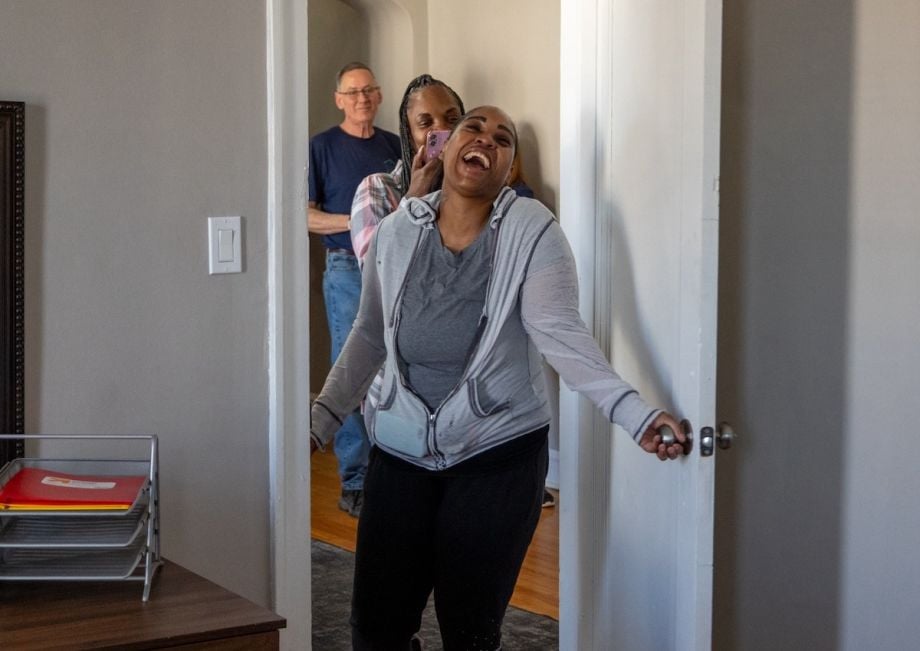
Above photo: A client reacts after seeing their newly-furnished home. Digs With Dignity.
Chicago’s Digs with Dignity shows that a furnished home can be the difference between staying housed and starting over again.
Homelessness in Chicago has surged in recent years, with the number of unhoused Chicagoans tripling last year. As housing costs climb and public funding shrinks, more families are cycling in and out of shelters without the resources to make a new place feel like home.
One local nonprofit is tackling that gap, offering support that social service agencies aren’t able to provide. By collecting and upcycling donated furniture, the Chicago-based nonprofit Digs With Dignity designs and furnishes homes for families transitioning out of homelessness, creating spaces that feel comfortable, functional and dignified.
The organization’s dual mission — preventing waste and preventing displacement — has helped keep hundreds of families stably housed. While the notion that America’s homelessness crisis is intractable has persisted, Digs With Dignity helps show how pairing affordable housing with additional support can help break the cycle of homelessness.
Next City spoke with co-founder and executive director Kim Hannay about how circular economy principles can support housing stability and help families stay housed for good.
Tell Us About Your Organization And Your Role At Your Organization. What Issues Are You All Trying To Address And How Did Your Organization Get Started?
Myself and two other partners at the time who met working at another organization took the best of all three of our talents and put them into one business. We knew that we wanted to address the issue of homelessness at large and that sustainability was going to be a huge part of that. We started Digs six years ago by simply collecting furniture and home goods from the community and then using them to custom design and furnish spaces for families transitioning out of homelessness. Since then, we’ve evolved more into a dual-purpose mission. Not only are we supporting those families, but we also have that heavy focus on sustainability and keeping items out of landfills.
On a weekly basis, we’re upcycling anywhere from six to 10 pieces of furniture. In our shop, we spend a lot of time painting, sanding and refinishing pieces of furniture. Jan [Claibourne] will make custom legs for things that are missing them or fix broken drawers. He’ll reconstruct and work on getting items to be functional, so that everything that’s going into the family’s home looks as dignified and brand new as possible.
We have about 10 different partners who refer to us on a regular cadence. They are the ones who are providing all the wraparound case management support for our families and getting them stable and placed into their home. A lot of the partners we work with are overloaded in terms of their caseload. They’re also quite underfunded and under-resourced. Furniture is just simply something that they don’t have a budget for.
So there’s this cycle of families getting into housing, but then [the caseworkers] are not really setting them up with the tools in the housing for it to be sustainable for them. Our families are making those tough choices: Do I feed my kids, or do I buy a bed to sleep on? A lot of times we walk in and our families are sleeping on an air mattress, maybe sharing one mattress, or they have hand-me-downs from friends or neighbors.
How Is Your Organization Playing A Role In Combating Displacement?
Cyclical homelessness is a big problem when families get placed in housing. If you’re coming from a shelter, you at least have a bed in a shelter. At least you don’t have to pay the electricity bills and all of that at a shelter. But if you’re moving into a new apartment, you can’t even afford the proper furniture for your space to give you comfort, safety and stability.
So families will typically fall back into the cycle of getting housed, staying housed for a little bit, and then falling back into the shelter system, because [there] they don’t have to worry about the giant burden and weight of having to furnish their home. That’s where we come in.
We’re one piece of the puzzle for families to be able to find the stability that they need and get back on their feet. That displacement is a real thing when you don’t really have anything that you’re coming home to and feeling proud of. You’re trying to hold a job, and coming home and sleeping on the floor doesn’t feel very good, and you’re just trying to pay your rent and pay your like major bills that you’d have to pay in order to keep your housing. There’s not really a lot of extra to get all the other pieces in your home that you need.
How Do Families Find You?
We get all of our referrals by way of social service agencies. They range in focus area. Some are focused on supporting women who are survivors of domestic violence. Some are supporting women who are formerly incarcerated. Some focus on substance abuse and recovery. We’ve worked with Jesse Brown VA for veterans, so we’re across the spectrum.
We have established relationships with those case managers to make sure that those families are getting the support that they need beyond just getting in housing and getting furniture. Through the case managers, they have someone that they can pick up the phone and call when they’re having tenants rights issues with their landlord or if something happens with their job or they’re having major barriers to getting back on their feet.
A lot of our partners help them combat those. For example, the first and last month’s rent and a security deposit is often such a large expense that a family who’s just starting out again can’t really afford. They’ll remove that barrier. Sometimes they land a job, but they don’t have reliable transportation back and forth. The case managers will get them set up with a CTA card. Those case managers are helping them all across the board, and doing really great work and supporting what our families need beyond just housing.
What Has Been Your Greatest Success?
Truly, the statistics are great. We’ve serviced 240 families. We’ve kept 265,000 pounds of furniture and waste out of landfills. Those are numbers that we’re really proud of but I think what I’m most grateful for in doing this work is hearing the impact that it is having on people’s lives long term.
Homelessness is such a massive issue. It’s giant in scale. We talk about addressing homelessness like there’s a one-size-fits-all solution for it. But the reality is homelessness is experienced on an individual level, and it requires individual solutions in order to make it work.
One person is not going to be the same as the next. I think when we can come in and hear a person and give them some autonomy in choosing what colors they like, and tell us what their kids are into, and explain to us how we can make a home feel like a true home for them that really helps them in staying in housing long term and continuing to move forward.
What Is Your Metric For Measuring Your Anti Displacement Success?
About two years ago now, we hired a previous client of ours. Her name is Okeisha, and she is our client liaison. She’s someone who has experienced a lot of different things that our families have experienced from domestic violence to substance recovery to several bouts of homelessness, and she is absolutely crushing it. She’s over five years sober. She’s married and stable and in a really great place in her life.
It was a no-brainer for us to hire her to be the person that could bridge that gap to build relationships with our families. Now she has gone back through our entire client list and tried to get in touch with any family that she could to gather statistical data for us and figure out what gaps there still are, and see if we can create any additional workshop programming and resources that for our families would be helpful to support them in continuing to move forward and doing great things.
It’s so important to have that client voice at the table, and somebody who has that lived experience to help bridge that gap and make sure that we’re relating to our clients in a way that feels really comfortable and safe for them, because they’re hearing a voice of somebody who’s also been through it. Of all the clients that she’s spoken with, 95% of them are still housed. So you’re taking that recidivism rate, which is typically around 45-50% of families falling back into the cycle of homelessness, and we’re disrupting that so that 95% of our clients are safely, comfortably, stably housed after receiving our services.
Okeisha is such an example of being able to build relationships and trust amongst our clients and for our clients to know that she’s a valued resource for them to reach out to. Another important metric for us, is that our clients know if they’re going through hard times or have questions or need more support, we can connect them with additional resources and that we are truly invested in their long term success.
That statistic speaks volumes to me, and then it’s also all of the individual stories that we’ve heard about people getting promotions and people retaining their housing, which sounds like such a simple thing, but it’s such a massive thing for them. They’re moving on to get married and having babies, and their kids are growing up and maybe exploring college options, which is something that you know in the past hasn’t been an even an option for them to consider. A lot of our families talk about breaking that cycle of the generational trauma and cyclical homelessness that they’ve experienced.
Once you’re part of the Digs family, you’re truly a part of this bigger community of people who care about you and are invested in your success and your stability moving forward. I think the power of community is something that, especially now, we’re all craving. We’re craving community and connection and positivity. If we can create that for our families, it can be a pretty powerful thing.
What Are The Biggest Challenges That You Faced While Doing This Work?
As a nonprofit, funding is obviously always a challenge, especially in an unstable economy. Getting furniture donated to us has never been a huge issue at Diggs. There’s so much stuff that is floating around in the city of Chicago that our warehouse has always been able to be full. It’s really been getting the funding to do the work that we do and pay our warehouse rent, keeping up with maintenance and gas for the moving truck. We have a staff of nine and we’re continuing to move the needle forward and grow, and that requires funding, so that’s always been our biggest hurdle.
What Lessons Have You Learned In Doing This Work, And What Guidance Would You Give To Other Organizations Starting Out?
My partner, Jen, and I always talk about how either of us went in with any expectation of how big we were going to grow, how quickly we were going to grow. Every so often, we step back and are like, ‘Whoa. This has become something really big. This has become a real movement that’s got some really great forward momentum in the way that it is impacting people and building community.”
I think a lot of our programming has developed in a really authentic, organic way. We are meeting people where they’re at, we’re asking what they need, and building programming about the things that they have expressed that are important to them, and the gaps that are still existing for them and need to be filled. The biggest lesson is just going in with not too specific of expectation, but being able to really flow and move with what the actual need is, and listen to the voices of the people that have the need when you’re creating that work, because that’s where the real impact then happens.
What’s On The Horizon For Digs With Dignity?
Our gala is on Oct. 23; if people are interested in our work, that’s a really great way to learn more about our mission and to support our work in a big way. So come into our warehouse, see the work, be a part of the design prep and everything that happens on a daily basis.
We’re always looking for volunteers. In order to move one family a week, it requires a lot of hands, prep and pre-planning, because we’re only in families’ homes for about five, six hours the day that we move them in. We start with a completely empty slate. We clean everything, and by the time [we] leave, beds are made, the kitchen is fully stocked and set up, art is on the walls, and everything is ready to be lived in.
This story was produced through our Equitable Cities Reporting Fellow for Anti-Displacement Strategies, which is made possible with funding from the Robert Wood Johnson Foundation. This Q&A is part of Lessons from the Field, Next City’s series of interviews with anti-displacement practitioners across the country.