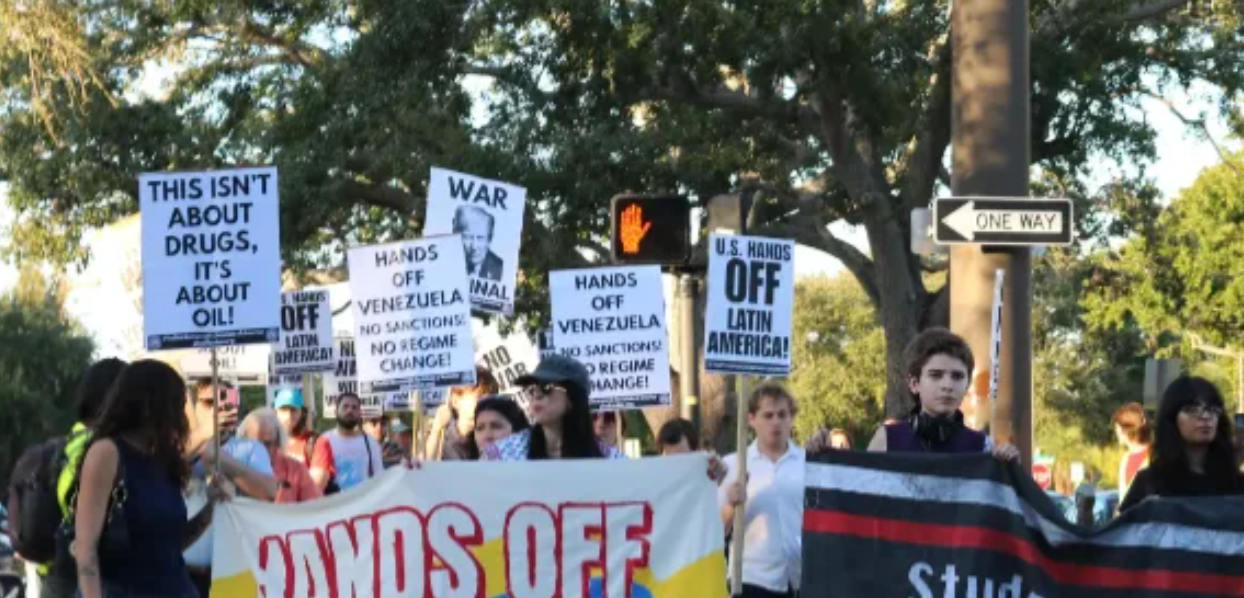
Above photo: Venezuela has received support from multiple regional bodies and solidarity movements across nations, including the United States and St. Petersburg. Leah Burdick.
Warn of ‘Spill-Over Effect’.
The US 22nd Marine Expeditionary Unit, specialized in foreign operations, is currently conducting joint exercises with Trinidad and Tobago.
The Non-Aligned Movement (NAM) and the Group of Friends in Defense of the UN Charter have condemned the United States military escalation in the Caribbean, warning that attacks on Venezuela could have a “spill-over effect” across the entire region.
In communiqués issued on Tuesday, both multilateral organizations expressed concern for the increased military build-up in the Caribbean, including several warships, a nuclear-powered submarine and the recently arrived USS Gerald R. Ford, the world’s largest aircraft carrier.
The 121-member NAM called on the US to stop its airstrikes against small vessels in the Caribbean and the Pacific, which have killed over 80 civilians since September, and to avoid “any further hostile actions.” While the US claims that the boats were involved in drug trafficking, it has not released any supporting evidence. UN experts have warned that, even if the allegations were true, drug trafficking does not carry a death sentence, and the strikes would still be considered extrajudicial killings under international law.
The Non-Aligned Movement likewise warned against any direct armed attack on Venezuela or any other nation in the hemisphere, stating that it would risk triggering a “spill-over effect” throughout the Latin American and Caribbean region.
For its part, the Group of Friends in Defense of the UN Charter expressed concern about the 22nd Marine Expeditionary Unit, which specializes in attacks in foreign countries, conducting joint training exercises with forces from Trinidad and Tobago from November 16 to 21. This is the second joint drill involving the US and its regional ally, located about seven miles off the coast of Venezuela, in less than a month. The previous operation involved the USS Gravely missile destroyer.
The Friends Group’s statement urged Washington to refrain from all covert and overt actions aimed at advancing regime change in Caracas, including “manufacturing false pretexts” of combating drug trafficking to justify aggression. It also called on the US to immediately withdraw all military assets from the Caribbean region.
The two multilateral groups’ calls follow a recent CELAC-EU summit where the two regional blocs likewise called for the Caribbean to remain a zone of peace.
Since August, Washington has amassed naval assets and thousands of troops in the Caribbean region on a self-declared anti-narcotics mission. This followed accusations that Caracas was playing a major role in international drug trafficking. However, the UN Office on Drugs and Crime (UNODC) and the US Drug Enforcement Agency (DEA) have contradicted the White House’s claims, assessing that Venezuela does not produce drugs and that less than 10 percent of narcotics from neighboring nations transit through the Caribbean nation.
The drug trafficking allegations emerged during the first Trump administration. In 2020, the US Department of Justice brought “narcoterrorism” charges against President Nicolás Maduro and other senior officials, accusing them of being leaders of the so-called “Cartel de los Soles.” A reward for information leading to Maduro’s capture was raised to US $50 million in August.
However, US officials have never presented court-tested evidence of the alleged cartel’s existence or of any involvement of high-ranking Venezuelan officials in drug smuggling.
Despite the lack of evidence, US Secretary of State Marco Rubio announced Sunday that the so-called cartel will be designated as a Foreign Terrorist Organization (FTO) effective November 24.
The US Treasury Department previously placed sanctions on “Cartel de los Soles,” labeling it a Specially Designated Global Terrorist (SDGT), but the new FTO designation unlocks a broader range of potential aggression against the South American nation. Analysts have speculated that the FTO might be the administration’s attempt to create a legal case for possible decapitation strikes or attacks on land targets inside Venezuela.
President Donald Trump recently told reporters that he had “sort of made up his mind” on how to proceed with Venezuela, without giving any details, and suggested the possibility of restarting dialogue with Caracas. Maduro, who has repeatedly called for direct talks, said on Monday that he was ready to talk “face to face” with Trump.
The Venezuelan president claimed that Trump’s inner circle, including long-standing regime change advocate Rubio, was orchestrating the military campaign against Venezuela. He warned that if an attack occurs, it would mark the end of Trump’s political career.
Caracas has warned the UN Security Council about the use of fabricated narratives to justify military intervention and has defended its right to protect its territorial sovereignty. In recent months, the armed forces have deployed almost 200,000 soldiers to protect vital sites and infrastructure, as well as carrying out military drills with militia volunteers.