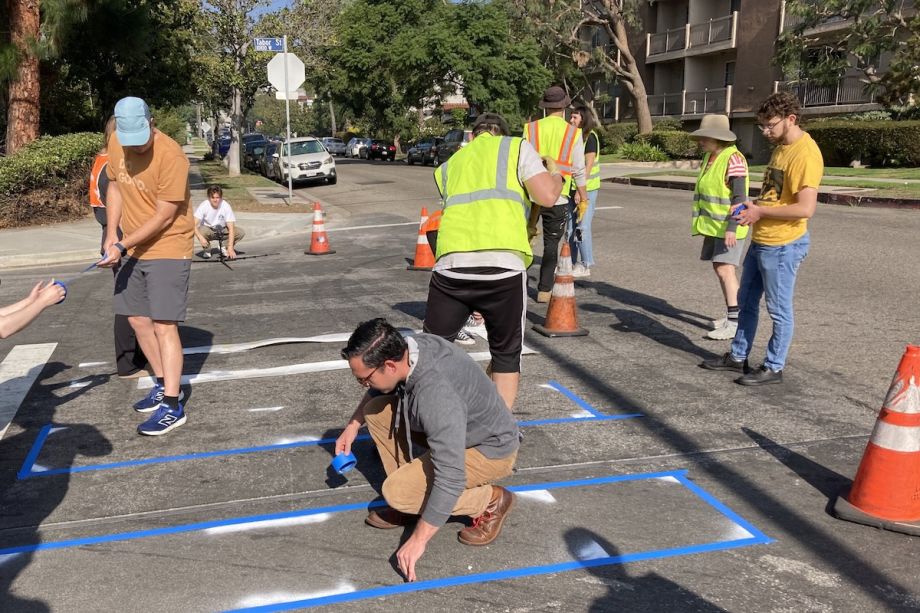
Above photo: People’s Vision Zero is painting crosswalks across Los Angeles to protest for safer streets. Maylin Tu.
Los Angeles failed to eliminate traffic fatalities.
So Angelenos are taking Vision Zero into their own hands – one bucket of paint at a time.
Painting a crosswalk is cheap and easy. A group of neighbors can paint an entire intersection in one morning for $100 or less. Getting the city of Los Angeles to paint a crosswalk, on the other hand, might take 14 years and the death of a 9-year-old boy.
Across L.A., neighbors are banding together to paint crosswalks to protest the city’s failure to protect people outside of cars.
Jonathan Hale, a UCLA law student who goes by “Jonny,” spent four Saturday mornings painting crosswalks with neighbors at Stoner Park this summer, covering each corner of the park. After the city removed them, he went to the press and vowed to repaint them.
“I was like, ‘Next Saturday, we’ll be out there, and you’ll have to deal with it. It’ll be a spectacle. And, like, everybody kind of hates you right now.”
The city painted official crosswalks a week later.
Now, Hale is leading a new group, called People’s Vision Zero, to continue to paint crosswalks across the city to protest for safer streets. Painting guerilla crosswalks in L.A. is not new — the anonymous group Crosswalks Collective LA has been doing it since 2022. What is new: Hale is putting his name and his face on the movement, challenging the city to take a public stance on vigilante crosswalks.
“I was in hot water with the city attorney’s office,” he says. “They don’t like me. People on Reddit [were] threatening to go to the bar. It was scary.”
Painting unofficial crosswalks is not without its legal and financial hazards. During one operation, an employee at the city’s transportation department called the police; Crosswalk Collective members were each fined $250 with the threat of $1,000 tickets if they re-offended.
Still, Hale’s approach seems to be working so far.
While the Crosswalks Collective sometimes paints new crosswalks in secret, Hale says he is alerting the mayor’s office every time he takes paint to pavement.
“I just want the city to admit that they’re wrong and that the system is broken. That’s it. If the city does that publicly, I’ll give it up,” he says.
The city is failing to achieve the goal of Vision Zero first set in 2015. From 2017 to 2021, traffic deaths and severe injuries increased by 13% with an average of 132 pedestrians killed each year. Can Los Angeles afford to squelch grassroots efforts to curtail traffic violence?
Making Tactical Urbanism Part Of Vision Zero
Painting a crosswalk as a concerned citizen might be a crime, but it doesn’t have to be. The city of Atlanta started a tactical urbanism program in 2020 for temporary, quick-build projects that modify the street to make it safer for walking, biking and rolling. Under the program, community members can make street improvements in their own neighborhoods. Residents recently built a bike lane for $10,000 on a school route.
“Temporary” might be a misnomer, says Rebecca Serna, executive director of Propel ATL, the street safety nonprofit that (in its previous iteration as the Atlanta Bicycle Coalition) pushed for Atlanta to adopt the program. All but one tactical urbanism project is still in place.
“The de facto fact of the matter is that they have been somewhat permanent, more permanent than anticipated,” Serna says.
The city is trying to improve and streamline the permitting process, according to Serna, to make it easier for community organizations to implement their own projects.
“[Atlanta’s program is] not exactly what we would want if we were starting from scratch,” she says. “There is an insurance requirement that particularly under-resourced communities have found really challenging.”
Cities are already asking residents to roll up their sleeves, points out Carter Lavin, co-founder of the Transbay Coalition and author of the new book “If You Want to Win, You’ve Got to Fight.” In Los Angeles, Mayor Karen Bass is mobilizing Angelenos to spend their Saturdays picking up trash and cleaning city streets. His organization is working with the city of Richmond, California, to make guerilla bus benches sidewalk legal.
“What I recommend is for the city who’s uncomfortable with the crosswalk thing, one, get comfortable with the crosswalk thing,” Lavin says. “But if that is just so impossible of a burden for them for whatever reason, okay, legalize benches.”
Could a street safety champion emerge in L.A.? Heather Hutt, L.A. city councilmember and chair of the transportation committee, is actively working to implement long-awaited improvements at a Koreatown intersection where 9-year-old Nadir Gavarrete was hit and killed in July. Crosswalks Collective LA painted crosswalks and a memorial in August, which the city replaced with official crosswalks and a quick-build traffic circle on Nov. 13.
“We look forward to working with our community to develop more improvements to reduce injuries along this stretch of Koreatown and will continue to assess other neighborhoods in Council District 10 for improvements,” her office says in a statement.
L.A. probably won’t implement a tactical urbanism program, says Michael Schneider, founder of Streets for All, a transportation advocacy organization that passed Healthy Streets LA.
“The city is incredibly conservative because it gets sued so often,” he says.
Even if the city council passed a motion to study how to implement a tactical urbanism program it’s unlikely to be implemented, believes Schneider.
“The city is basically run by the city attorney when it comes to stuff like this.”
The office of LA City Attorney Hydee Feldstein Soto did not return a request for comment on guerilla crosswalks in time for publication.
If the current crop of councilmembers don’t champion tactical urbanism, perhaps future councilmembers will. Already, two people running for city council have joined People’s Vision Zero to paint crosswalks.
Jon Rawlings, candidate for Council District 3, believes a formalized tactical urbanism program could be a good short-term solution.
“I’d love to be doing at least one every month,” Rawlings says. “I’d also want to inspire others in my district and throughout the valley to start this up themselves and do more.”
However the city chooses to respond, the crosswalk movement is taking on a life of its own.
“The city would be really wise to formalize, create some kind of an outlet for that energy so that it can work towards the greater good and not work at cross purposes,” Serna says.
From Paint To Policy
After the city repainted crosswalks at Stoner Park, Hale met with the mayor’s office to present a set of policy recommendations, including decriminalizing vigilante crosswalks. The city is facing a budget crisis and a backlog of broken sidewalks and missing curb ramps.
City staff were appreciative of his advocacy but also “a little condescending,” he says. When Hale quotes city staff, his already deep voice drops even lower.
“It was very much like, ‘Oh, thank you for your advocacy. But you know, you’re young and idealistic, and you need to understand that… these rules exist for a reason.”
One issue: The intersections that People’s Vision Zero painted at Stoner Park are not up to current ADA requirements, in part because there are no sidewalks on some sections of the street. According to federal guidelines, every time a city alters the street through repaving or reconstruction, it must add curb ramps. It’s unclear if a citizen-painted crosswalk would trigger these requirements.
Bringing an intersection up to current standards can be costly — a single curb ramp costs the City of Los Angeles $50,000 to $100,000. However, to advocates impatient for change, citing accessibility requirements is just one more excuse to delay simple improvements that could prevent people from dying while crossing the street.
Following the rules can take millions of dollars and, in the case of the safety improvements at the intersection where Nadir Gavarrete was hit and killed, over a decade to implement.
Take the traffic circle at 4th and New Hampshire, first proposed in 2011. According to public records obtained by Next City, the project was funded in 2015 but saw no progress for about five years. The design phase took roughly four years under the Bureau of Engineering and was finished at the beginning of 2025. Construction is slated to begin next year.
In a statement to Next City, Mayor Bass’s office came out as pro-crosswalk.
“While the City continues to install crosswalks that comply with federal, state, and local regulations, the Mayor’s Office is working with City departments to explore solutions that are innovative and will expedite crosswalk installations across Los Angeles.”
Crosswalk Painting As Collective Effervescence
On Nov. 8, People’s Vision Zero painted crosswalks at an intersection in the Palms neighborhood where a driver hit a pedestrian in 2017.
About 20 people showed up — the biggest group yet.
“I first heard about this on a Reddit post,” says Luis Fernando Anguiano Quiroz, an urban designer and planning grad student at UCLA. “This is my neighborhood, so I wanted to build community and get to know my neighbors.”
Carl, who has lived on the corner for 30 years and declined to share his last name, was initially skeptical when he saw people painting the street. He was worried the city would simply undo the work. But after talking to Hale, he’s on board.
“The city needs help, and if they’re doing a proper job, and a city inspector comes out and says it’s 98% right — leave it alone.”
The mood and the weather are bright. People take turns rolling out the paint and pulling up the tape, which is the most satisfying part of the process. Waiting for the paint to dry, they chat and riff about their favorite TV shows.
This is the 10th intersection that People’s Vision Zero has painted, and it won’t be the last. What happened at Stoner Park only made Hale more determined to keep going.
“It’s awesome. It feels so good. I love my neighbors. It was so touching to see the news, and to see my neighbors interviewed on the news, just saying that they appreciate it… I did it for them” Hale says.