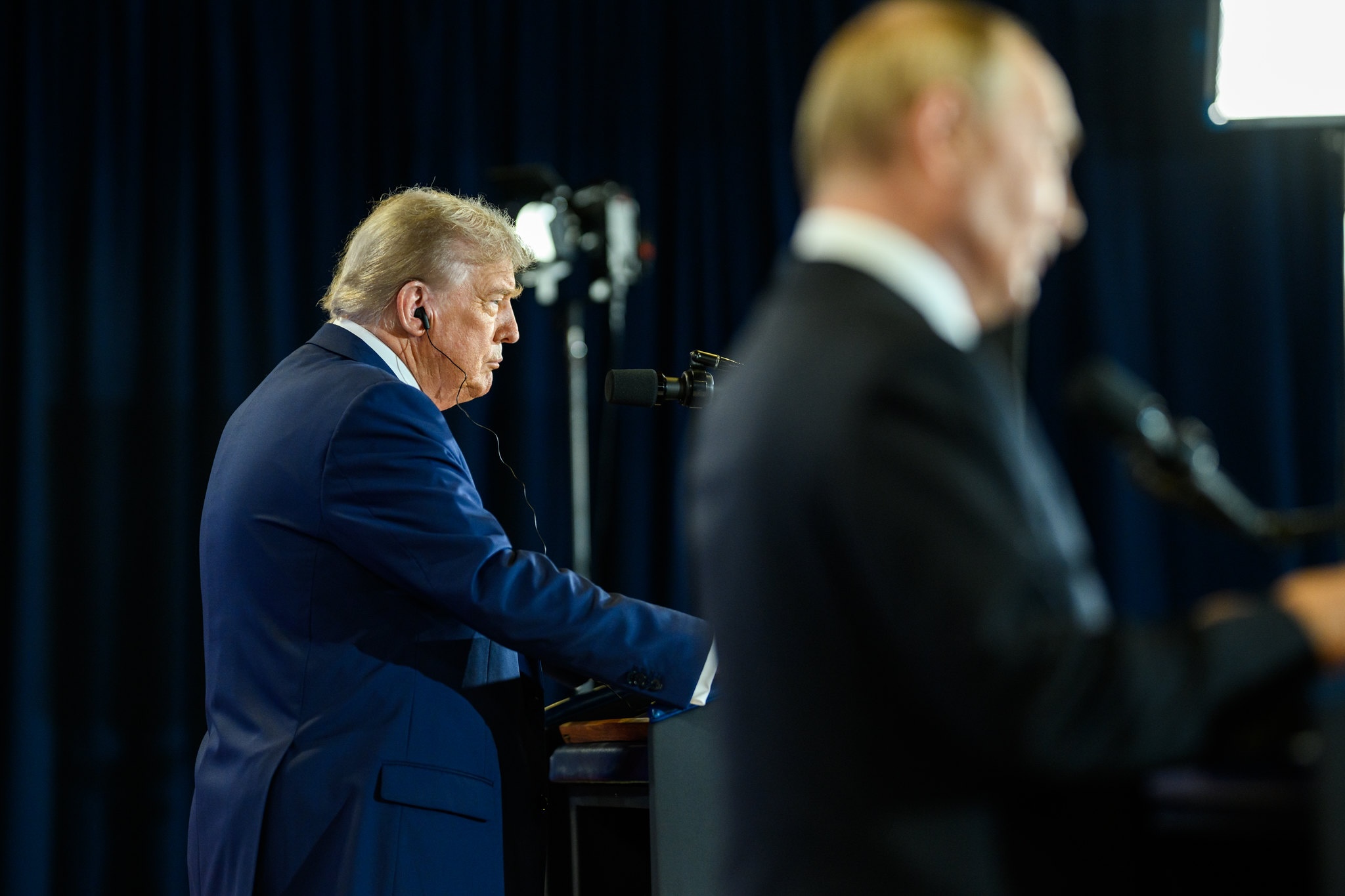
Above photo: President Donald Trump and Russian President Vladimir Putin in a joint press conference after meeting in Anchorage, Alaska on Aug. 15. White House /Daniel Torok.
The Trump regime’s 28–point Ukraine peace plan accepts Moscow’s core concerns as legitimate.
That’s essential for any possible settlement of the war, or the broader crisis between Russia and the West.
There are any number of reasons you may not like, or may even condemn, the 28–point peace plan the Trump regime has drafted to advance toward a settlement of the war in Ukraine.
You may be among those many all across the Western capitals who simply cannot accept defeat on the reasoning — is this my word? — that the West never loses anything, and it certainly cannot lose anything to “Putin’s Russia.”
You may think that President Donald Trump and those who produced this interesting document, which leaked out in the course of some days last week, have once again “caved” to the Kremlin.
The outstanding contribution in this line comes from the ever-mixed-up Tom Friedman, who argued in last Sunday’s editions of The New York Times that Trump is to be compared with Neville Chamberlain and Trump’s plan with the much-reviled British prime minister’s “appeasement” of Hitler via the Munich Agreement of September 1938.
I cannot think of a klutzier interpretation of history or a more useless comparison, given it sheds not one sliver of light on what the document to hand is about.
Or you may stand on principle and attempt the well-worn case that Ukraine is a liberal democracy — let me write that phrase again just for fun — Ukraine is a liberal democracy, altogether “just like us,” and must be defended at all costs in the name of freedom, the rights of the individual, free markets, etc.
Or you may think this is no time for the United States and its European clients to relent in their unceasing effort to destabilize the Russian Federation. Those of this persuasion cannot, of course, acknowledge that Ukraine is nothing more than a battering ram in this dreadful cause, at this point much-bloodied. This dodge tends to swell the ranks of those professing the defense of democracy against autocracy as their creed.
Anyone paying attention to the reactions to the Trump plan among the trans–Atlantic policy cliques and the media that serve them has heard all of this and more these past few days. I find it all somewhere between pitiful and amusing.
Pitiful because those who so wildly overinvested in the corrupt, Nazi-infested regime in Kiev prove incapable of acknowledging that Ukraine lost its war with Russia long ago, and this attempt to subvert Russia now proves a bust.
Amusing because those who so wildly over-invested in the corrupt, Nazi-infested regime in Kiev now squirm at the thought that the victor will have more to say about the terms of peace than the vanquished.
Whad’ya mean we don’t get to dictate a settlement just because we’re the losers?
This, in a single sentence, is the position shared across the West and in Kiev. Trump’s latest sin — and this plan counts as another in many quarters — is that what he and his people now propose favors simple realities over elaborate illusions.
Those asserting that the Trump plan caters to the Kremlin are not altogether wrong, to put this point another way. They are merely wrong in their objections. These 28 points, with many elaborations —No. 12 is followed by 12a, 12b, 12c and so on — indeed give Russia a lot — but not all — of what it has spent years attempting to negotiate.
The missed point is plainly stated: It is a very wise and fine thing finally to recognize the legitimacy of Russia’s perspective. At this point what will serve Russia’s interests will also serve Ukraine’s and the interests of anyone who thinks an orderly world is a good idea.
A couple of things to note before briefly considering the contents of the Trump plan. I am working from a copy of the text apparently leaked to the Financial Times last Thursday.
One, it is a working document, nothing more. Trump’s people, notably Marco Rubio, Trump’s secretary of state, and Steve Witkoff, the New York property investor now serving as Trump’s special envoy, had extensive negotiations with Ukrainian and European delegations in Geneva over the weekend. These are to continue.
Trump earlier gave the Kiev regime until Thanksgiving, this Thursday, to accept or reject its terms, and he has not since said anything differently. But the Trumpster has already stated that if things are going well this deadline can be superseded. All is subjective.
Two, Rubio and Witkoff take credit for drafting this plan, reportedly in consultation with Kirill Dmitriev, the chief executive of Russia’s sovereign wealth fund, who seems sometimes to serve as a diplomat close to the Kremlin. But it has Trump’s name on it, and anything with the Trumpster’s name on it is subject to radical and unpredictable revision or withdrawal at any time.
Promise Of Enduring Settlement
Setting these matters aside:
There are numerous on-the-ground provisions among its 28 clauses. No. 19 specifies that the Zaporizhzhia nuclear power plant along the Dnieper River, controlled by Russian forces since March 2022, less than a month into the war, will be restarted under the authority of the International Atomic Energy Agency, and the electricity it generates will go equally to Russia and Ukraine. Russia is to allow Ukrainians to use the Dnieper “for commercial activities” (No. 23).
There is to be a prisoner swap (No. 24a) and, a family reunion program (24c). A general amnesty will extend to “all parties involved in the conflict” (No. 26). “Measures will be taken,” No. 24d states, “to alleviate the suffering of victims of the conflict.”
These clauses, boilerplate humanitarian provisions and low-hanging fruit, are worthy enough, but read to me as greeting-card niceties next to the weightier items in this plan.
There is the much-discussed, much-disputed question of territory. Crimea and the Donbas — Luhansk and Donetsk — will be recognized as Russian territory, but de facto as against de jure. Why this distinction, the Russians would be perfectly right to ask.
The land from which Ukrainian forces will be required to withdraw will be designated a demilitarized zone that belongs to Russia, but the Russians will not be permitted to enter it. Again, what is this all about? As to Kherson and Zaporizhzhia, the southerly provinces Russia and Ukraine each partially control, they are to be divided and fixed at the current line of contact.
No. 22: “After agreeing on future territorial arrangements, the Russian Federation and Ukraine undertake not to change these arrangements by force.”
It is hard to say how either side will view these proposed divisions of territory. They award Moscow much of what it has demanded for some time, but in qualified fashion, and take away from Kiev much of what it has long said it will never surrender. So: Not enough for the Russians? Too much for the Ukrainians?
In my read the drafters’ intent here is to set down working language on the territory question as the basis of a lot of horse-trading. If I am correct, the U.S. side is not saying Kiev must accept or reject these terms as written so much as Kiev must agree finally to stop striking poses and do serious business at the mahogany table.
To be noted in this connection: It is long past time to dismiss all the rubbish of the past three years to the effect that Moscow’s intent has been to seize and occupy all of Ukraine. It is as ridiculous as the Europeans’ preposterous assertions — more cynical than paranoiac —that if the Russians are not stopped in Ukraine they will soon be in London and Lisbon.
In my view the Russians have never been interested in taking land so much as in buffering their borders against the West’s incessant threats. The evidence here begins with President Vladimir Putin’s active support of the Minsk Protocols of September 2014 and February 2015. They were to give the Donbas — Russian-speaking, Eastward-facing — autonomy in a federalized Ukraine.
It was when Kiev and the Minsk accords’ treacherous European backers, the French and the Germans, betrayed the Protocols (and, so, Putin personally and altogether the integrity of the diplomatic process) that the course was set. As Kiev shelled its own citizens daily for the next seven years, Moscow concluded that the federalization project would never work and taking the Donbas militarily was its only alternative.
Whatever territory the Kiev regime will now have to give up, in other words, this outcome owes only to its own reckless miscalculations and those of its supporters in Europe and in the Washington of the Biden years. I see no other way to think about this. I am tempted to say, “Serves ’em right,” but I will refrain.
What recommends this plan most persuasively and promisingly, at least for my money, is the breadth of its provisions beyond Ukraine’s borders. Until now the Western powers and the repellent slobs in the press who reproduce their nonsense, have impudently dismissed out of hand what Moscow has taken to calling “the root causes” of the Ukraine mess. This document at last addresses them.
To put the point another way, the Trump draft acknowledges and attempts to redress all the duplicities and betrayals that began back when Mikhail Gorbachev sought “a common European home” for post–Soviet Russia only to find that the triumphalists reigning in Washington would serially break their word and that the Cold War had a new look but had not ended.
Point No. 2, right up top: “A comprehensive and comprehensive [sic] non-aggression agreement will be concluded between Russia, Ukraine and Europe. All ambiguities of the last 30 years will be considered settled.”
Bingo. This is absolutely splendid language. It holds the promise of an enduring settlement between Russia and the West that will benefit not only the Russians but everyone with an interest in global peace. The only losers here are the warmongers.
NATO Provisions
I may as well quote verbatim the provisions concerning NATO, as they rank among the most important in this draft.
No. 4: “A dialogue will be held between Russia and NATO, mediated by the United States, to resolve all security issues and create conditions for de-escalation in order to ensure global security…” O.K, an excellent idea, although I do not see how the United States can mediate any such talks given NATO is its creature. But let’s mark this down as an easily repaired muddle, or a nod to Donald Trump’s incorrigible vanity.
It is No. 7 — brief, perfectly clear — that goes straight to the point: “Ukraine agrees to enshrine in its constitution that it will not join NATO, and NATO agrees to include in its statutes a provision that Ukraine will not be permitted in the future.”
Point No. 5 offers Ukraine “reliable security guarantees,” and No. 6 is to limit the Armed Forces of Ukraine, the A.F.U., to 600,000 personnel. It is not yet clear what the former may turn out to mean, and the latter is a bit of a fraud. Western press reports have it that the 600,000 figure amounts to a drastic restriction.
Nonsense. At the time of the U.S.–cultivated coup in February 2014 the A.F.U. had roughly 130,000 soldiers on active duty; post-coup this figure increased to a quarter of a million. It was only when the Kiev regime began gearing up for war at Washington’s urging that these numbers rose appreciably. For a nation committed to peace, the pre-coup A.F.U. should be the reference.
This question leads to another, larger one. Wherein lies enduring security for postwar Ukraine, if, indeed, the Trump plan brings it closer to post-anything?
The Austrian Example
Chas Freeman, the emeritus ambassador who hangs in as a perspicacious commentator on global events, made the point some months ago that enduring security is not to be achieved by way of military victories or permanently stationed arsenals in contentious territories. It comes by way of creative statecraft and diplomatic settlements that serve all sides.
Chas’ example is Austria, which has prospered since 1955, when Washington, London, Paris, Vienna and Moscow signed the Austria State Treaty, which made Austria a constitutionally neutral nation pledged never to join military alliances and never to allow foreign military bases on its soil.
It became, then, a Cold War buffer between East and West, just what was needed at the time. All sides understood, all sides agreed and Austria became Austria as we have since known it.
The 28–point plan now on the table makes reference to “a non-aggression agreement.” In the best outcome, Ukrainian neutrality fixed in international and national law will be the better term.
We will have to see.
Since the talks in Geneva at the weekend the Europeans have been carrying on in their predictable and ineffectual way.
Friedrich Merz and Johann Wadephul, respectively Germany’s chancellor and foreign minister, have insisted that Ukrainian sovereignty remains beyond negotiation — this from Merz in an interview with Deutsche Welle, German radio — and, from Wadepuhl, that all questions “concerning Europe” and NATO have been removed from the Trump plan.
Mice that roar, these two. Point No. 1 in the Trump draft states, “Ukrainian sovereignty will be confirmed,” and what this means has to be reconsidered in view of who has won the war and what it insists must be addressed. The rest is mere delusion, of which there is a surfeit among the Europeans these days.
As to Wadepuhl’s assertion about the removal of clauses to do with Europe and the Atlantic alliance, the Trump draft remains the working document; Wadepuhl appears to refer to a European counter-proposal advanced Sunday evening European time. And to this we must ask, “So what?”
Once again, the Europeans appear content to talk self-referentially to themselves, and we are best leaving them to it. If Trump’s people are foolish enough to edit their document as the Germans suggest, we can all forget about Moscow taking any interest in all this one-sided diplomacy.
My surmise about the provenance of the 28–point plan — and this is not more than a surmise — is that Trump and his people did again what they did in September, when they developed their famous “peace plan” for Gaza: The Russians more or less wrote this document just as the Israelis more or less wrote the Gaza plan.
For one thing, neither Rubio nor Witkoff is capable of the caliber of statecraft that went into the language of this document. Trump certainly isn’t, to state the very obvious. For another, it is not quite the Russian “wish list” all the hawks in Washington and the Tom Friedmans in the press are now shrieking about, but it is unmistakably in this direction.
It is time to accept this as a good thing. It is time to accept that there cannot possibly be a settlement of the Ukraine crisis, or the broader crisis between Russia and the West, without accepting Moscow’s concerns as legitimate.
It is time to recognize that at its core the Ukraine crisis has been all along about the emergence of the new world order that fairly bursts through the fabric of the old at this point, and that a settlement between Russia and the West will mark a significant advance in this direction.
Remember Molly Bloom’s last word, her famous yawp, on the last page of Ulysses? “Yes!” she declared — an affirmation of life in all its grandeur and imperfections and miseries. I don’t know why this line comes to me now, but here goes: “Yes,” I say, to the Trump peace plan for Ukraine — as we have it now, at least — for all it stands to make possible.
Patrick Lawrence, a correspondent abroad for many years, chiefly for the International Herald Tribune, is a columnist, essayist, lecturer and author, most recently of Journalists and Their Shadows, available from Clarity Press or via Amazon. Other books include Time No Longer: Americans After the American Century. His Twitter account, @thefloutist, has been restored after years of being permanently censored.