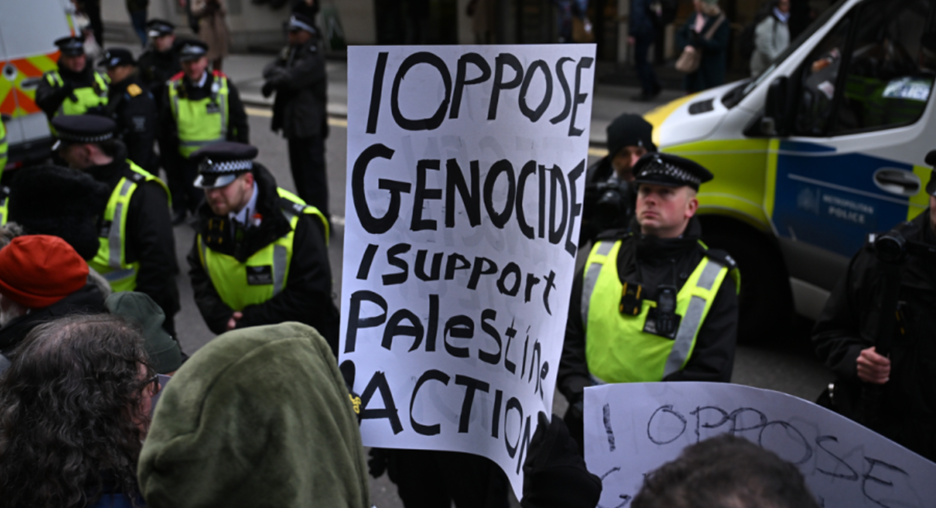
Above photo: Police detain demonstrators as activists gather outside the Ministry of Justice during the “Lift the Ban” protest launched by the Defend Our Juries campaign group ahead of the judicial review on the designation of Palestine Action as a terrorist organization in London, United Kingdom, on November 20, 2025. Raşid Necati Aslım – Anadolu Agency.
Five activists who targeted Israel’s arms manufacturer Elbit Systems in Germany are being held in harsh and legally questionable conditions.
Charged under a statute increasingly used to criminalize political dissent, the ‘Ulm Five’ face solitary confinement, surveillance, and prolonged detention without bail – highlighting how Germany’s proclaimed ‘reason of state’ translates into repression of Palestine solidarity at home.
For years, Palestine activists in Germany have looked to Britain with a sense of astonishment. The state that promised Palestine to Zionist settler colonialism in the 1917 Balfour Declaration is scarcely less pro-Israel than the Federal Republic of Germany, with its so-called Staatsräson (‘reason of state‘) that proclaims unconditional solidarity with Israel – albeit without ever having been codified into law. And yet, solidarity in Britain appears – at least from this vantage point – to be more vibrant, broader, and above all more effective.
This perception is partly shaped by the mass demonstrations that repeatedly brought hundreds of thousands of people to the streets of London between October 2023 and October 2025. In Germany, by contrast – despite its many large cities but lack of true megacities – numerous decentralized actions have taken place every week since the start of the Gaza genocide. However, truly large demonstrations breaking the 50,000 or even 100,000 mark did not occur until last summer.
A model: ‘Palestine Action’
For many, this positive view of the British Palestine solidarity movement has also been decisively shaped by the group Palestine Action (PA), which succeeded in combining ‘direct action with media work and political struggle, including legal battles in court. Quite a few activists in Germany felt – and continue to feel – that the time had come to strike directly at the infrastructure of the genocide industry here as well.
That moment arrived only this fall. On September 8, five activists entered a factory belonging to the Israeli arms manufacturer Elbit Systems in the southern German city of Ulm. They filmed themselves, unmasked, damaging equipment and holding documents up to the camera. They then allowed themselves to be arrested without resistance.
‘Terrorists‘ there, ‘criminals‘ here
While in Britain thousands have taken to the streets since PA was designated a ‘terrorist organisation this summer – despite the risk of long prison sentences – the situation surrounding the so-called ‘Ulm Five‘ has so far remained strikingly quiet. The reasons are obvious: the group had no years-long history of actions through which to establish itself; the Palestine solidarity movement in Germany remains highly fragmented; even many activists only marginally noticed the action. Finally, the repression faced by the ‘Ulm Five’ – at least so far – has not reached the same extreme levels seen in Britain.
Unlike their British counterparts, the German authorities don’t accuse the activists of belonging to a ‘terrorist organisation a charge made possible by Section 129a of the Criminal Code, introduced in 1976. Instead, they are accused of forming a ‘criminal organisation‘ under Section 129, which carries a potential sentence of up to five years in prison. This alleged offense would be added to the charges of property damage already leveled against them.
Section 129, originally intended to combat organized crime, is increasingly being deployed against political groups. Most recently, it has been used against young climate activists and militant anti-fascists. In practice, this amounts to a kind of ‘light‘ version of a terrorist designation – while simultaneously denying the political nature of the accused and treating them as ordinary criminals.
Harassment and struggle behind bars
The treatment of the imprisoned activists is similarly harsh and legally questionable, according to a report by seven lawyers representing the five. As in Britain, they have been denied release on bail. The lawyers also describe harassment immediately following the arrests: the activists were forced to undress and wait in their cells wearing only underwear – women without brassieres included. For 30 hours they received almost no food, and in one case medically prescribed medication was withheld for 20 hours. Interrogations were conducted in the absence of legal counsel.
The harassment has continued. Several prisoners are reportedly held in solitary confinement for 23 hours a day. One individual was denied access to their lawyer for two weeks; in another case, contact with family was blocked for an entire month. Meetings with attorneys remain severely restricted, and family visits are in some cases limited to one hour per month. All communication is fully monitored, and letters are arbitrarily withheld.
While eight PA activists in Britain have been on hunger strike since early November to protest their conditions of detention – and are now said to be in life-threatening condition – the imprisoned ‘Ulm Five’ have not yet resorted to this drastic measure. But neither in Britain nor in Germany would they be the first political prisoners to turn their bodies into weapons against repression. And as the history of the Irish liberation struggle and West Germany’s urban guerrilla movements makes clear, those in power – there as here – have shown little hesitation in allowing prisoners to die.