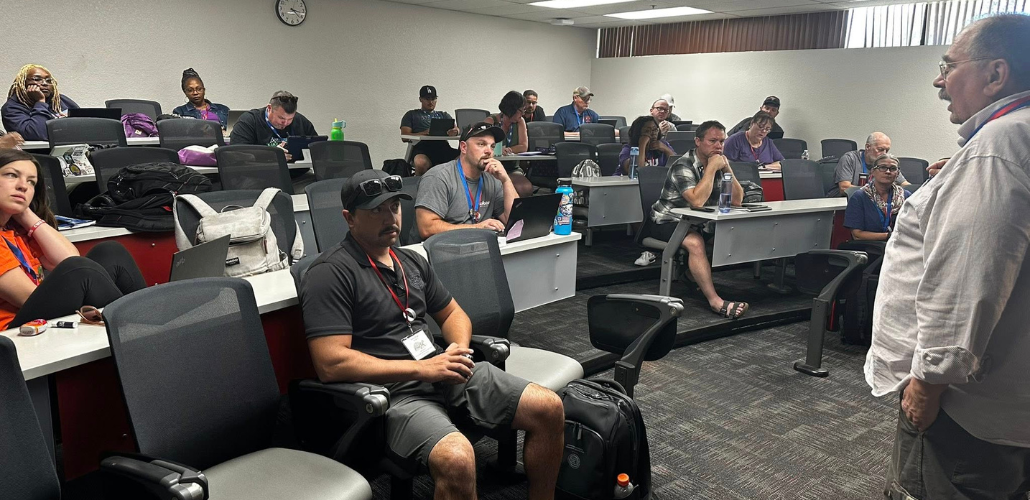
Above photo: Richard de Vries led a training at the Grace Carroll Rocky Mountain Labor School. Grace Carroll Rocky Mountain Labor School.
Recently I did some training with a group of newly elected officers and business agents. We used their International’s steward training manual, but I felt it missed the mark on several issues. When I reviewed manuals from other unions, these mistakes kept coming up:
1. Representing two members who get in a fight
One new business agent asked, “Two members get into a fight. Both get suspended, under a zero tolerance policy. Can I refuse to file a grievance for the one who was clearly at fault?”
In a conflict, it’s impossible not to be biased, blaming one worker and excusing the other. But no matter who threw the first punch, each member deserves the highest standard of representation against discipline.
If one member gets little or poor representation, no one should be surprised if they file a duty of fair representation charge against the union at the National Labor Relations Board (NLRB).
Remedy: The union should assign two stewards of equal experience, one to each member. The same applies to later steps in the grievance procedure: two business agents. If there’s an arbitration for one member, the local should consider it for the other.
2. Representing in case of sexual harassment between members
My immediate sympathy goes to the victim. But again, there will be two versions of events, and the union must represent both members’ interests.
The victim’s grievance is because of inadequate punishment of the perpetrator, and management’s responsibility to provide a safe workplace.
Both cases may call into question the rules or lack of rules, consistent enforcement, quality of investigation, and uniformity of punishment. Often the company’s bias becomes a core issue.
Remedy: Again, two stewards, two business agents, and two arbitrations may be needed to protect each member. Shocking as it may seem, the perpetrator is entitled to good representation.
3. Representing new probationary employees
The most common error I saw was “under our contract we don’t represent probationary employees.” Another statement heard too often: “They aren’t really members yet.”
This issue is affecting more workers, as employers bargain longer probationary periods. Thirty days used to be the norm; now some contracts say six months.
Are probationary employees excluded from the grievance procedure? Give your contract a careful read. Often the exclusion is from arbitration, not from filing a grievance.
Even if the employee is excluded from grievances, a great steward will still stand up for them. Suppose the new member isn’t correctly paid overtime. Do you ignore it? No—you march right into the office with them and make it right.
Is it OK for management to use racial slurs on new hires? Absolutely not. The contract doesn’t stop a steward from dealing with basic right and wrong.
Remedy: The recognition clauses in most contracts state: “The employer recognizes the union as the sole and exclusive representative…” Grievance or not, the union can still represent a probationary employee.
In new-hire orientation, stewards should give an introductory talk on what the union is all about and how to get in touch if there’s an issue. Practice this in steward training.
The goal is building a strong union from day one. New employees should know the steward is there for them, and stewards should know the union has their back.
How about outrageous conduct, like sexual harassment by managers? Hopefully new members still have statutory rights. Check with the union’s lawyer to see if a charge should be filed at the NLRB, the Department of Labor, or a state or local human rights commission.
4. Denying grievances which have no merit
Some manuals give a lengthy explanation of how to deny a grievance that has no merit. But stewards are part of a union team with business agents, staff, officers, and lawyers. In my opinion, stewards usually haven’t had enough training to deny a grievance. They should kick it upstairs.
Union politics may also play a role. What if the grievance is weak, but a dedicated union activist is pushing for it? Leaders may want a say in how to handle this, and stewards shouldn’t have to figure it out on their own.
Remedy: Don’t deny a grievance without consulting the union person who supervises your steward work.
5. Why a strong grievance doesn’t get arbitrated
After a grievance gets deadlocked, there’s a step some manuals don’t mention: the internal union process to determine which cases go to arbitration. A union can afford only so many. It takes time and money to lawyer up, prepare the case, write post-hearing briefs, and so on.
Which cases make the cut? Each local has an internal review process, often a regular meeting where officers and maybe the attorney review deadlocked grievances. A grievance with merit may get set aside because of a poorly organized and incomplete file. Union-side lawyers shouldn’t have to investigate from scratch.
Common mistakes which prevent a grievance going to arbitration:
- No cover statement of the union’s theory of the case and the employer’s theory
- No meticulous notes on the employer’s presentation and evidence
- Missing witness statements
- Insufficient detail on chronology of events
- Information requests weren’t made, or responses were incomplete
Remedy: Prepare the grievance file as if you were doing the arbitration yourself. A steward plays the crucial role of investigator, documenting details. Can you explain your case to the review committee in 15 words or less? Then your meticulously complete file may be recommended for arbitration.
Richard de Vries is a 30-year union rep, now retired, with Teamsters Local 705. He also teaches labor classes with DePaul University Chicago and Grace Carroll Rocky Mountain Labor School. You can reach him at richardjdevries1852@outlook.com.