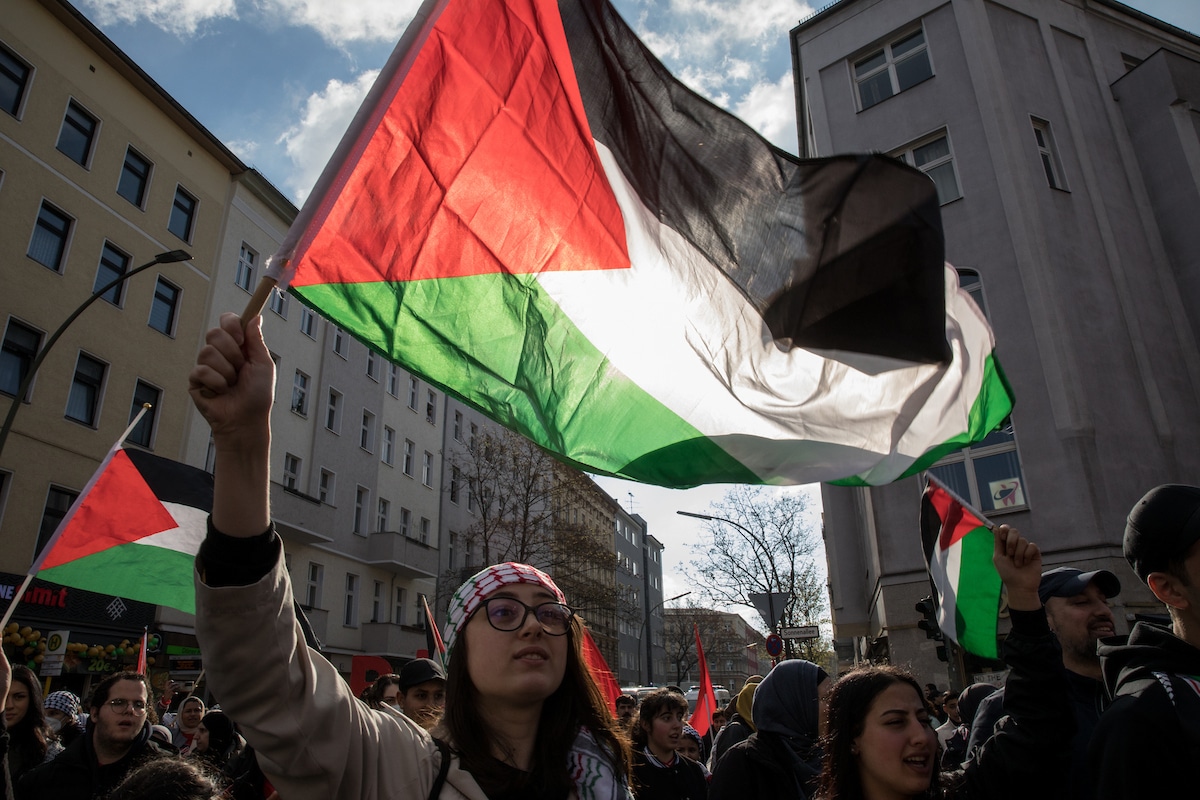
Above photo: Pro-Palestinian protesters rallying in Berlin, Germany in April 2023. Michael Kuenne / PRESSCOV via ZUMA Press Wire APA Images.
The global Palestine solidarity movement is at a crossroads as traditional forms of advocacy have become too easy for governments to ignore.
Moving forward, the movement must shift from reactive protests to building lasting political power.
Despite Hamas and Israel agreeing on a ceasefire on October 10, the genocide in the Gaza Strip has only slowed down.
United States President Donald Trump’s “peace plan” does not address the Israeli structural violence that still exists against Palestinians, and there has been no real movement or action from governments to hold the architects of the genocide accountable for their crimes. Although the daily massacres – averaging about 100 Palestinians in the Gaza Strip – have lessened, the mechanisms of oppression are still firmly in place: the territory remains blockaded, and Israeli aerial and artillery attacks persist with minimal resistance from world governments.
In the absence and failure of institutional change, the international pro-Palestine solidarity movement must sustain its momentum. It must continue to pursue direct and effective actions that challenge the foundations of Israeli dominance and the complicity of those who enable it.
The Illusion Of Calm
Since the theatrical photo opportunity of leaders converging in Sharm al-Sheikh to witness the ceremonial signing of the so-called truce on October 13, the brokers – Qatar, Egypt, Turkey and the US – have made a mockery of their promises to hold accountable Israel for its violations.
According to the Gaza Government Media Office, Israel has committed at least 497 violations of the ceasefire and has killed at least 342 Palestinians and injured 875 as of November 22. Israel has reneged on its stipulations of allowing 600 humanitarian aid trucks through to the battered and largely displaced population, with an average of 145 trucks entering daily.
Meanwhile, the Rafah border crossing remains shut, further putting the lives of tens of thousands of medical patients and wounded at risk, and essential supplies such as mobile homes, tents, medical supplies, frozen meat and eggs remain banned. The provision of Israel allowing heavy machinery to enter Gaza – which has been destroyed by 90 percent – to clear the rubble and recover the estimated 10,000 Palestinians buried under has all but been ignored, albeit for a limited equipment to search for the bodies of Israeli captives.
Starvation has also taken on a quieter form. Palestinians report that while the market, wholly dependent on what Israel allows in, is flooded with sugar, carbohydrate and starch-rich food – calorie dense yet nutrient poor. This influx is calculated for rapid and abnormal weight gain after months of famine that killed hundreds of people, but essential nutrient-rich foods such as meat, dairy, and fresh produce remain almost entirely absent.
These deliberate acts of Israeli intransigence are precisely why global solidarity for Gaza and Palestine as a whole must not lose momentum. If anything, international activism must be further accelerated in order to continue pressuring governments to hold Israel accountable.
Pariah State
According to a report by Francesca Albanese, the UN Special Rapporteur on Palestine, at least 60 countries have deepened and benefited from economic, trade and political ties with the Zionist regime, including several Arab countries.
Therefore, citizens must continue to call out their complicit governments, who will no doubt hide behind the shadow of the hollow ceasefire. These governments have exposed the sham of the rules-based world order by ignoring their obligations under the Genocide Convention, the ICJ Advisory Opinion on the illegality of occupation, and the International Criminal Court’s case against Israeli Prime Minister Benjamin Netenyahu and his former Minister of Defence, Yoav Gallant, for war crimes and crimes against humanity.
Public pressure in several countries served as a reminder of the rising public tide against Israel – one that must culminate in its designation as a pariah state, sanctioned on the economic, political and diplomatic levels. One such example of how this pressure translated into official policy is Spain’s arms embargo on Israel, becoming the second European country after Slovenia to do so.
And while these measures can be interpreted by some as the bare minimum, in light of the blood-soaked scenes of torn limbs livestreamed onto our devices over the past two years and the terrifying bombardment calculated to be around eight Hiroshima nuclear bombs, this is exactly why citizens must continue to rally and push for accountability.
Otherwise, Israel will continue sailing in the realm of respectability – not just on the political level, but also in sports and cultural avenues. It is not lost on many that it took the global footballing association FIFA only four days to ban Russia following its invasion of Ukraine in February 2022, yet continues to allow Israel to compete in its tournaments with impunity.
Taking Stock Of The Palestinian Solidarity Map
In this new and uncertain phase, it is vital to take stock of what forms of solidarity have proven effective in confronting Israel’s entrenched regime of impunity, and which have merely echoed into the void of international inaction.
Over the course of the genocide, some of the most impactful forms of actions have emerged not from international conference halls or diplomatic summits, but from the streets, the ports, university campuses, and the factory floors. Where state institutions have failed, each of these sites of resistance has played a vital role in transforming outrage into tangible political pressure.
Across Europe and North America, the eruption of student encampments demanding university disclosure of and divestment from companies complicit in the oppression of Palestinians represented a sign in shifting public opinion, but more importantly a moral awakening among a new generation. Their tents became classrooms of resistance, exposing the entanglement between academia and the global war economy. Despite mass arrests, smear campaigns, expulsions and university crackdowns, the encampments succeeded in shifting discourse, forcing academic institutions to reckon with the cost of their investments in upholding systems of domination, and demonstrating that solidarity can be both intellectual and insurgent.
At the same time, workers’ actions have proven decisive in turning outrage into economic consequences. In Italy, France, Morocco and Spain, dockerworkers have refused to load or unload Israeli-bound weapons, while trade unions across Belgium and India have declared their refusal to facilitate the flow of arms and logistics complicit in the destruction of Gaza. These actions strike directly against the supply chains that sustain the Israeli regime’s military apparatus, transforming the docks into arenas of international accountability.
Direct action networks, such Palestine Action in the UK has taken this further, targeting factories producing weapons and components used by Israel’s genocide and aparthied regime. Their disruptive action has forced multinational arms firms to suspend operations, lose contracts, and face public scrutiny. In doing so, they have made visible what polite diplomacy continues to conceal: that genocide is a business model, and disrupting it is a moral imperative.
Meanwhile, the Gaza flotillas have challenged Israel’s maritime blockade despite repeated interceptions and detention of the activists onboard. By forcing the world to witness the obstruction of humanitarian aid at sea, the flotillas transform symbolic resistance into a concrete critique of global complicity, highlighting how maritime enforcement functions as a tool of domination and a test of international accountability. For this, bigger and more frequent missions would be an effective tool to raise the likelihood of breaching the blockade to deliver aid and reach Palestinian shores, thereby contributing to the shift in political discourse.
One major factor in changing public opinion has been the weekly mass pro-Palestine protests in capital cities around the world that has attracted millions of people from all walks of life. And while heartening to see, the impetus is to transform this grand scale mobilisation into acts of civil disobedience that defy the status quo – such as nation-wide strikes – which results in interrupting and denying the very machinery that sustains genocide.
Complementing these grassroots and direct action is The Hague Group – a block of states coordinating legal and diplomatic measures to enforce international law. Their joint efforts and invocation of the Genocide Convention have turned public outrage into structured, state-led pressure. While international justice remains painfully slow, the Group’s coordinated measures represent a critical shift, to enforce international law in the face of a prevailing culture of impunity and hegemony.
Yet as the Palestine solidarity movement expands, so too does the repression it faces. Across Europe and North America, governments have sought to criminalise the Palestine solidarity movement under the guise of “counterterrorism”, “public order”, “national security”, or “antisemitism”, creating a chilling effect by bypassing judicial oversight. In the UK, Palestine Action was proscribed as a “terrorist group”, in France, Urgence Palestine was targeted, while in Germany Palestinian Prisoner Solidarity Network Samidoun was banned. Activists challenging the infrastructure of Israel’s war economy – those chaining themselves to factory gates, blocking roads, occupying consulates, demonstrating, or sailing to Gaza – have faced police raids, arbitrary arrests, vilification, and deportations.
However, repression has only clarified what is at stake: solidarity with Palestine is not an act of charity but a form of political resistance against a global system premised on colonial hierarchies, corporate militarism, and selective human rights. The attempts to silence and criminalise solidarity action has exposed the extent to which state power is invested in maintaining impunity for Israel, underscoring that the struggle over Palestine is also a struggle over the boundaries of political legitimacy and civic resistance worldwide.
What’s Next For Global Solidarity?
The genocide on the Gaza Strip, marked by its unapologetic brutality and impunity, will take years to fully comprehend in scope, impact, and human cost. As of April 2025, reports estimated 680,000 Palestinians out of the territory’s 2.3 million population have been killed. Meanwhile, Israel’s colonialism and occupation continue to strangle the occupied West Bank in what many describe as a slow-motion genocide.
The question now is not only how such atrocities were allowed to happen, but how the unprecedented global response to them can be transformed into lasting power. For two years, millions marched, organized, and refused to look away. Yet the so-called ceasefire came only when Washington decided it was politically convenient, revealing the stark limits of moral outrage without political leverage.
This is the crossroads the global solidarity movement now faces. Traditional forms of advocacy have proven too easy for governments to ignore. Despite unprecedented public mobilization, Israel was never treated as the pariah state many demanded, nor was it sanctioned. Instead, lucrative deals – such as Egypt’s $35 billion gas deal with Israel signed this year – and military partnerships surged. The system absorbed the anger and remained unchanged. To lose momentum now would be to allow this moment of clarity to dissolve into the same cycles of impunity that enabled decades of dispossession and violence.
Going forward, solidarity must evolve from reactive protests to enduring political power. This means sustained pressure on governments and institutions, making support for Israel’s occupation a liability for politicians rather than an expectation. It means expanding the legal pursuit of Israeli officials responsible for war crimes, and challenging the corporations whose technologies and investments sustain the occupation’s infrastructure.
Economic disruption, through divestment, consumer pressure, and the withdrawal of institutional complicity, must continue, organised not as isolated campaigns but as long-term strategies.
Just as crucial is the need to go beyond conventional protests and episodic mobilisation that rise in crisis and fade under repression. It must develop the infrastructure, alliances, and strategies that ensure longevity, especially when media attention fades.
Digital organising, counter-disinformation work, and secure communication networks must become central tools. Alliances built over the past two years with anti-colonial, labour, feminist, climate, and racial justice movements must be deepened, so that the Palestinian struggle is understood not as an isolated crisis but as part of a global fight against systems of domination.
And above all, solidarity must keep Palestinian voices at its centre. The movement’s power will rest on its ability to follow the direction of Palestinians themselves in upholding their demands, strategies, and vision for liberation, without allowing governments or NGOs to dilute or reframe them.
What comes next cannot be a return to episodic outrage or symbolic gestures. Failure to capitalise on global pressure before the ceasefire was signed – which Netanyahu himself admitted last August as Israel “losing the propaganda war” – will only relegate the Palestinian cause to the whims and fancies of imperialist powers and psychopaths in suits. To honour the lives lost and protect those who remain, global solidarity must be rebuilt as something structural: embedded in institutions, cultural spaces, political programmes, and everyday practices of resistance and care. The response to Gaza has already altered global consciousness. Whether it alters global power depends on the choices we make now.
The struggle for Palestinian liberation has always been inextricably linked to the struggle for justice everywhere. What happens next will determine not only the future of Palestine but the integrity of any global movement that claims to stand against oppression.