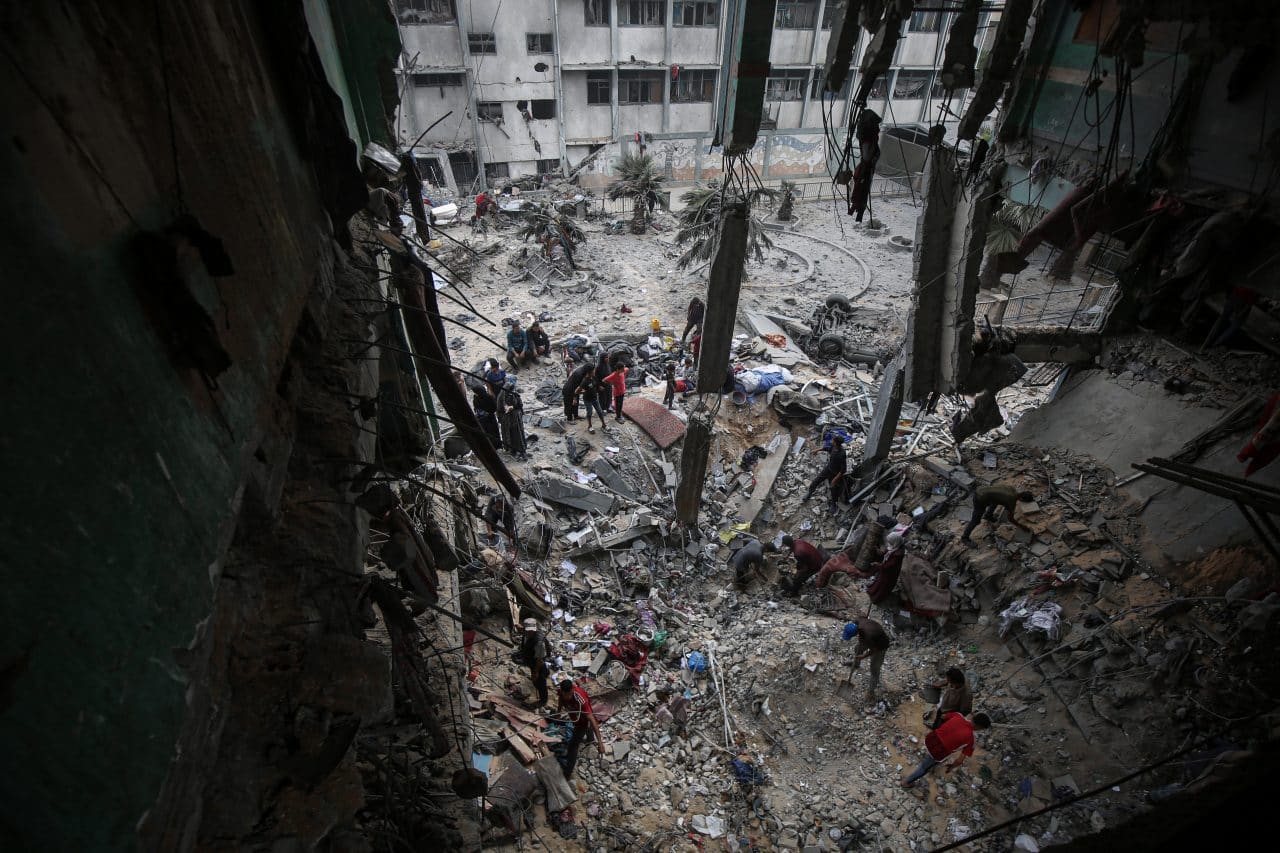
Above photo: Palestinians inspect the destruction of the al-Falah school in Gaza City’s Zaytoun neighborhood, June 30, 2025. Omar Ashtawy/APA Images.
The Israeli army is using airstrikes, rigged explosive APCs, and bulldozing operations to level neighborhoods and displacement centers in Gaza City.
Eyewitnesses and local officials say it is to cause mass flight and prevent residents from returning.
Ahead of its planned full-scale invasion of Gaza City, the Israeli army is causing widespread destruction in the Strip’s largest urban center, forcing residents to evacuate ahead of its publicly declared start date: October 7.
Recent reports from eyewitnesses and the Gaza Civil Defense show that the Israeli army has been using retrofitted armored personnel carriers (APCs) that are sent into dense population centers, including neighborhoods and displacement centers, before they are remotely detonated.
The attacks continue alongside an extensive bulldozing operation in the city and constant aerial bombardment. Between August 12 and August 18, the Israeli army destroyed over 400 buildings in the Zaytoun neighborhood and launched a limited ground incursion at its edges. The army also launched a similar operation in the Sabra neighborhood, west of Gaza City.
Civil Defense spokesperson Mahmoud Basal told Mondoweiss that the Israeli army destroyed over 1,500 buildings in Gaza City in aerial strikes alone since August 6, largely in Zaytoun and Sabra.
Basal explained that the Civil Defense continues to receive calls from trapped civilians in the two neighborhoods, but that there is no way to reach them due to heavy shelling and bombardment.
“We’re afraid that the Israeli invasion will get even deeper into Gaza City and that Civil Defense crews will be unable to reach the places they bomb,” Basal added. “Nowhere in Gaza is safe, whether north or south. Bombs chase residents from their homes, from their displacement centers, and even from their tents.”
Abdulwahhab Ismail, a resident of the Saftawi area in northwestern Gaza, evacuated his neighborhood on Tuesday after several buildings on his street were detonated by what he described as explosive “robots.”
“The Israeli army sends the robots near our homes, which stay parked there to terrorize us,” Ismail said. “The army doesn’t detonate them right away, waiting for fear to push us to flee. When people don’t leave, the army detonates the robots, regardless of whether there are civilians in the area.”
The “robots” described by Ismail are likely the Israeli army’s outdated M113 APC models, which have been retrofitted with explosives and remotely detonated near buildings throughout the war. Ismail told Mondoweiss that neither he nor his family had time to take anything from their home due to fears that the APC near them would be detonated.
“Before now, the army used to blow up one or two buildings with the robots. Now they destroy dozens of buildings at once. Robots and warplanes are working together to destroy every place in Gaza City,” he described.
Ismail said that he and his family won’t leave Gaza City — they can’t afford the transportation to move south and get a tent there, and they can’t move on foot either.
“We arrived here in the west of Gaza with nothing,” he said. “We are on the street. We will try to find something to cover our heads with, but we’re staying in Gaza City.”
Unprecedented Destruction
In lieu of a full-scale invasion, the Israeli army is using its combination of airstrikes, rigged APCs, limited incursions, and bulldozing operations to compel residents to flee ahead of the planned ground invasion.
Basal said the army has been carrying out the wide-scale bulldozing of buildings in Gaza City, clearing and flattening entire neighborhoods in a manner similar to other neighborhoods in Gaza City and other parts of Gaza. “It’s a large-scale bulldozing operation that is levelling the Zaytoun and Sabra neighborhoods,” Basal explained. “The army uses bulldozers run and owned by private Israeli contractors.”
But Basal clarified that the explosive APCs are now taking center stage at this point in the Gaza City operation, describing the remote-controlled vehicles as “death robots.”
“As of August 6, the Israeli army has sent up to five robots to different areas inside Gaza City every single day, especially in the al-Zaytoun and al-Saftawi areas,” Basal said, asserting that the APCs’ blast radius is 100 meters, and destroys or severely damages anything within that distance. He confirmed that the Israeli army has not yet fully advanced into the city, but has used the remote vehicles to level buildings and intimidate residents into mass flight.
Basal says this goal is apparent given one of the APCs’ targets: civilian displacement centers. According to Basal, the APCs have been used to destroy every displacement center in the al-Zaytoun neighborhood to prevent people from staying in the area. Basal described the destruction as “unprecedented.”
“The destruction operations in al-Zaytoun suggest something insane and unimaginable,” he explained. “Complete areas were erased and bulldozed. All the schools in the area were destroyed. Not a single school has been left standing in al-Zaytoun. It’s a clear plan to annihilate the area. Over 80 percent of it has already been destroyed.”
“We are talking about over 1,500 buildings destroyed by aerial bombardment alone,” Basal clarified. “The buildings destroyed by robots are not included. We are witnessing something similar to the destruction in the Beit Hanoun area.”
Gaza Residents Reluctant To Flee Under Bombardment
The Israeli army has also continued to drop leaflets and call Gaza residents by phone, urging them to evacuate and promising that “humanitarian” areas are being prepared for evacuees in the south.
Israeli army Arabic spokesperson Avichay Adraee posted a warning to the residents of Gaza City ahead of stage 2 of the operation. “Evacuating Gaza City is inevitable,” Adraee stated. “Every family moving south will receive the maximum humanitarian aid currently being prepared.”
The spokesperson said that the Israeli army was setting up tents and preparing areas for the distribution of humanitarian aid, the construction of water pipelines, and other infrastructure.
But so far, most people evacuating the city do so only when the bombing reaches them, due to the lack of other options, residents report.
“The residents of al-Zaytoun are almost 80,000 people,” Basal said. “Only about 20,000 remain in place. The rest had to leave when the bombing reached them. But all of them left for other parts of Gaza City, mostly to the west.
“One person in a thousand decides to follow Israeli army orders,” Basal said, clarifying that most people have no funds to hire transportation, which costs over $300, while a tent costs over $1,000. “People also have already tried what displacement was like in the south,” Basal added. “They know that there is no safety there. The Israeli army burns people alive inside their tents.”