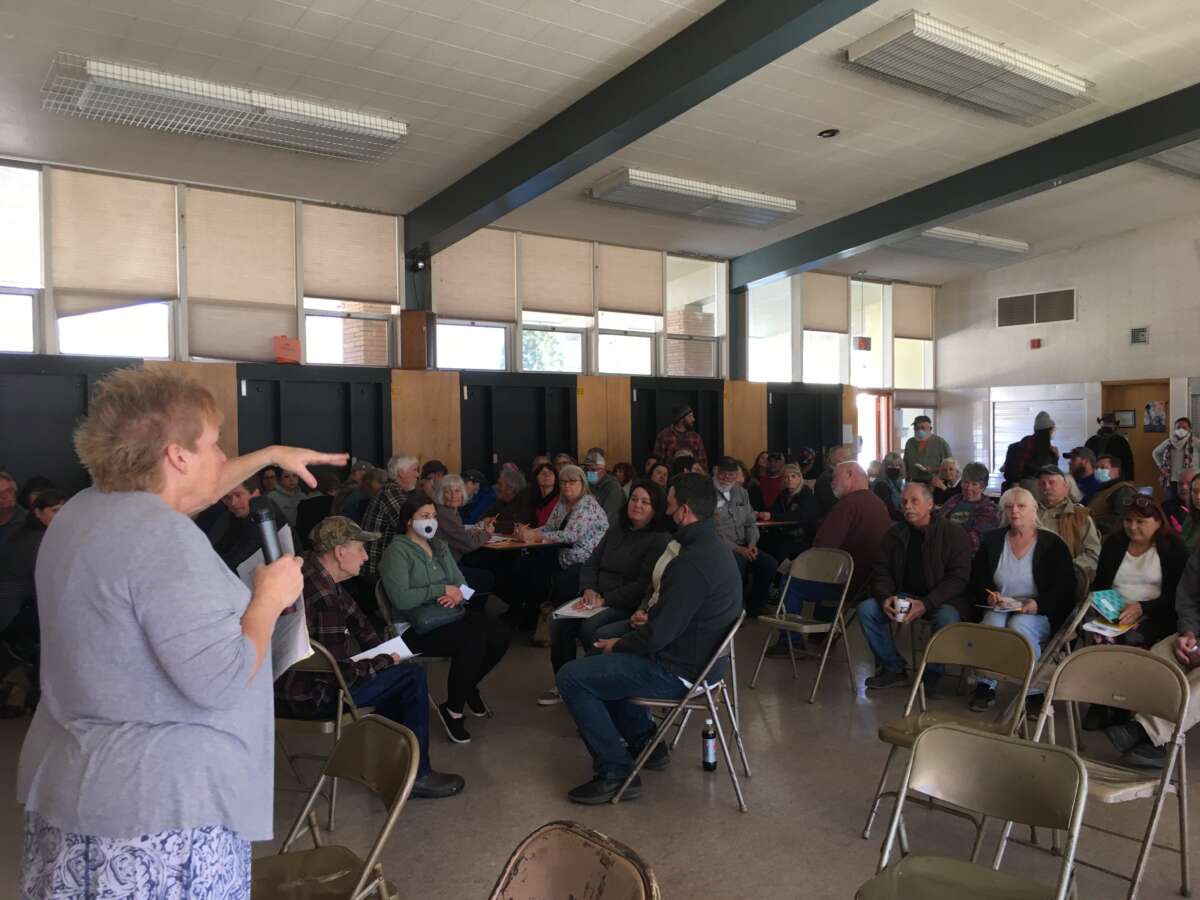
Above photo: Following the Dixie Fire of 2021, the Indian Valley Collective meets for its monthly meeting in the cafeteria of Greenville Elementary School — one of the few buildings in Greenville, California, to survive. Margaret Elysia Garcia.
Faced with abandonment from the state, rural residents built their own fire lines, shelters, and support systems.
If you live in a national forest in California, odds are pretty high that at some point or another you’ve been ordered to evacuate.
In Indian Valley, for the first twelve days, many of our residents did indeed evacuate, but a significant number stayed behind. Some residents had livestock to look after and often no solid indication of where they could take their animals that wouldn’t also need to be evacuated soon. With so many towns evacuating at once, some didn’t want to stay in evacuation shelters where the lights would be on all day and night and the likelihood of catching COVID was high. Some people had family or friends to stay with outside of the county and took advantage of that. But for people whose entire families were in the valley, those who never leave their small rural communities, the prospect of evacuation was daunting — and expensive and feeling impossible.
The Town That Said No
One Indian Valley community stands out in its defiance of evacuation: Taylorsville. The tiny town has roughly 150 people, comprising hippie artists, conservative ranchers, and a smattering of people in between, and is known for its independent spirit. The Taylorsville Tavern sports a giant mural of the State of Jefferson flag on one of its walls. It’s been no stranger to fires in the past and bears a considerable scar on the hill right above the downtown from several years ago when many thought the center of town would go up.
Not everyone remained, but a sizable number of people young and old alike stayed, long after PG&E cut power. The population stayed after their generators ran out of fuel, and those who stayed did so with a communal spirit. The woman who once owned a pie shop made sandwiches for whomever was left in town; she fed the volunteer firefighters and anyone fighting the fires. The non-evacuation grew increasingly troublesome.
Taylorsville residents watched the fire clouds over Greenville where it was burning seven miles away. They knew what could happen. They watered their roofs and decks. They kept their gardens alive. They cut any remaining dead standing trees. They cleared brush if they had any left. They made their own dozer lines. Ranchers with both water rights and water trucks wet down the town from nearby Wolf Creek. They stuck it out.
This was no easy feat after the fire took Greenville. The National Guard had been called in and blockaded the highway that led into and out of the valley. No one could come in to deliver more supplies; people could always leave, but they could not come back. Most people in Taylorsville waited it out. Some snuck in supplies like bandits on dangerous dirt roads. Much of the defiance seemed to be personified by one main Taylorsville: Dan Kearns. He began a twice daily livestream on his Facebook page disseminating information to whomever followed him.
“This is a disclaimer,” said Dan Kearns at the end of one of his livestream updates. “I’m just a guy. I’m just a volunteer.”
However, he interpreted the daily information releases from the county, the US Forest Service, and other agencies. His increasingly disheveled appearance and beard growing longer by the day seemed to embody what the rest of us were feeling. We’d grown feral. Taking matters into our own hands. His weariness was our weariness, and he seemed to embody what the rest of us were feeling.
As it was very easy to panic, Kearns became the voice of reason, assurance, and calm in the face of adversity, even if his politics sometimes struck people as bizarre.
“Clear, concise, and easily understood information from just a guy,” said Jeanna Van Brocklin on Kearns’s Facebook page, adding that Kearns also spotlighted neighbors feeding evacuees’ pets, restaurants that cooked for those who stayed, and the town’s workers trying to keep the water running.
Toward the end of August, when people still weren’t allowed back and provisions were running low, you could tell that Taylorsville residents might be on the brink of madness from the livestreams and the TV crews allowed in to do stories on the defiant town that didn’t burn.
Adult children returned to Indian Valley from all over Northern California to help out elderly family members and their properties. There were photos on social media of these returning sons and daughters borrowing bulldozers and cutting their own lines above their parents’ and grandparents’ properties. They saturated the wood decks and set their own back burns to alleviate fire risk to specific properties, something official firefighters would not have the time or resources to do. It’s hard to argue that those in Taylorsville should not have stayed put. None of their properties burned down. They saved their town.
In the spring of 2022, when we all had a clearer picture of what was burned and what was coming back, you could see how far down Mount Hough the fire burned and the huge green swath around Taylorsville that owed its life to those volunteers who didn’t leave town. The town was barely holding up, and this defiance saved some houses in nearby North Arm and some places in Genesee Valley. For many of the residents it became hard to argue that evacuation is always the best response to a fire disaster.
Evacuation Into Chaos
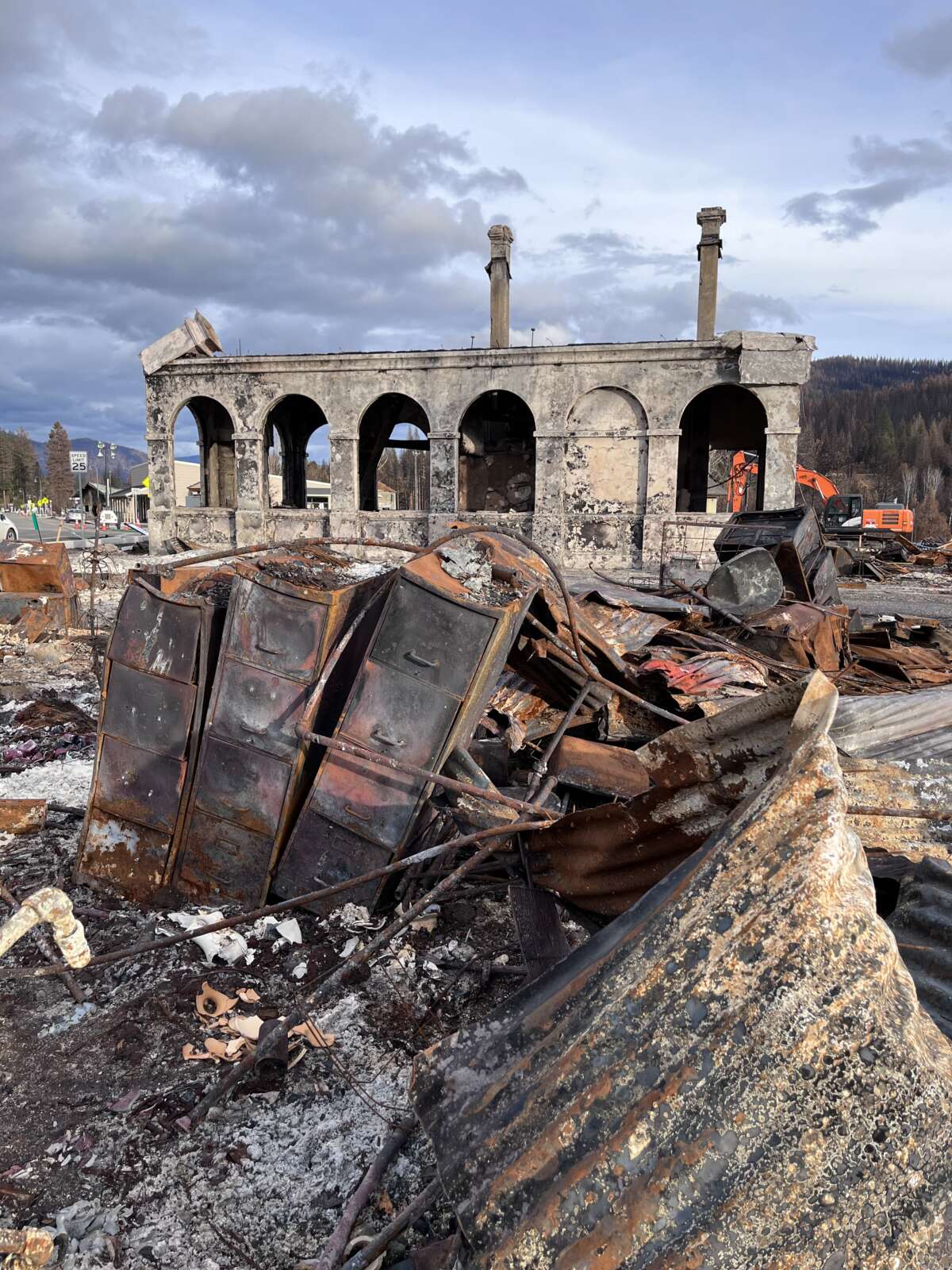
In the aftermath of the Dixie Fire incinerating Greenville, Canyon Dam, and Indian Falls along with the off-the-grid community of Warner Valley, the evacuation was not lifted quickly. News vans descended on the wreckage of the town with press passes to flash at the National Guard, but residents who had left were not allowed back, and those residents became increasingly frustrated. Why were coastal news organizations standing on the bones of the town when we ourselves were not allowed back? It brought an additional sense of hopelessness and loss of control. The governor, Gavin Newsom, visited and declared a disaster, someone from the feds finally declared a federal emergency nearly three weeks into our disaster, when finally enough monetary damage had been done, and the ball began rolling into the chaos of recovery. Still we officially couldn’t come back.
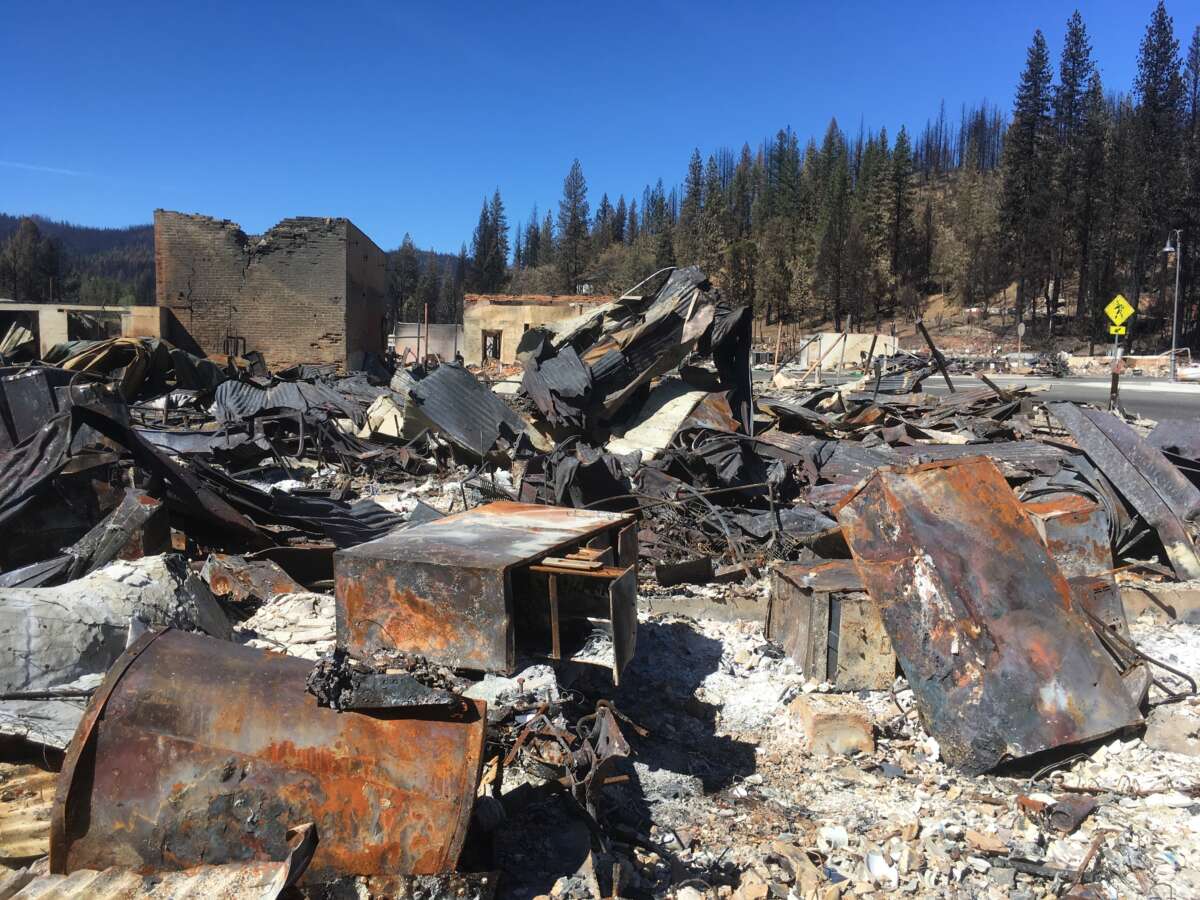
For those of us who still had houses, we had no power yet. For those of us not on our own wells and septic, there was no water. The sewer plant had blown up too. The school year began two weeks late for some, a month late for others, in year two of COVID. The evacuation camps at the fairgrounds and campgrounds were full, and people were catching COVID and getting sick from smoke inhalation.
We were finally on the map now that we were burned out of the map. Our downtown had the highest (worst) air quality index (AQI) levels on the entire planet for a week. We clocked in with an AQI of 851 one day.
Evacuation weighs down the psyche. No one can rest. No one can really make plans. Unsympathetic employers had no sympathy for workers burning through vacation time and sick days. Some were evacuated a total of eight weeks in the Dixie Fire, and at the end of the eight weeks many didn’t have a place to get back to. Eight weeks is a long purgatory.
We slept in our cars. We took house sitting gigs. We crashed endlessly on friends’ couches and couldn’t give them an end date. We camped outside even though it wasn’t safe to do so. We visited our animals still incarcerated in animal shelters and had no place to take them. We took relatives in Southern California up on that offer to visit them. We grazed meals — random bits of whatever was around, fast food. Kids on evacuation started begging for vegetables and never wanted to see a granola bar again. We hoped for some sort of salvation that felt like it would never come. Kids started school in tents, with an internet-based curriculum but no internet access.
No one had made a plan to live like this for so long. Eight weeks of evacuation — a time when none of us could plan or budget out an uncertain future, any future. We stayed glued to information on Twitter. And even though to not evacuate meant the very real possibility of running out of power and water, it seemed in these moments of uncertainty and unrest that camping out in our smoke-damaged homes was a better deal than whatever this was. To live like this is exhausting, and to be checking back online to see if our house was one with an X on a Google Earth map — meaning gone, or a check mark — meaning saved, was its own horrendous punishment during evacuation.
Evacuation as Community Event
My mother, a recent widow who has owned her own homes since the early 1990s and had no idea how much going rents were in California, let alone how much a motel would cost for evacuation, told me before the Dixie Fire that she didn’t want to live in the mountains by herself anymore. The winters were hard on her, and the summer fire season was increasingly uneasy. Where could she go and pay $800 a month for a small unit on one floor in California? I searched on Zillow. That will get you a studio apartment in Turlock with nothing included. Motels and hotels begin at $100 a night easy up here. She stayed the remainder of evacuation in Sierraville in an old dilapidated Victorian house full of women who took turns cooking, laundering, and doing other duties while they enjoyed conversations together and read books.
It’s in this context that property owner Leslie Wehrman opened up her heart to offer thirty-seven people (along with nine dogs, five cats, eight goats, fourteen chickens, and one goldfish) refuge from the fire on her five-acre parcel between the towns of Portola and Graeagle (eleven miles apart), safe space during evacuation.
“Emergency cohabitation with virtual strangers experiencing deep stress and the trauma of loss over a seven-week period was hands down one of the most influential time periods in my life,” wrote Wehrman in a story for the Feather River Co-op Newsletter. Each evacuee took on a different job in the makeshift commune — from tending the barn of evacuee animals to harvesting and tending the garden, and doing laundry.
Michelle Fulton and her wife Lovely Hatzell of FulHat Farm in Meadow Valley were two of the fire refugees Wehrman took in during what Fulton called “an opportunity for community fellowship.” Together with their goats and cat and dogs they took refuge at Wehrman’s, though their chickens stayed behind on the farm and were tended to by a neighbor who did not evacuate. Fulton became the barn boss, while Hatzell became the camp chef. Each evacuee took up the role best suited to them. The feeling, the atmosphere the makeshift commune created — all things and personalities taken into account — was calm, slowed down and focused on meeting basic needs and functions. Evacuees didn’t try to retain their usual everyday lives. They tried instead to maintain a safe haven for all. According to Fulton, one person eventually left and another person who was a bit high-strung in the first place “freaked out,” but by and large they created seven weeks of harmonious living.
“We had fun,” said Fulton. “We shared meals. We played games. We had a good time in the middle of all of this.” She likened it to a camping trip — if you could get your mind and anxiety into that space instead of one of looming dread and waiting for more bad news to strike.
Perhaps that’s what the model for evacuation should be. Like packing go-bags or knowing where the exits are beforehand, what if we had a plan for evacuation that encompassed who we wanted to evacuate with? What if we assessed beforehand what we would have to offer a group in this situation? Seeing evacuation as an opportunity for community might be what saves us all or at least lessons the anxiety and stress of feeling like one is all alone against the fire, every fire.
After Evacuation
As evacuations were beginning to come to a close and residents of evacuated rural mountain hamlets were slowly allowed to return, I got an invitation to join a group on Facebook. It was a group of neighbors around my mother’s house. I joined immediately. Nowadays, though my mother and other retiree neighbors have left the state for cheaper and less fiery pastures, the bulk of us remain.
We now act like neighbors should have acted in the first place. From my office at the local newspaper, I begged the sheriff to let us back when the neighboring area was back, pointing out that we were on the same power grid, not on Greenville’s grid. We ganged up on Waste Management together when it kept charging us but didn’t pick up our trash for weeks on end. We shamed the postal service into restarting service in our area. We let each other know when we saw a bear or mountain lion on our game cameras. We watched each other’s property since post-fire break-ins began when the sheriff ’s department was stretched too thin to do proper patrols. We complained en masse to Frontier Communications and PG&E for their lackluster delivery of services — as monopolies, they are not prone to put a high priority on customer service. Post-evacuation, we’ve learned a good deal about ourselves. Our humanity came back to us. Our strength was forged in fire.
We are slowly recovering financially. There’s no relief coming for those who had to max out their credit cards. For my part, I wish the toll of evacuation was taken more seriously by those around us. Could school administrators and teachers be more empathetic to students whose houses burn, who are not living anywhere stable for the first few weeks of the school year in evacuation? Could landlords, creditors, and employers be more empathetic? Can we all acknowledge that evacuation is a strange planet that evacuees visit physically but not mentally? That it might exist in its own time and space altogether. How do you keep living your normal existence when things are anything but normal?
The answer to the last question may be a single word: “community.”
This article is an excerpt adapted from Red Flag Warning: Mutual Aid and Survival in California’s Fire Country, by Margaret Elysia Garcia. Published by AK Press.