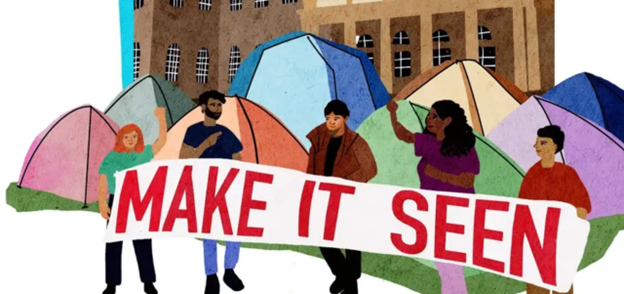
Above image: Rosie Davila.
The Campaign Nonviolence 2025 calls-to-action engage people in powerful interventions to the violence we see in our world right now.
For 12 years, Campaign Nonviolence has worked with tens of thousands of people to build a culture of active nonviolence. Looking at the devastating violence in our world — from racism to war to poverty to the climate crisis — we asked people to join us in engaging the transformative power of nonviolence in our lives, communities and society.
Thousands of groups joined in. Over the years, they’ve marched against gun violence. Created zones of peace in violence-prone areas. Shut down military bases. Trained thousands of students in anti-bullying practices. Held racial healing circles. Distributed tens of thousands of meals in mutual aid. Pressured banks to divest from fossil fuels and weapons. And so much more.
This year, the cry for change seems more urgent than ever. Rising authoritarianism. Funding cuts to public services and international aid. Mass deportations. Genocide. Climate disasters. Slashes to health care, gun violence prevention programs, suicide hotlines. Persecution of student activists. Crackdowns on protests.
What can nonviolence do at a time like this? A lot.
Nonviolence has a millennia-long history and offers serious remedies and responses for what we face today. As we gear up for Campaign Nonviolence Action Days, from Sept. 21 through Oct. 2, 2025, it’s evident that ours is a world yearning desperately for the strategies, tactics and solutions that come in the nonviolence toolbox.
The theme for Campaign Nonviolence 2025 is practicing nonviolence toward self, others, world and earth. Simple as that sounds, it is a clarion call for a radically different world. Our calls-to-action in 2025 are designed to engage people in powerful interventions to the violence we see in our world right now. Let’s explore how they relate to our current crisis.
Nonviolence toward self: self care keeps you going
Burnout. Health issues. Exhaustion. Despair. Overwhelm. These are intensely stressful and painful times for everyone who is working for change — or simply trying to pay attention to what’s going on. But we can be intentional about practicing nonviolence toward self in the form of something known as self care.
Self care is more than just a spa day. It’s an act of intentional resistance to a culture that expects you to harm yourself by not getting enough sleep, healthy food, exercise, breaks and time with the things that nourish your heart and soul. It’s a humble acknowledgment that if we want to be here for the movement, the community or even just our family, we also need to take care of ourselves.
During Campaign Nonviolence Action Days, Sept. 21-Oct. 2, we’re inviting everyone to make a date for some self care. It might not be the whole day — some people are signing up to simply practice stretch breaks every hour during their desk work. Others are trying out a new fitness routine, yoga, or tai chi with efforts like World Wellness Weekend. Whether it’s cooking your favorite meal or taking a long walk, there are countless ways to carve out a little time to take care of yourself and replenish your well for the next round of the unrelenting struggle. Learn more in our toolkit.
Remember: self care is good for us, but it’s also good for everyone around us. Cultivating greater focus, resilience, stamina and health ripples out into how we respond to crisis. It also impacts how we deal with conflicts — and from the personal to the political, our world is full of them.
Nonviolence toward others: protect the vulnerable
From marshals at protests to violence interrupters in the streets to peace teams in hot conflict zones, nonviolence is a field that has tools and skills for stopping violence before it breaks out, and de-escalating it when it kicks off. Whether we’re concerned about counter protesters, harassment of LGBTQ+ community members, ICE raids or other kinds of person-to-person violence, there are ways that individuals or small groups of people can make a big difference.
As part of Campaign Nonviolence’s call to practice nonviolence toward others, we’ve put together a toolkit of resources for forming a community safety team. Created with support from groups like Nonviolent Peaceforce, Cure Violence, DC Peace Team, Meta Peace Team and Portland Peace Team, the goal is to introduce how we can prepare our friends and neighbors to respond effectively to a range of potential situations.
We’re encouraging individuals and groups to learn about bystander intervention, de-escalation, situational awareness, and other peace team skills. Then, work with people in your community to expand collective capacity to offer nonviolent security in a form that makes sense in your local area. You can use these skills during Campaign Nonviolence Action Days, and you’ll find that they can serve your community over and over again throughout the year. Learn more here.
Nonviolence toward world: make it seen
Visibility actions are how we make our issue seen. From the massive protests for No Kings to the picket lines outside dealerships during Tesla Takedown, visibility actions are everywhere. They’re a staple of the nonviolent toolbox. They help us sound the alarm. They lift up solutions. They call out the problems. With street demonstrations, banner drops, street theater, rallies, vigils, posters and more, visibility actions are a versatile toolbox that you can use to take action where your passion lies.
During Campaign Nonviolence Action Days, we’re welcoming local organizers and social justice campaigns to participate in holding visibility actions for their cause. These actions are also one of the common ways that new people start taking nonviolent action, so it’s a good way to expand the culture of active nonviolence. One of the most effective tactics you can use are overpass banner actions. These simple, adaptable demonstrations are taking place in dozens of cities every single week. In an hour or two, you can reach tens of thousands of commuters with your message. Our partners at Backbone Campaign offer trainings, banner kits and more.
Sample messages for urgent issues:
- Stop the Billionaire Takeover
- Democracy, Not Dictatorship
- #NoKings
- #MeltICE or #AbolishICE
- SOS — Save Our Services
- Let Gaza Live
How will you make your message heard? Explore our toolkit on visibility actions.
Nonviolence toward Earth: move the money
With climate denialism being the official policy of the current administration, it’s more critical than ever to put pressure on other sectors of society. There is one sector that can put an end to the climate crisis: the banks and insurance companies. It’s time to move the money out of fossil fuels — and while we’re at it, weapons and militarism, too.
In the past year alone, the United States has experienced the catastrophic impacts of Hurricane Helene, the Palisades Fire in Los Angeles and the deadly flashfloods in Texas. During Campaign Nonviolence Action Days, we’re helping people take strategic action on climate by demanding that banks, insurance companies, pensions and endowments move their money out of destructive industries.
The U.S. government wants to ignore the climate crisis, but we know we can’t afford to. It’s time to move the money. Learn more in our toolkit.
International Day of Peace and International Day of Nonviolence
Campaign Nonviolence Action Days is bookended by the International Day of Peace on Sept. 21 and the International Day of Nonviolence on Oct 2. To honor these days, we invite people to engage in these two specific actions:
International Day of Peace — Love Peace? Stop War.
International Day of Peace on Sept. 21 will be commemorated by cities and towns across the U.S. and around the world. From classroom activities to candlelight vigils, many groups and organizations hold events for peace.
But sometimes, it seems like these feel-good peace events forget that ending war and militarism are essential ingredients for the commonly-held longing for peace. Naming and opposing the horrors of current wars is required if our Peace Day celebrations are to be meaningful. From Gaza to Ukraine to Iran, there’s plenty of tough topics to broach.
During Campaign Nonviolence Action Days, we urge peace activists to do leafleting actions at Peace Day events, making the connection between our love of peace and the commitment to stopping war. Since many activists have additional actions planned that week, this is also a good time to hand out fliers and recruit people to join antiwar and anti-militarism actions.
In addition, with the National Guard still occupying Los Angeles and militarized, armed ICE agents snatching people off the streets, this is also a time to speak out against the militarism that is being used to target immigrants for arrest, detention and deportation. Other issues that can be raised include: the deployment of Marines to Los Angeles in violation of the Constitution, About Face’s effort to encourage active duty soldiers to refuse to obey unjust orders, and how there always seems to be money to send weapons to commit genocide, but no money for health care or food for the most vulnerable in the U.S.
Want tools and tips for these actions? Check out our toolkit.
International Day of Nonviolence — Creative teach-ins on nonviolent history
Oct. 2 is the birthday of Mahatma Gandhi and is commemorated as the International Day of Nonviolence. Research has shown that nonviolent action is the most effective way for citizens to achieve democracy and independence. It has been used for over 2,000 years to win human rights, equality, fair wages, social change and environmental protections.
In these times of crisis, the power of nonviolent action is a survival skill for humanity. On International Day of Nonviolence, we encourage educators, parents, elders, youth groups, activists, faith communities and more to use our free, downloadable teaching tool: the Nonviolent History Coloring Pages!
With accompanying study guides and discussion questions, each coloring page illuminates another powerful campaign — many of which are perfect for talking about today’s issues.
Want to get rid of a dictator? Teach the story of how the Women of Liberia Mass Action For Peace stopped a civil war, ousted a dictator and won democracy. Or how the People Power Revolution in the Philippines also achieved those three goals.
Frustrated about DEI rollbacks? Teach DEI through the Birmingham Children’s March or the Capitol Crawl for the Americans with Disabilities Act.
Furious about logging on public lands? Teach the origins of the term ‘treehugger’ in the Chipko Movement and the Bishnois Forest Protectors in India.
Want to open up conversations about deportations and round-ups? Use the Rescue of Danish Jews for a way to draw parallels across history. Or explore the Delano Grape Strike for farm worker justice. Or stay tuned, because we will soon be releasing a new page on Casa de Castelar and Los Angeles’ efforts in the late 1800s to welcome immigrants with mutual aid and support.
Find all the Nonviolent History Coloring Pages here and explore other creative teach-ins with the resources in our toolkit.
Campaign Nonviolence Action Days has something for everyone
These are serious times where we face rising authoritarianism, genocide, a catastrophic climate crisis, dismantling of public services and the social safety net, widening economic hardship, mass deportations, increasing hate crimes and harassment and more.
Nonviolence is a broad toolbox that encompasses direct actions, protest, mutual aid, healing work, conflict skills and countless other practices, tools and skills. During the Campaign Nonviolence Action Days, Sept. 21-Oct. 2, 2025, we urge individuals, community groups, nonprofits and nationwide campaigns to join us in exploring what nonviolence has to offer us in these challenging times.