Capitalism’s focus on profit poisons our food, our planet, and our class.
From knowingly unhealthy products to deadly working conditions.
In a moment of breathtaking — and allegedly accidental — candor, a Campbell’s Soup executive was recently caught on tape letting the truth slip. “We have sh*t for f*cking poor people,” allegedly declared Campbell’s Vice President Martin Bally, before admitting he barely eats the company’s products himself because they’re “not healthy” and contain “bioengineered meat.” Now, it’s reported, the company has decided to “dismiss” (aka fire) the VP for his comments in an effort to save face.
The same company that sells us nostalgic, heartwarming commercials featuring sweet old snowmen is, in the boardroom, run by people who openly acknowledge they peddle often unhealthy foods to the working class and poor.
Is anyone surprised? Of course not. This is not an aberration; it’s the inevitable consequence of a system in which corporate profit is always put ahead of public welfare.
This news is only a behind-the-scenes admission of what the capitalist food system is engineered to do: produce cheap, unhealthy, environmentally destructive — yet often highly profitable — food for a majority of the population. Globally, and perhaps most egregiously in the United States, governments prop up this system with tax breaks and subsidies, ensuring that the real costs are externalized onto our health, our labor, and our planet. The designed crisis has been exposed through long accounts by films like Food, Inc. and scholars like Vandana Shiva.
A System Built On Exploitation And Poison
The consequences of this system are an ongoing list of horrors. According to a powerful report by the Freedom Food Alliance, which we encourage readers to consult, the reality is stark.
In America, meat and poultry processing represents one of the most hazardous occupations for workers, whose injury rates are more than twice the national average. They are subjected to sharp machinery and repetitive strain injuries, inhaling toxic chemicals such as ammonia and hydrogen sulfide that create grave long-term respiratory problems. And this is to say nothing of the psychological toll of laboring in an environment of industrialized suffering and slaughter of living beings.
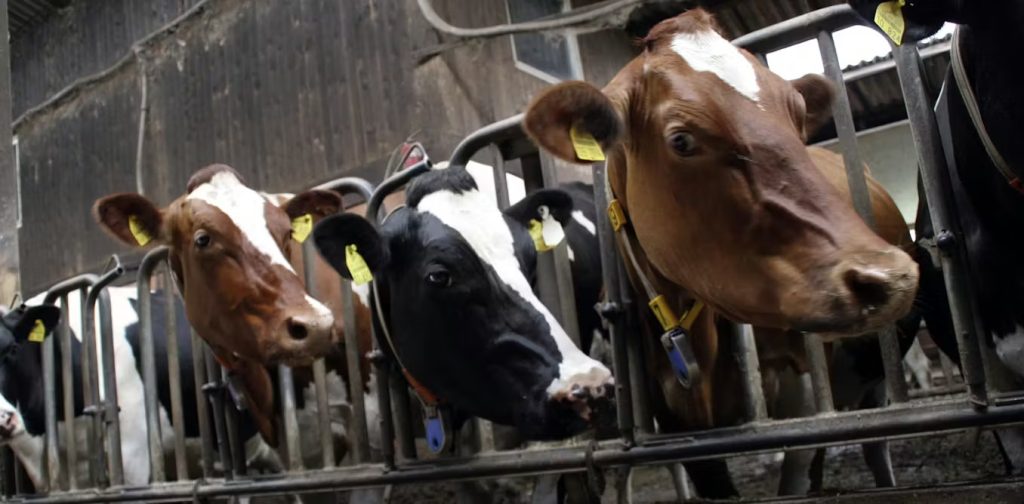
For the environment, factory farming is a disaster. These operations generate waste equivalent to 13 times the sewage of the whole U.S. human population. This is all stored in open lagoons or sprayed onto fields-both methods highly contaminating water and air. Communities nearby Concentrated Animal Feeding Operations (CAFO), a sanitized term for these disgusting factory farms, report elevated rates of asthma, gastrointestinal illnesses, and depression linked to the overpowering fumes they emit.
For public health, it’s a ticking time bomb. Since 1940, half of all new zoonotic diseases, including H1N1 and mad cow disease, have come from animal agriculture. To stave off the infection-prone conditions of factory farming, 75% of the world’s antibiotics are given to livestock, fueling the rise of antibiotic-resistant superbugs that already kill 1.27 million people annually and are projected to become the leading global cause of death by 2050.
The Myth Of “Feeding The World”
But the capitalists and their politicians cry, “We need factory farming and industrialized agriculture to “feed the world”!
But this, too, is a capitalist lie. Far from solving hunger, the industrial monoculture model at the heart of factory farming actively exacerbates it. As Vandana Shiva has noted, “industrial agriculture accounts for only 28% of the world’s food production, [but] it is using up 75% of the world’s resources.” Capitalists constantly frame the system as more “efficient,” but here too we see a system of staggering inefficiency. Industrial agriculture’s reliance on vast single crops like corn and soy — a large portion of the global harvest dedicated to livestock feed — causes varying levels of environmental destruction. Industrial agriculture under capitalism “pollutes the environment by increasing the use of inputs, accelerating soil erosion, polluting water resources, raising carbon level in the atmosphere, and decreasing biodiversity.” This model then often drives deforestation to clear land for more monocultures or cattle, further damaging biodiversity and fueling climate change.
This same system of capitalized foods incentivizes certain crop monocultures such as corn because they can then be manipulated into numerous substances from high-fructose corn syrup to other sweeteners, thus adulterating the food supply. These substances can then cause various types of metabolic diseases and literally be addictive themselves.
And besides destroying the environment and destroying the physical health of consumers, this system also binds farmers, especially in the Global South, into cycles of debt pushing them to adopt farming various GMO monocultures. As Vandana Shiva has covered, this debt trap has forced Indian farmers to commit suicide with the same pesticides that were supposed to bring them success. Today suicides plague Michigan farmers as they and their families are hurt by many of the same processes Indian farmers face.
Meanwhile, of the food that is produced, artificial scarcity is maintained to uphold profit margins as studies show “About 30 percent of food in American grocery stores is thrown away. US retail stores generate about 16 billion pounds of food waste every year.” According to the USDA, food waste is estimated to be around 30-40 percent of the food supply in the U.S., and quite literally billions of pounds of food are discarded yearly. Much of this is food that could be eaten if given away to those who wanted it but instead is thrown out if it’s not bought. For-profit companies would rather throw away food than give it to those who need it under capitalism.
The Working Class Has The Answer
As we discuss this system, Karl Marx identified the root of this problem long before the advent of factory farming. In the Economic and Philosophic Manuscripts of 1844 Marx wrote that, under the domination of private property, money “has robbed the whole world — both the world of men and nature — of its specific value. The view of nature attained under the domination of private property and money is a real contempt for, and practical debasement of, nature.”
This debasement is personified in the contempt of the Campbell’s executive for his own customers; to him, working people are not human beings to be nourished but a market for “sh*t” to be peddled.
So we have to ask ourselves: if the working class were in control of the food system, would that be how it was organized? Would we design workplaces to maim our bodies, food to make us sick, and an economic model to hurtle us toward climate collapse and pandemic? Obviously not.
A workers’ food system would be organized around human need, not corporate greed. It would prioritize health, sustainability, and the dignity of labor. It would dismantle the factory farming model and develop ecologically sound, democratically controlled methods of production.
The leaked tape from Campbell’s is more than a corporate scandal; it’s an indictment of an entire system. It confirms that the capitalist class knows the poison it is selling. It is about time we eliminated this system of capitalism altogether from the earth and built a new one, from the ground up.