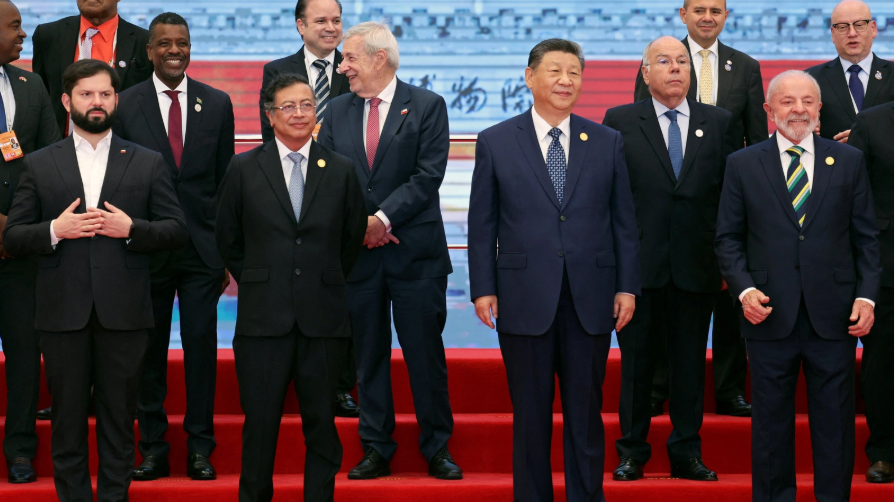
Above photo: Chinese leader Xi Jinping, Brazilian President Luiz Inacio Lula da Silva, Chilean President Gabriel Boric, and Colombian President Gustavo Petro attend a group photo session before the opening ceremony for the China-CELAC Forum ministerial meeting. Reuters/Florence Lo/Pool.
The people have their say.
As if by fate and unplanned twists of history, at the very moment that Trump was threatening Latin America and the Caribbean (LAC) and Marco Rubio was making clear his conviction that the Western Hemisphere is Washington’s property, thus reviving the Monroe Doctrine and its Trump corollary for the 21st century, the government of the People’s Republic of China released its third document on its foreign policy toward the region.
In 2008, the Chinese government published the first Document on China’s Policy Toward Latin America and the Caribbean, in which it set out the objective of establishing a China-LAC Comprehensive Cooperation Partnership based on equality, mutual benefit and joint development.
In 2014, the leaders of China and LAC held a meeting in Brasilia, Brazil, where they jointly determined the positioning of China-LAC relations. This led to the creation in January 2015 of the China-CELAC Forum (CCF) as a multilateral cooperation mechanism comprising 33 states to serve as the main platform for promoting political dialogue, economic collaboration and cultural exchanges between China and the countries of the region. [CELAC stands for Community of Latin American and Caribbean States.]
100+ initiatives
Under the auspices of the CCF, more than 100 initiatives have been carried out, covering various sectors such as agricultural production, scientific and technological innovation, poverty reduction, sustainable development, defense collaboration, the fight against corruption and law enforcement.
In addition, various platforms have been established, such as the China-Latin America Centers for Sustainable Food Innovation, Technology Transfer and News Exchange, the China-Latin America Cooperation Fund and the China-Latin America Special Infrastructure Loan. Likewise, various development financing options have been offered to Latin American and Caribbean nations.
In 2016, the Chinese government published the second Document on China’s Policy toward Latin America and the Caribbean, in which it stated that China would dedicate itself to building a new configuration of relations with LAC based on the “five in one” proposal, in order to take relations to a new height.
Now, as 2025 draws to a close, China-LAC relations have entered a new stage characterized by equality, mutual benefit, innovation, openness and well-being for the peoples, setting a benchmark for South-South cooperation.
A shared future
China and LAC have become a community with a shared future that moves forward hand in hand and enjoys equitable treatment, mutual benefits and shared gains through robust momentum, openness and inclusiveness as a vision based on quality and the well-being of peoples as a fundamental objective, thus boasting vigorous dynamism and broad prospects for development.
From China’s perspective, unprecedented changes in the world over the last 100 years, which are also evolving at an accelerated pace, have led to profound adjustments in the international balance of power. With its robust growth, the Global South is playing an increasingly important role in the cause of human progress.
However, as the global economy lacks the driving force for its growth, conflicts and partial turmoil arise frequently and unilateral actions are undermining international peace and security. Human society faces unprecedented challenges.
For its part, China has already completed the construction of a moderately prosperous society and by 2020 had achieved the goal set for the first centenary. Now, it intends to comprehensively promote the construction of a great modern socialist country and revitalize the nation through the process of modernization.
As a developing country and member of the Global South, China shares the same aspirations and future as Latin America and the Caribbean and other members of the Global South. In recent years, China’s President Xi Jinping has proposed a series of far-reaching initiatives and measures to strengthen relations and cooperation in various areas between China and LAC, giving a new connotation — in keeping with our times — to Sino-Latin American and Caribbean ties.
In this context, the Chinese government, in publishing the third Document on China’s Policy Toward Latin America and the Caribbean, aims to summarize experiences looking toward the future and comprehensively outline China’s policy toward Latin America and the Caribbean, in order to take relations and cooperation in various fields to a new height.
The third document, structured in five programs, covers almost all possible areas of international cooperation in the pursuit of mutual benefits for both parties. A brief look at the programs and areas of cooperation shows that they are grouped as follows:
- Solidarity Program
- Conduct high-level exchanges.
- Generate mutual support on respective vital interests and core concerns.
- Create and deepen intergovernmental dialog and consultation mechanisms.
- Conduct exchanges between legislative bodies and political parties.
- Implement the Global Governance Initiative (GGI) developed by China.
- Promote reform of the global economic governance system.
- Establish China-LAC cooperation mechanisms and trilateral cooperation.
- Development Program
- Implement the Global Development Initiative (GDI).
- Jointly build the high-quality Belt and Road Initiative.
- Establish cooperation in trade and investment, finance, taxation, energy and resources, infrastructure, manufacturing, agriculture, space, maritime affairs, between chambers and institutions promoting trade and investment, market regulation, environmental protection, climate change response and natural disaster reduction.
- Establish joint mechanisms for scientific and technological innovation.
- Establish joint mechanisms for customs inspection and quarantine.
- Develop bilateral programs for development assistance.
- Civilization Program
- Implement the Global Civilization Initiative (GCI).
- Deepen exchanges and mutual learning between Chinese and LAC civilizations.
- Create mechanisms for human resources education and training.
- Develop joint programs for the practice and development of sports.
- Exchange experiences and cooperate in the areas of press, publishing, radio, film and television.
- Promote academic exchange between research institutes and think tanks.
- Peace Program
- Implement the Global Security Initiative (GSI).
- Generate mechanisms for exchange and cooperation in military matters.
- Cooperate in law enforcement and justice, in the fight against corruption and in the repatriation of fugitives and recovery of stolen funds.
- Cooperate and generate mechanisms for assistance in cybersecurity.
- Establish export control mechanisms to prevent the proliferation of nuclear weapons.
- People’s Program
- Establish cooperation in governance and social development, poverty reduction, health, consular affairs and tourism.
- Create mechanisms to promote greater exchange between peoples and at the subnational level.
As has been made clear, China supports the integration process in LAC, attaches great importance to the development of relations with CELAC and is willing to work with LAC in accordance with the principles of respect, equality, plurality, mutual benefit, cooperation, openness, inclusion and non-conditionality, in order to proactively advance cooperation in various areas within the framework of the CCF.
China supports maintaining an action-oriented approach, fully utilizing mechanisms such as the Ministerial Meeting, the Dialogue between Chinese and CELAC Foreign Ministers and the CELAC Quartet, and the Meeting of CCF National Coordinators, making full use of the CCF Cyber Secretariat, which will continuously and properly organize the activities of the subforums in various areas, encouraging all social sectors on both sides to actively participate in them, continuously improve the institutional construction of the CCF, and hold the China-CELAC Summit with the attendance of the leaders of China and CELAC when conditions are more favorable.
Given this evidence, readers can draw their own conclusions about what the United States and China offer Latin America and the Caribbean: facts vs. chimeras, construction vs. death, bilateral cooperation vs. threats. The decision to be made is limited to preparing for an independent and sovereign future or returning to the dark past of domination and subordination. The people have the floor.
The author is a Venezuelan consultant, international analyst, former Director of International Relations of the Presidency of the Bolivarian Republic of Venezuela and former Ambassador of the Bolivarian Republic of Venezuela to Nicaragua. (sergioro07.blogspot.com) Translation by John Catalinotto.