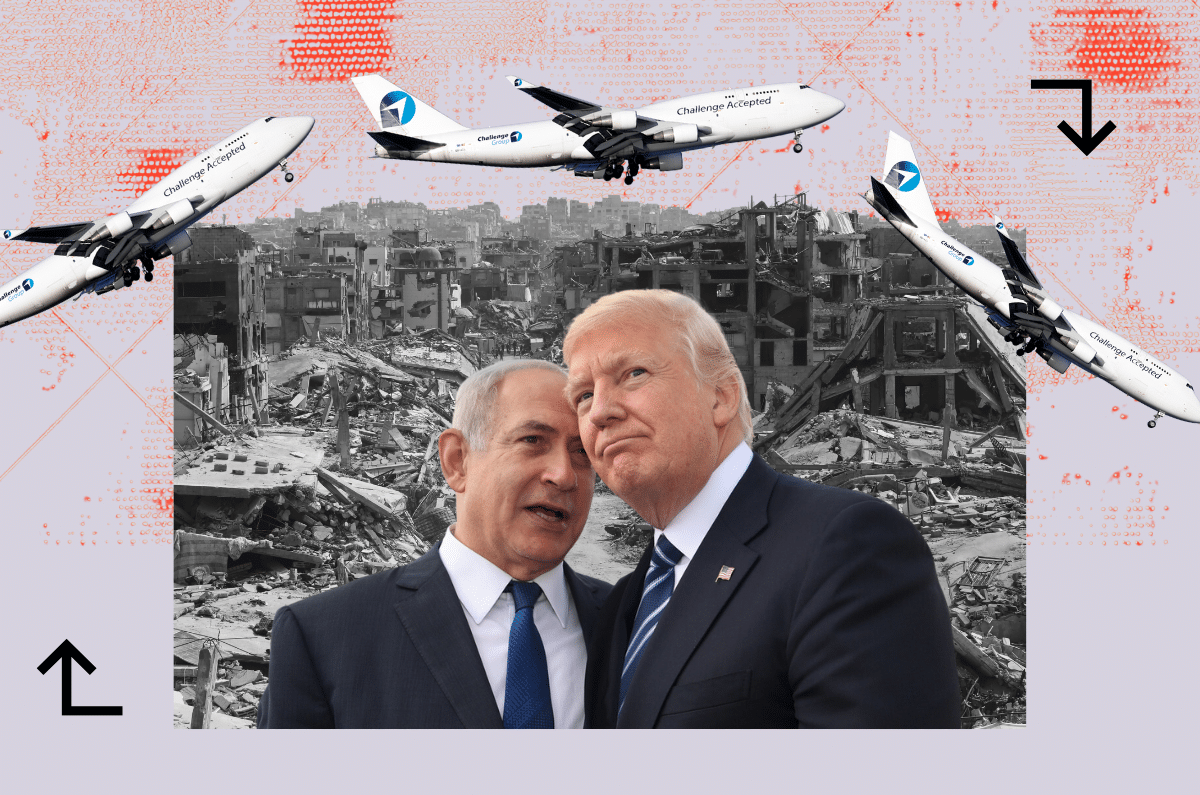
Above photo: Mondoweiss.
Shipping records obtained by Mondoweiss show New York’s JFK Airport is a key transit hub for U.S. weapons parts headed to Israel’s genocide in Gaza.
On July 16, 2025, a Boeing 747 operated by Challenge Airlines lifted off from JFK Airport in New York. The cargo manifest listed a 347-kilogram shipment from Lockheed Martin. Inside was a BRU-68 bomb release unit, a mechanism that allows an F-35 fighter jet to drop 2,000-pound bombs.
The flight’s final stop was Nevatim Air Base in southern Israel, home to the F-35I fleet bombing Gaza.
This was not an isolated transfer. Internal shipping records shared by the Palestinian Youth Movement, and cross-referenced with public flight-tracking data, reveal a steady flow of U.S.-made weapons components moving from New York to Israel. Parts for fighter jets, missile launchers, and ammunition have routinely left JFK on commercial cargo flights while Israel’s air campaign destroys homes, schools, and hospitals.
These shipments started before the current genocide, but have increased greatly since October 7, 2023. They continue now despite mounting evidence of war crimes and calls for an arms embargo. What they reveal is that New York City is a crucial logistical hub in the supply chain arming Israel’s assault.
Between July 2 and July 23, at least six arms shipments from JFK to Israel were verified through waybills, flight data, and internal records provided to Mondoweiss.
These findings add new depth to earlier reporting in The Intercept and The Ditch, showing how JFK Airport has become a critical link in Israel’s military supply chain.
“What these records show is that the genocide in Gaza isn’t only manufactured in Washington—it’s facilitated right here in New York,” said Kaleem Hawa of the Palestinian Youth Movement. “JFK has become a gateway for the weapons that are killing our people.”
These flights and their deadly cargo reveal the logistics networks arming Israel’s genocide in Gaza that, for many in the U.S., is hiding in plain sight.
A Civilian Airport Moving Weapons To Genocide
Challenge Airlines flight ICL982 departs JFK for Tel Aviv on a near-routine schedule, often before sunrise. Cargo bays handle electronics, produce, and mail. Mixed in are crates labeled “aircraft components” or “hazardous materials,” terms that hide their military use.
Among the shipments traced in July were:
- Aircraft structural parts and missile launcher struts from Lockheed Martin
- Fuel selector valves used in Elbit Systems aircraft
- Ammunition link containers for Israel Military Industries
- A BRU-68 ejector unit for the F-35
- Wingtip protective lenses for fighter jets
Each part is essential to the maintenance and repair of larger weapons systems, and they are moved under the cover of civilian logistics.
“Most of us just scan the cargo tags—we’re not told what’s inside,” a JFK cargo worker who asked to remain anonymous told Mondoweiss. “When pallets show up wrapped and labeled ‘confidential’ or ‘secret,’ we know not to ask questions. They bypass normal screening. We just load them.”
A second cargo handler recalled the difference on days when major military shipments arrive. “The pallets are heavier, wrapped tight, and marked with tags you don’t see on normal freight. Security is always hovering nearby. We’re told nothing and only given the signal to load.”
Why JFK? Geography, Logistics, And Loopholes
JFK’s east coast location shortens routes to Europe and the Middle East. Explosives depots along the coast allow rapid transport from factory to plane.
Jack Cinamon of Shadow World Investigations, an international research group that tracks the global arms trade and corruption, who studies U.S.-Israel weapons transfers, points to two reasons JFK is such a strategic node in the supply chain. The first is proximity to suppliers. “Along the East Coast are multiple explosives and ammunition depots,” he explained to Mondoweiss. “Being close to those locations makes JFK much more advantageous.”
Cinamon also says the abundance of established cargo carriers, like Challenge and FedEx, which operate full logistics hubs inside JFK, provides cover for defense contractors.
The airport also stores hazardous and explosive materials, a capability not available everywhere. This combination lets military cargo move in the same space as ordinary freight, hidden by commercial operations.
JFK is not the only American airport feeding the supply lines into Israel’s war machine. Dallas-Fort Worth, Memphis International, and Oakland also serve as key transit points in this network.
The Endpoint: Nevatim Air Base
The end of the line is Nevatim Air Base, carved into the Negev desert southeast of Be’er Sheva. It’s here that Israel stations its fleet of F-35I “Adir” jets, the U.S.-built fighters engineered for precision bombing runs.
Among the cargo routed from New York City are BRU-68 ejector units, the hardware that allows these jets to release heavy munitions. The Pentagon itself places the BRU-68 under “Category VIII – Aircraft and Related Articles” on the U.S. Munitions List, noting its use in deploying precision weapons like the 2,000-pound GBU-31. These ejectors wear down quickly and must be replaced often, making the shipments routine. Alongside them are fuel valves, targeting consoles, and protective lenses—the pieces that keep the F-35Is in the sky and combat-ready.
The path is seamless. Parts are made from a Lockheed Martin assembly line, to a cargo bay at JFK, to the blast craters in Rafah. It is this steady pipeline between New York and Nevatim that enables Israel to sustain its air campaign over Gaza.
Law, Policy, And Complicity
Under the International Traffic in Arms Regulations (ITAR), Israel receives exemptions that speed licensing for some weapons components. The Arms Export Control Act and the Leahy Law bar U.S. assistance to military units committing human rights abuses, yet exports have continued throughout the bombing of Gaza.
Patrick Wilcken, Amnesty International’s head of military, security, and policing work, told Mondoweiss any state transferring arms to Israel “risks complicity in genocide and war crimes” and violates its obligation under the Genocide Convention to prevent genocide. States that knowingly continue transfers, he added, risk “aiding and assisting” in crimes under international law, including war crimes, crimes against humanity, and genocide.
Wilcken noted that Israel’s preferential treatment under U.S. export rules does not override international obligations. “International humanitarian law prohibits all states—including the U.S.—from transferring weapons to a party to an armed conflict where there is a clear risk that doing so would contribute to the commission of war crimes,” he said. Amnesty has long called for a total arms embargo, citing extensive evidence of repeated violations in Gaza.
The risk extends to private industry. “Companies, their executives, and employees risk being accomplices in crimes under international law if the products and services they provide contribute substantively in the commission of those crimes,” Wilcken explained. If they know their cargo will likely be used unlawfully, “they could be found legally liable.”
Amnesty says the threshold for halting arms transfers has already been met. Court challenges in Belgium and the Netherlands have successfully blocked shipments to Israel, even as similar efforts in France and the UK have failed.
In Belgium, regional governments suspended licenses for military goods bound for Israel following legal pressure and public outcry, while in Ireland, parliamentarians have raised questions over flights carrying Israeli explosives through Shannon Airport. Reporting from The Ditch revealed that shipments tied to Israel’s Ministry of Defense were routed through Europe, sparking scrutiny of how states may be complicit in the transfer of arms used in Gaza.
Congressional Oversight
JFK Airport sits within the district of Congress member Gregory Meeks, who, as a ranking member of the House Foreign Affairs Committee, holds one of the key positions in Congress responsible for reviewing and overseeing arms sales. Under the Arms Export Control Act, his committee can delay, question, or block transfers, and Meeks has made use of that authority in the past. In 2021, he sought a temporary pause on a $735 million sale of precision-guided munitions to Israel to allow more time to review, and in 2024, he pressed the State Department for further assurances on a multibillion-dollar package of F-15s. These episodes highlight that he is not only aware of the stakes but is willing, at least in certain cases, to assert the committee’s oversight powers.
At the same time, Meeks has long been supported by pro-Israel advocacy networks, including AIPAC, whose lobbying efforts consistently push for expedited transfers and minimal restrictions on U.S. defense exports to Israel. Meeks has received more than $400,000 from AIPAC as of the most recent federal elections filings. Those ties place him at the center of competing pressures: on one side, his formal role as a gatekeeper tasked with scrutinizing foreign military sales, and on the other, the political influence of a lobby that has made the uninterrupted flow of weapons a top priority.
Mondoweiss contacted Representative Meeks for a comment on the fact that these shipments leave directly from his district through JFK. His office did not respond.
Protest And Suppression
On July 9, protesters gathered outside JFK to stop a shipment of Elbit Systems parts. Authorities responded with a coordinated lock down. The Port Authority, MTA, and NYPD restricted access to all terminals, barring the press from the grounds. Protesters were pushed out of sight.
“We were blocked from every angle,” said a protester who asked to remain anonymous. “Police set up barricades so far back you couldn’t see the cargo area—not the planes, not the loading trucks, nothing. Anyone without a boarding pass was turned away. From where we were pushed, it was impossible to tell if anything was being moved. It felt deliberate.”
“They shut down the public’s right to witness it,” added another organizer.
The flight left on schedule.
Shaniyat Turani-Chowdhury is an investigative reporter from Queens, New York. He received his master’s in International Relations and Certification in Modern Journalism from New York University in 2024. Follow him on Instagram at @__Shaniyat.