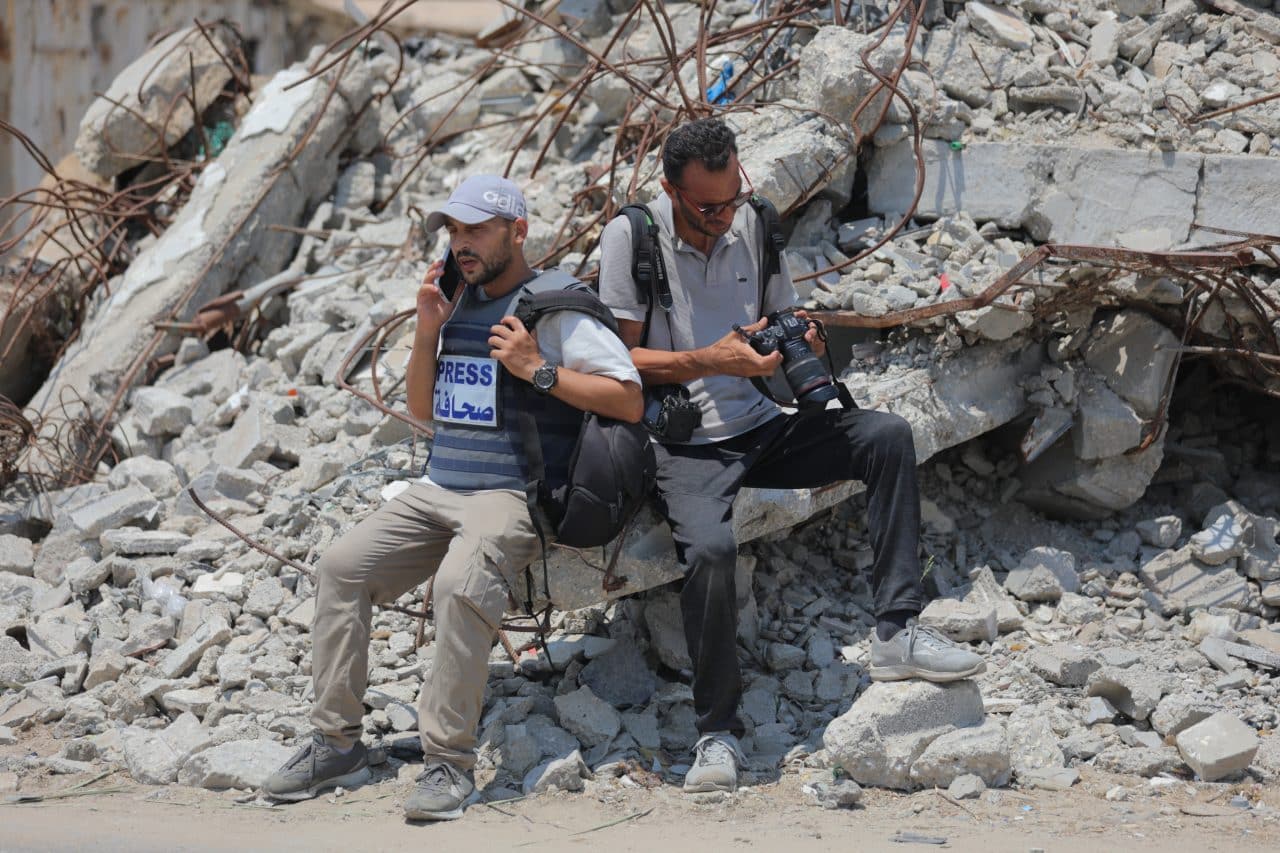
Above photo: Palestinian journalists continue their hunger strike in solidarity with displaced civilians suffering amid famine, July 27, 2025. Ahmed Ibrahim/APA Images.
‘Until The Last Child Is Fed.’
A growing number of journalists and first responders in Gaza are going on hunger strike amidst the famine. “If you want to eat, you have to run after aid trucks. I refuse to do it,” says Mahmoud Basal, the spokesperson for the Gaza Civil Defense.
Wadea Abu Soud, a reporter for Yemen TV in Gaza and father of four, declared his hunger strike on July 20 alongside two of his colleagues. He says his hunger strike is a message to the world about the famine in Gaza, where most families can’t feed their children.
“I am a starving journalist who is attempting to convey the suffering of his starving people,” Abu Soud says.
Abu Soud is one of a growing number of journalists and first responders in Gaza who have declared that they are going on hunger strike in the midst of a famine. Their demand is that all of Gaza’s children must be fed.
“Our voices are reaching the world,” Abu Soud says. “The occupation has failed to launder its lies to the world.”
Abu Soud’s hunger strike has been ongoing for 20 days now. He says he is giving any food he secures for himself to kids on the street. He also feeds his four children, but does not share in the meal with them.
“I will not eat until the youngest child in Gaza is fed,” he added.
On July 29, the UN’s top famine-monitoring agency, the Integrated Food Security Phase Classification (IPC), said that the “worst-case scenario of famine” is now unfolding in Gaza, and that “Famine thresholds have been reached for food consumption” in most of the Strip.
A Different Sort Of Hunger Strike
While Palestinians have engaged in countless hunger strikes throughout the history of their struggle, most of them took place in Israeli prisons. This is the first hunger strike to be launched during a famine.
In late July, the spokesperson for Gaza’s Civil Defense, Mahmoud Basal, declared his own hunger strike.
“I’m looking at the children who starved to death due to the lack of food and malnutrition, and I look to the world for signs of humanity, but it does not exist,” Basal tells Mondoweiss, explaining that this global indifference is what led him to start his hunger strike.
As a Gazan native, Basal suffers from the same shortages as everyone around him. “There is no food in Gaza except scraps,” Basal says. “The food that comes in is exclusive to some people. Thieves who are working with the Israeli army coordinate the looting of aid, and most people are not able to obtain it.”
Israel’s “engineering of chaos” in Gaza has ensured that aid does not reach the people who need it most, choosing which aid convoys are targeted by looters, which reach their destination, which are beset by crowds of starving civilians, and which are shot at by the army when civilians try to grab food off of them.
Basal has been describing these details to the media for months. But despite his constant messaging on the humanitarian situation in Gaza, he says that no one is listening. “That’s why I decided that maybe my body will change something,” he explains.
Basal says his hunger strike is not meaningless or futile but instead conditional. His demands are that food be allowed into Gaza and distributed to the starving population in a safe and humanitarian way, without humiliation or death.
“The way aid enters Gaza, it’s inhumane,” he says. “So many people can’t reach it — the injured, the sick, the elderly. I personally can’t reach it…if you want to eat, you have to run after aid trucks. I refuse to do it. I won’t end my hunger strike unless the world provides food to my people with dignity.”
Basal has not stopped working as the Civil Defense spokesperson throughout his hunger strike, stating that he gets his strength from what he witnesses every day. “When I see a child die from starvation while I’m still alive, it’s a message for me to keep up my hunger strike,” he says. “People talk to me every day and tell me about their struggles. A pregnant woman told me days ago that she lost weight throughout her pregnancy, from 70 kilograms to 50. Other women say they try to feed their infants with water instead of milk.”
Still, Basal’s voice is one of the loudest today. “I want my voice to stay alive because I’m addressing the international community.”
Working around the clock, Basal receives 900 shekels ($266) every three months. With the astronomical rise in prices, this sum can feed his family for one day. “But my children’s lives are not more valuable than those of Gaza’s children.”
“My kids keep telling me to end my hunger strike. They say they don’t want me to die,” Basal says. “But even my own children aren’t the first priority amid all this horror.”
Basal recounts witnessing the death of Muhammad Sawafiri, who starved to death and was transferred to the hospital on July 20. “His image does not leave my head,” he says. “When I looked at his body, I thought that people’s bodies reach this stage of decomposition months after their deaths. Muhammad’s reached it while alive.”
“As long as the situation in Gaza is still unbearable, I will keep up my hunger strike until the last child in Gaza is fed,” Basal says.