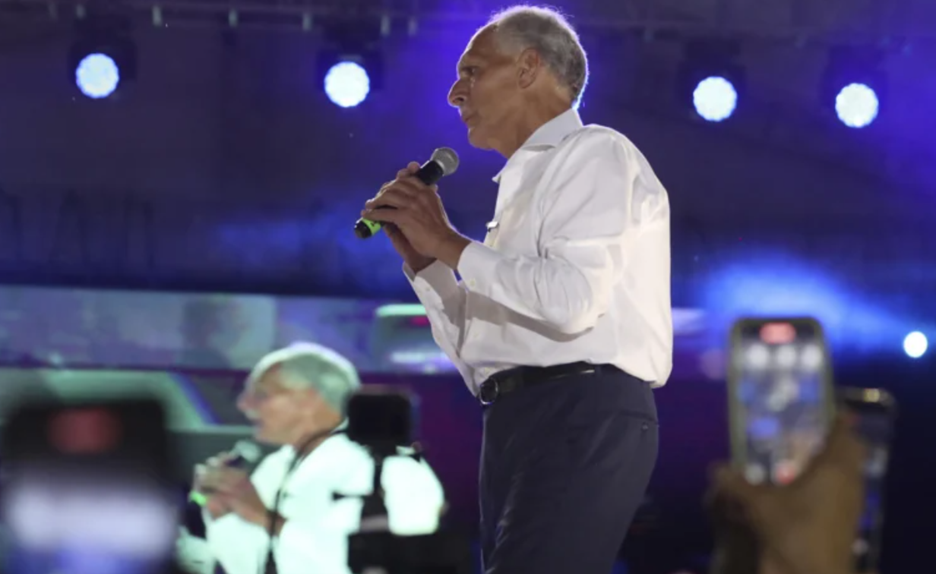
Above photo: Nasry Asfura, declared president-elect of Honduras, addresses supporters on December 24, 2025. EFE.
Ricardo Salgado, the Honduran secretary of Strategic Planning, said that the country suffered a new form of coup d’état following the proclamation of right-wing candidate Nasry Asfura as the president of Honduras by the two CNE councilors who belong to the Honduran bipartisan system: Ana Paola Hall García and Cossette Alejandra López.
On December 24, the two aforementioned CNE officials declared Asfura the winner of the November 30 elections, without completing the special recount or resolving the challenges filed in response to the numerous irregularities reported.
In a statement on Friday, December 25, referring to the grave US interference and external maneuvers that affected the democratic process, Salgado accused US President Donald Trump and fascist forces of implementing “every possible form of fraud” in an “unprecedented psychological and military operation.”
El fascismo, impulsado por la gusanera de Miami y Donald Trump, ha llevado a cabo una operación psicológica y militar sin precedentes en Honduras. La lucha en este país no ha sido contra los partidos de la derecha, ha sido contra el imperio y todas las fuerzas fascistas de habla…
— Ricardo Salgado (@RicSalgadoB) December 25, 2025
“Fascism, driven by the Miami gusanos and Donald Trump, has carried out an unprecedented psychological and military operation in Honduras,” he said, adding that the Honduran left had to contest not against right-wing parties but “against the empire and all fascist forces in the Hispanic world.”
“All existing forms of fraud were applied simultaneously, along with new techniques,” the official stated, arguing that it cannot be considered that the Honduran electorate was convinced by Asfura, given that he “had no campaign” and was dubbed the “silent candidate.”
Salgado downplayed the role of the two councilors on the National Electoral Council, claiming that their participation is insignificant compared to the “imperialist deployment” that affected the peoples of the continent. Even the local oligarchy, he argued, was rendered “insignificant” by the operation.
In addition to Donald Trump’s explicit endorsement of Nasry Asfura ahead of the elections, the US government threatened economic sanctions if its preferred candidate did not win. Meanwhile, millions of text messages were sent to remittance recipients warning of losses if Trump’s candidate did not prevail.
Salgado emphasized the need to “fully analyze what has happened, because a new form of coup d’état is being imposed, and the alleged winner’s lack of resolve to defend the people’s will only reflects that they are complicit and were always part of the plan.”
“If we learn the Honduran lesson well, this could be stopped sooner than anyone may think,” he remarked.
The declaration of Asfura, the candidate publicly endorsed as president by Donald Trump, comes amid serious allegations of irregularities during the vote-counting process, strong foreign interference, and a plot orchestrated before the November 30 elections.
The complaints were presented by Libre and the Liberal Party, as well as by CNE Councilor Marlon Ochoa, who, among other issues, objected to the other two councilors’ refusal to conduct a vote-by-vote recount.