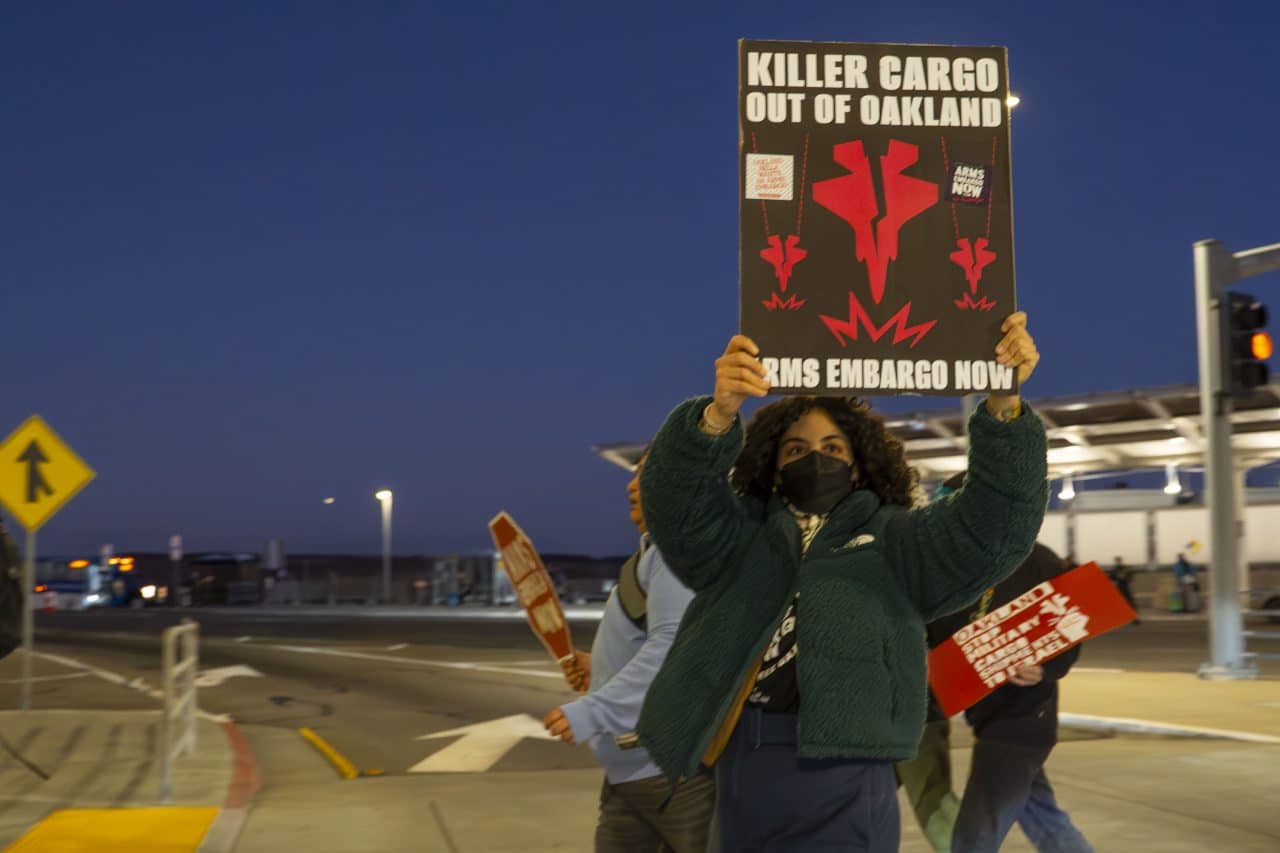
Above photo: Protesters from the Oakland People’s Arms Embargo at Oakland International Airport. Saman Qadir.
‘Genocide Is Not An Oakland Value.’
Oakland International Airport has become a key hub for transporting military cargo to Israel during the Gaza genocide. Now, over 30 groups and thousands of Oakland residents have come together in the Oakland People’s Arms Embargo to stop it.
Talia Rose starts their shift at Oakland International Airport (OAK) at 3:00 a.m., unloading same-day packages from UPS planes. Across the tarmac, they watch FedEx planes come and go. “I never had any idea what the hell is on those planes besides big metal containers that carry packages,” Rose said.
But that would change in August, when Rose attended a local organizing forum where a member of the Palestinian Youth Movement (PYM) presented a soon-to-be-public report titled “Exposing Oakland’s Military Cargo Shipments to Israel.”
The report—published by PYM, Arab Resource and Organizing Center (AROC), and U.S. Palestinian Community Network (USPCN)—details FedEx’s routine shipments of F-35 Lockheed Martin fighter jet components to Israel’s Nevatim Airbase. The report describes OAK as a “dependable conduit for critical military technologies,” concluding “beyond a reasonable doubt that military cargo being shipped out of OAK has been used by the Israeli Air Force to carry out airstrikes and commit genocide in Gaza.”
Learning about OAK’s role in facilitating genocide disturbed Rose. “After reading the report, knowing there’s a minimum of three [shipments] a week going through the airport that have F-35 parts, it’s a feeling of overwhelming anxiety,” they said. “I’m right there, you know? I’m across a tarmac from it. It feels like I should be able to do something.”
With the launch of the Oakland People’s Arms Embargo campaign, Rose and thousands of Oaklanders would find what they could do.
The campaign was launched shortly before the People’s Conference for Palestine, a weekend-long event aimed at strengthening the movement, where PYM called for a shift towards local arms embargoes. Their theory was that a strong campaign would need the trifecta of a mass local base, organized workers, and progressive elected officials. Oakland has all three.
A Central Node Of The Weapons Supply Chain
Voulette Mansour, a PYM-Bay Area organizer whose grandparents were displaced during the 1948 Nakba, attended the People’s Conference. Behind the scenes, Mansour and PYM had been preparing for the campaign launch for months, eagerly anticipating this moment. “We had been doing a lot of background work on the research and preparing to launch the report,” Mansour said.
Through research infrastructure developed by PYM’s Mask off Maersk campaign—which targeted the largest maritime carrier of U.S. military cargo (including F-35 components) to Israel—PYM uncovered OAK’s role in the F-35 supply chain. “We were shocked that Oakland popped up on the map, not just as a blip, but as a central node,” said Mansour, “When we found this out, we were disgusted that this was happening in our city, but we also saw it as an opportunity.”
The “Exposing Oakland’s Military Cargo Shipments to Israel” report confirmed multiple shipments every week for over a year, making OAK the second most important logistical hub in the U.S. F-35 supply chain to Israel, behind Fort Worth.
The F-35 fighter jet is considered the crown jewel of the Israeli Air Force; Israel has its own modified version, called the F-35I, which is retrofitted specifically for Israeli weapons systems. Each jet costs around $100 million (subsidized by U.S. taxpayers in the form of federal weapons contracts) and can carry up to 18,000 pounds of munitions. Lockheed Martin is the primary manufacturer of the F-35, but over 1,900 contractors are involved in supplying various components, creating a vast and intricate global supply chain that the U.S. Defense Logistics Agency (DLA) is responsible for coordinating.
Many essential F-35 components are gathered at the DLA’s “San Joaquin” distribution site in an Oakland suburb. These components include bomb-release units used to equip F-35s with 2,000-pound ‘bunker-buster’ bombs, avionics such as infrared cameras and bomb guidance systems, and even the literal nuts and bolts of the F-35. Components are transported from the DLA warehouse to OAK, where FedEx flies them to its international hub in Memphis, before they are shipped overseas and eventually land at Israel’s Nevatim Airbase.
From there, Israel’s F-35 fleet is routinely deployed against its adversaries across the region, including civilian targets in Lebanon, Syria, Yemen, and Iran. F-35s also enable Israel’s genocide in Gaza, such as the July 2024 Al Mawasi massacre, when the aircraft dropped three 2,000-pound bombs on Palestinians sheltering in a “designated humanitarian safe zone,” killing 90 people.
With this tangled array of parties complicit in Israel’s atrocities, the Oakland People’s Arms Embargo campaign chose the Oakland Airport as its primary target. “FedEx and Lockheed Martin are exploiting Oakland’s public infrastructure to facilitate a genocide without the consent of the people of Oakland,” said Mansour. “Our demands are directed at the airport because we have a say over what our public infrastructure is used for.”
The Oakland People’s Arms Embargo is demanding that the City of Oakland cease military shipments from OAK to Israel, prohibit the use of civilian infrastructure for military transfers to Israel, and create processes of accountability to ensure Oakland is not complicit in genocide. These demands are directed toward the Oakland Port Authority, the Oakland Mayor, and the Oakland City Council.
Mansour said an arms embargo is needed now more than ever after the recent so-called ceasefire deal, which she believes was an attempt to curb the global movement’s momentum towards economically isolating Israel. “The Israeli state has demonstrated a pattern of repeatedly violating ceasefires dating back to its creation. And in fact, during these times, Israel replenishes its stock of weapons in order to continue its project of ethnic cleansing and of genocide… We know that a ceasefire without an arms embargo is just more genocide.”
Because the weapons supply chain relies on public infrastructure such as OAK, the campaign believes an arms embargo would not only have an immediate material impact but also set a precedent for the broader movement. “There’s an opportunity to start something here that could be proliferated across the nation,” said Mansour.
Raising The Alarm
Since the public launch, the Oakland People’s Arms Embargo has built a coalition of over 30 movement organizations, led by PYM, AROC, and USPCN. The coalition’s first task was to raise the alarm about OAK’s F-35 shipments and popularize its demands.
East Bay Families For Ceasefire, a parents organizing body and coalition member, found a perfect role to fill. “We do weekly flyering in front of the Grand Lake Theater,” said Annie Banks, a mother of three. “My kids hand out flyers, and people honk their horns, waving keffiyehs out their window and screaming. It’s a reminder that there’s overwhelming consensus and opposition to genocide.”
During bi-weekly outreach days, organizers canvas different Oakland neighborhoods. Banks recently flyered outside a BART (the Bay Area’s public transit system) station in Fruitvale. “We took clipboards and petitions and were trying to engage with people on their way to their train. We got lots of people to sign the petition. It was really positive.” The campaign’s petition calling for the city to immediately cease all military cargo shipments from OAK amassed nearly 12,000 signatures.
This core demand resonated with many Bay Area residents who were demoralized by the toothlessness of symbolic resistance to genocide in Gaza. “People were feeling devastated and unclear on next steps,” said Banks. “To have such a powerful invitation to take part in a tangible campaign about stopping weapons has a special resonance.”
Banks shared that during one flyering session, “an older couple sat with us and said ‘we did this during Iraq,’ and they were just so glad that people are still fighting against militarism. That felt really beautiful because there is a sense of political history here.”
Oakland is known as a social justice movement hub, being the birthplace of the Black Panthers, a center for labor struggles, and the first major U.S. city to pass a ceasefire resolution. Wandering the streets of Oakland and encountering murals dedicated to Palestine Solidarity, Black Power, and Indigenous Sovereignty, one gets the impression that resistance is an essential part of Oakland’s culture. And discovering that the airport is being used to ship F-35 components appears to have struck a chord with local people. “Having that history is a deep connection for folks,” said Banks. “Genocide is not an Oakland value.”
During Israel’s 2014 war on Gaza, Oakland’s legacy of solidarity was solidified yet again by the “Block the Boat” campaign led by AROC that successfully blocked a ZIM ship—Israel’s largest shipping company—from docking at the Port of Oakland. Thousands of people showed up to picket at the port, and the dockworkers’ union, ILWU, honored the picket by refusing to work. ZIM has not returned to the Port of Oakland since.
Labor In Lockstep
“Labor power is in the fabric of Oakland,” said Gabriel Kahn, a middle school teacher and executive board member of the Oakland Education Association (OEA), Oakland’s largest union. OEA is one of 18 locals to endorse the campaign so far. On November 11, the Alameda Labor Council, a regional body representing over 125 unions and 135,000 workers in the East Bay, unanimously voted to endorse the Oakland Arms Embargo campaign. Kahn described this endorsement as an act of “extraordinary coherence” and believes “labor is in lockstep with each other.”
Talia Rose is focused on organizing Teamsters Local 70, which represents logistics and transportation workers and has not yet endorsed the campaign. “The goal is to build mass support within UPS Local 70 at the airport so we can present a united front,” said Rose. “We’re not saying the union’s gotta go over there and bust it up [the F-35 shipments]. We’re saying we need to endorse this campaign. And we need to have our members speak about it, specifically as airport workers.”
Rose pointed out that FedEx is crucially one of the only non-unionized logistics companies in the Oakland Airport. “It’s not lost on us that they had to use non-unized labor in order to get this shit through… we’ve got a radical history of our dockworkers not loading anything going to Israel.” According to Rose, FedEx is infamous for its “always firing, always hiring” labor model, dissuading workers from taking the action that their unionized counterparts are historically known for.
Still, the campaign believes the overwhelming support of labor will be a factor in pressuring city officials to implement an arms embargo. “As the pressure continues to increase, we’ll see just how much power labor has,” said Kahn. “I think we’ve forgotten as a society how powerful withholding our labor is as a strategy for change.”
On November 18, the campaign organized a picket at OAK, with a crowd of sixty handing out flyers to travelers and airport workers. As workers are confronted with their proximity to the weapons supply chain, there is a growing sense of “being made complicit,” said Rose. “This genocide that we are all witnessing through our social media screens, there’s a piece of that right here.”
Even workers who were once hesitant to discuss Palestine at work have expressed disgust at their workplace’s complicity. “Turning that into action is a lot harder though,” said Rose.
Taking The Fight To The Port
One site of action has been the meetings of the Oakland Board of Port Commissioners—a seven-person body nominated by the mayor and appointed by the city council—which has sole executive control over cargo coming in and out of OAK. Before a recent meeting on November 20, the campaign announced its first public call to “Pack the Port,” and 24 hours later, more than a hundred people showed up.
Public comment periods are typically bureaucratic affairs; however, the diverse array of speakers at the meeting was emblematic of Oakland’s rich movement history. “All the voices of Oakland have representation in that room,” said Rose. “This isn’t a niche special interest, but is in fact a people’s issue.”
A Palestinian man spoke about how 60 family members in Gaza were killed by Israel since October 2023; an anti-Zionist Jew expressed support for an arms embargo; a mother cradling her child talked about how this genocide is being waged on children; and Rose shared how they can no longer sleep at night knowing they work directly across from a piece of the weapons supply chain.
There’s hope that the Board would be persuaded to act.
“I’ve been in a lot of public comment sessions about Palestine. I’ve watched a lot of bureaucrats hear what we’re saying go in one ear and out the other. That was not the case at the Port Authority Commission,” said Rose. “You can see it on their faces, it affects them.”
At the meeting, the Board of Port Commissioners published a statement saying they were “saddened” to “learn of shipments from OAK that could be used to cause harm,” but claimed federal laws prohibit them from taking action.
“The port commissioners were clearly responding to the massive opposition to these military shipments that we’ve garnered, but their statement is simply a starting point,” said Mohamed Shehk, Organizing Director of AROC Action. “This decision-making body passed bold, materially binding legislation against apartheid in South Africa in the 1980s, and it’s within their power to do the same against genocide in Palestine today.”
At the meeting, the Oakland Peoples Arms Embargo presented their own resolution to the Board, demanding that they take concrete steps to stop the shipments.
Raising The Ceiling Of Struggle
In Oakland, excitement about the potential impact of this campaign is palpable. “As people find out about the campaign, they feel personally invested,” said Annie Banks, the parent-organizer. “I feel personally invested. I live here. I’m not gonna stand idly while we’re fully participating. Not just in some minor way: we’re literally shipping the parts that make it possible to murder people. And if we can stop that, that’s a huge impact.”
For Kahn, the Oakland Arms Embargo carries the potential for a broad shift in consciousness. “I hope this campaign captures the imagination of people of conscience around the world, that we pay attention to what we ship and what moves through our ports and through our airports, that we feel empowered and like we can be agents of change.”
While the material impact of a local victory at OAK would be meaningful enough, organizers believe it would also set a national precedent for what is possible. “There are actions that kick off a wave of impacts. And I think that’s the case here,” said Banks.
That wave is swelling. On November 22, PYM launched a new global campaign, the People’s Embargo for Palestine, by creating an international arms embargo ecosystem through the coordination of research and strategies across local campaigns.
This is the next phase of our struggle,” said Mansour. “We raise the ceiling of our struggle through pushing for an arms embargo.”
Joseph Mogul is an anti-Zionist Jewish writer, organizer, and independent journalist. You can read more of his work at hereandtogether.substack.com.