On The Coloniality Of Solidarity.
The ‘pure’ leftism of the Western academy denounces Iran’s state while ignoring its real crime: defying imperialism. This selective solidarity has become a weapon of empire, disarming the very movements it claims to support.
Western Marxism, as Ponce de León and Rockhill (Citation2024) note in their introduction to Domenico Losurdo’s Western Marxism, has long been characterized by ‘the dogmatic rejection of actually existing socialism’ and a neglect of national liberation and anti-colonial struggles. This is not an intellectual quirk, it is a structural feature: it treats the fight for sovereignty in the Global South as a secondary matter – at best a distraction, at worst a reactionary detour. The logics behind this are rooted in Eurocentrism and sustained by the material privileges of the imperialist core – what Lenin (Citation1916) identified as a bribed ‘upper stratum’ of the working class, made possible by ‘super profits’ from colonial exploitation that ‘foster, give shape to, and strengthen opportunism’. Lenin’s century-old warning remains relevant: monopoly profits from the periphery create a privileged layer in the core whose interests align with the maintenance of imperialism.
It is from within this material and ideological context that much of Western academic Marxism operates, producing a safe Marxism that is critical of capitalism in theory, but carefully avoids solidarity with those confronting it at its most violent frontiers. This tendency has political consequences. It leads to selective solidarity, where, as Ajl (Citation2025) argues, oppressed peoples are abstracted from the states and institutions that make their survival possible. It encourages an unexamined hostility to the Global South state – hostility that, in practice, mirrors the objectives of hegemonic powers that seek to destroy those same state structures – through imperialist military assault and economic interventions, including sanctions, structural adjustment, and trade/tariff wars. This tendency also feeds a habit of moral judgment against nationalist movements that do not fit the imagined – Eurocentric or colonial – model of ‘pure’ liberation.
Garrido (Citation2024) has described this tendency as a ‘purity fetish’ that forgets ‘that socialism does not exist in the abstract, that it must be concretized in the conditions and history of the peoples who have won the struggle for political power’. This fetish, he argues, produces an armchair radicalism that refuses to support actually existing struggles if they fail to meet imagined ideological benchmarks. In the case of Iran, such purity politics feed into the coloniality of Western solidarity – granting sympathy to ‘the people’, or worse ‘some of the people’, while rejecting the state and institutions that make their survival possible.
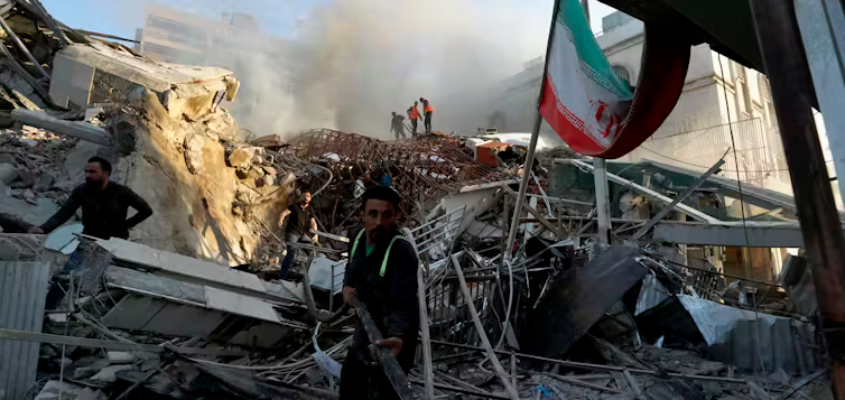
The June 2025 US–Zionist aggression against Iran, launched in the shadow of Israel’s genocide in Gaza, offers a concrete case study of what is at stake when that solidarity is absent, and why the national question remains central to socialist politics. Publicly, the Zionist assailants framed their aggression as a preemptive strike against Iranian nuclear ambitions. In reality – in both its aims and its conduct – it was an attempt at regime change and state collapse: the elimination of what they saw as the backbone of support for the Palestinian resistance and the most consistent anti-imperialist state in West Asia. The nuclear issue was a pretext, with the real goal, as Professor Marandi (Citation2025) contends, being ‘to remove Iran from the regional equation, [and] to break the backbone of the Palestinian resistance’.
The US–Zionist assault on Iran is the sharp edge of a broader imperialist strategy to strangle independent nations, seize control of West Asia’s resources, and crush the emerging multipolar world order. For over 70 years – since the 1953 coup against Mohammad Mosaddegh – Washington has wielded coups, sanctions, proxy wars, and military threats to keep Iran under its thumb. Today, Iran stands as a linchpin of resistance: a sovereign state that refuses to submit, anchors the Axis of Resistance, and builds deep strategic alliances with China, Russia, and the Global South as it promotes multipolarity and regional leadership (Wu and Moshirzadeh Citation2025). Its integration into BRICS and the Shanghai Cooperation Organization, its role in Eurasian transport corridors, and its leadership in de-dollarization efforts represent a direct challenge to the US petrodollar system – the financial lifeline of empire. Recent US involvement in the Zangezur Corridor dispute between Azerbaijan and Armenia appears to constitute a deliberate effort to sever Iran’s direct land access to Armenia – a historically significant strategic partner and a critical conduit for Tehran’s trade with the Eurasian Economic Union (EAEU). This maneuver seeks not only to diminish Iran’s regional influence and constrain its strategic presence in the South Caucasus but also to marginalize its function as a pivotal node in regional logistics and energy transit networks. Furthermore, such actions may be interpreted as part of a broader strategy to obstruct potential infrastructure frameworks facilitating connectivity between Iran, China, and Russia.
This latest aggression on Iran, however, is not born of imperial strength but rather of imperial decline. US economic supremacy is rotting from within, its military overstretched and its control over the world’s trade and finance shaken by new centers of power. Eurasia’s integration – energy pipelines, railways, and trade routes bypassing US chokepoints – threatens to make the empire irrelevant. Iran’s defiance embodies a future in which nations refuse the dictates of Washington and Tel Aviv, choosing cooperation over coercion.
The war on Iran is thus a war on the very idea that the world can be organized on principles other than imperialist plunder. In resisting this assault, Iran is not only defending its own sovereignty, it is helping to midwife a multipolar order that could finally bury the unipolar tyranny of the US–Zionist project.
Beyond military force, the US–Zionist aggression on Iran is sustained by a politics of confusion and a propaganda machine that manufacture consent for genocide. For the Global North’s Left to effectively challenge imperialism, it must win the cognitive warfare – countering dominant narratives and exposing the material realities behind the attack on Iran. Recognizing the high stakes of this imperialist aggression requires building active support for the Iranian state including through rigorous knowledge production, grassroots organizing, and mobilization. Yet purity politics and the coloniality embedded in Western solidarity continue to undermine these efforts, disarming the Left when genuine solidarity is most urgently needed.
Tracing The Roots Of The Coloniality Of Solidarity: The National Liberation Blindspot
The failures of socialist internationalism in confronting colonial oppression have deep historical roots, particularly within the legacy of the Second International. Although the Second International ostensibly united workers across borders, it notoriously collapsed into European nationalism during World War I when most European social democratic parties supported their respective imperialist states’ war efforts. This moment exposed how the material privileges derived from colonialism had created a labor aristocracy within the imperial centers, a privileged layer of workers whose interests aligned with maintaining imperialist exploitation rather than challenging it (Foster Citation2024). Trade unions tied to the Second International thus often became complicit in upholding colonial domination, reflecting an entrenched Eurocentrism that framed anti-colonial struggles as secondary or reactionary.
Zhun Xu’s analysis deepens this critique by showing how the retreat from Marxist theories of imperialism in the postwar and neoliberal eras has facilitated a resurgence of Second International politics – an ideological position that downplays imperialism’s structural violence and undermines genuine solidarity with anti-colonial struggles. Xu (Citation2021) argues that this shift has led many leftists to prioritize reformist or liberal-capitalist agendas within imperial centers, framing anti-colonial resistance as marginal or reactionary. By rejecting the centrality of imperialism as a global system of class exploitation, contemporary left-wing discourse weakens support for national liberation movements and perpetuates coloniality within leftist politics.
Lenin’s writings from 1916 to 1920, including his ‘Preliminary Draft Theses on the National and Colonial Questions’ and speeches to the Comintern, emphasized that imperialism was not simply inter-imperialist rivalry but fundamentally a system of global class exploitation, where monopoly capital from a few wealthy nations plundered colonies and semi-colonies, sustaining an international order of oppression and dependency. This framework highlighted the essential role of supporting national liberation movements as integral to socialist revolution, a lesson since largely ignored or distorted by much of Western Marxism.
This coloniality of solidarity endemic to Western Marxism was further exemplified by the French Communist Party’s (FCP) refusal to back the Algerian National Liberation Front during Algeria’s anti-colonial war (1954–1962). As Elias Murqos documented in his 1959 work The French Communist Party and the Algerian Cause, the FCP consistently subordinated the Algerian liberation struggle to its own political interests within France, denying the revolution’s organized and national character and instead framing it as isolated instance of violence or premature unrest (Jabbour Citation2025). Rather than embracing the FLN as the legitimate representative of Algerian self-determination, Jabbour points out how the FCP pursued a ‘moderate colonizer’ position – advocating for reforms and equality within the colonial framework while ultimately maintaining French nationalist priorities (Jabbour Citation2025). This amounted to a paternalistic and racist stance that sought to domesticate and weaken the revolutionary movement, illustrating how the FCP’s Marxist rhetoric masked a deeper commitment to preserving French imperial power. The party’s reluctance to fully endorse Algerian independence – initially justified in terms of Algeria being a ‘nation in formation’ and later by alleged fears of US imperialism, mirrored broader failures of the Western Left to transcend Eurocentric biases and colonial imbrication.
One of the most glaring and damaging blind spots within the contemporary Left has been its failure to shift from viewing Palestinians only as victims to agents of their own liberation, most notably manifested as a reluctance to seriously engage with Palestinian resistance factions as key actors in the struggle against settler colonialism. Too often, leftist solidarity with Palestine is reduced to sanitized rhetoric that demands purely secular, ‘socially progressive’ alternatives, while dismissing the working-class nature of Hamas’ resistance or excluding Hamas as a reactionary or regressive force. This selective solidarity not only distorts Palestinian realities but also reproduces imperialist frameworks that seek to delegitimize the very resistance they claim to support. As Abdaljawad (Citation2024) incisively argues, authentic solidarity requires reckoning with the political forces that actually lead the fight on the ground. The central fault line in Palestinian politics, he contends, is not over secularism or ideology, but between those committed to defiant resistance and those invested in accommodation with colonial domination. By refusing to acknowledge armed resistance as a necessary and valid form of anti-colonial struggle, much of the Western Left inadvertently has become complicit in sustaining colonial oppression, and thus demonstrating the persistent coloniality within leftist internationalism.
This ongoing coloniality of solidarity is powerfully evident in the Western Left’s response to Iran’s confrontation with imperialist aggression. Just as genuine solidarity with Palestine requires a dialectical understanding of how imperialist settler-colonial violence shapes the material conditions of resistance – and the recognition of movements like Hamas as legitimate anti-colonial actors – solidarity with Iran must also confront the reality of a nation under siege for decades, where defending the state is central to resisting imperialist domination. Failing to appreciate these complexities risks replicating imperialist narratives that erode anti-colonial sovereignty and weaken the broader global struggle against imperialism. With this foundation, we now turn to a detailed analysis of the Zionist-imperialist assault on Iran and its wider implications for anti-imperialist solidarity.
Anatomy Of The Zionist-Imperialist Assault On Iran
US and Israeli planners expected their aggression to be short and decisive, leveraging overwhelming firepower to paralyze Iranian defenses and trigger political collapse. This expectation was based on a familiar pattern from imperialist wars in the region: massive initial bombardments, quick destruction of command-and-control structures, and the cultivation of internal dissent to topple governments. The model was Iraq in 2003 – decapitation, occupation, and restructuring under a compliant client regime. But this model imploded after October 7, 2023, with the Al Aqsa flood operation successfully challenging Zionist-imperialist military might and maintaining command and control despite the superior capabilities of the imperialist enemy. Furthermore, Iran is not Iraq in 2003. It is not even Iraq in 1991. Iran has spent decades preparing for precisely this type of confrontation.
The initial Blitzkrieg, which took out scores of Iranian top military leaders and nuclear scientists, coupled with coordinated cyber-attacks and a campaign of intimidation against Iran’s political and military leadership, failed to achieve its intended goals. Rather than spreading terror, sowing confusion, and fomenting social unrest, Iranian society rallied around the flag, and the Iranian state exhibited a high degree of composure, organizational depth, adaptability, and resilience.
Within hours, replacements for the assassinated military leaders were announced and the first phase of ‘Operation True Promise 3’ was underway. Instead of a Pavlovian reaction, Iran’s response was calculated, measured, and proportionate. The Iranian riposte relied largely on older drones and missiles, preserving its most advanced systems, while still overwhelming the multi-layered air defense umbrella the collective West put in place to shield its colonial outpost. ‘By the end’, Marandi observed, ‘nine out of ten Iranian missiles got through.’ This was not simply a matter of brute firepower, but of intelligence, planning, and an acute understanding of the Zionist settler colony’s weaknesses.
The United States, meanwhile, burned through nearly a quarter of its Tomahawk stockpile – some 800 to 850 missiles – in less than two weeks. This was an unsustainable expenditure for what had been envisioned as a short, high-intensity campaign. It exposed the logistical strains of maintaining US military dominance in multiple theaters at once, from Ukraine to the South China Sea. Iran’s strategic restraint, its choice to hold back advanced systems, sent a message: we can fight longer than you can, and we haven’t even shown our full hand. The war ended with Iran’s command-and-control structures intact, its military standing firm, and without the political fracture or fallen government that Washington had hoped to provoke. Far from being destabilized, Iran emerged more confident, openly preparing for the next war, reinforcing air defenses, and deepening military cooperation with Russia and China.
The aggression against Iran was inseparable from the genocide in Gaza. For Tehran, this was not a peripheral issue. Support for Palestinian liberation is not a bargaining chip in regional diplomacy; it is a matter of principle and a defining feature of Iran’s geopolitical identity. This commitment – material as well as rhetorical – puts Iran at odds with the entire imperialist-Zionist project in West Asia. It also exposes the hypocrisy of Western human rights discourse, which condemns civilian casualties when inflicted by official enemies, but excuses or justifies them when carried out by allied settler-colonial, imperialist states. The same Western capitals that speak of a ‘rules-based order’ and ‘the protection of civilians’ have financed and armed the Zionist entity’s deliberate and systematic destruction of Gaza’s hospitals, schools, agricultural land, and water infrastructure.
Iran’s stance here is not unique in the history of national liberation movements. From the expressions of anti-colonial solidarity enshrined in the Bandung Conference (Citation1955) and Tricontinental Conference (Citation1966) conferences, to China’s and the Soviet Union’s support for Global South anti-colonial struggles, to Cuba’s role in Angola, the link between anti-colonial sovereignty and support for other liberation struggles has been a constant. Iran is taking up the mantle of anti-colonial solidarity, providing meaningful support through arms, technology, and training, rather than engage in purely symbolic acts.
Beyond The Coloniality Of Solidarity: Why Defending The Global South State Matters
Overcoming the coloniality of solidarity constitutes a formidable challenge, necessitating rigorous self-reflexivity, a deliberate interrogation of material positionality, and a conscious recalibration of ideological dispositions. The binary oppositions between ‘regimes’ and ‘peoples’ in the Global South – once a central analytical framework within comparative political science in the imperialist core – have been uncritically adopted and normalized among certain leftist formations in the Global North. This discursive tendency manifests in prevailing attitudes toward states such as Iran, Nicaragua, Cuba, Zimbabwe, China, Syria, and Venezuela, where reductive categorizations persist.
This is the point at which Ajl’s cautionary argument, in relation to Iran, assumes critical significance: ‘By separating “the regime” from “the people”, the US–Israeli propaganda justifies state collapse in the name of the people. You cannot defend a people by adopting the rhetoric used to justify their destruction’ (Ajl Citation2025). This separation, now common in Western Left discourse, fetishizes an abstract ‘people’ while rejecting the actual institutions that make their survival possible. In the Global South, and in Iran in particular, patriotism can be a working-class ideology because the state is the shield against imperialist dismemberment. It is the state that funds hospitals, operates power grids, sustains education systems, and maintains the armed forces capable of defending those functions. To demand solidarity with ‘the people’ while refusing to defend the state is, in effect, to adopt the imperial premise. It mimics imperialist discourses that those institutions are illegitimate and expendable.
The material role of the Global South state in resisting de-development, the process by which imperialist powers seek to dismantle the economic sovereignty of targeted nations, is inseparable from the military question. Iran’s military-industrial capacity, developed under sanctions and siege, is part of a broader strategy of self-reliance. This is why it can produce its own missiles, drones, and even civilian infrastructure components. The destruction of that capacity, through war or sanctions, would not liberate the Iranian people. It would subject them to the dependency and poverty that follow imperialist ‘reconstruction’.
The Zionist-imperialist 12-Day War did not just fail to achieve its objectives, it reshaped the regional balance of power. Israel’s willingness to strike anyone, including groups it had previously cultivated as proxies, revealed that loyalty bought no security. Erdogan’s quiet facilitation of Israeli aims, even through contact with and material support for al-Qaeda-linked factions, underscored this reality. Arab states that had once hoped for accommodation with Tel Aviv began to reconsider, some privately acknowledged Iran’s military and political victory.
For the Gulf monarchies, the lesson was sobering. If Israel could not decisively defeat Iran in a concentrated war, then aligning fully with US–Israeli strategy carried risks. It could provoke conflict without guaranteeing protection. This recognition has opened new diplomatic opportunities for Tehran, particularly with states wary of being caught in another Western-designed regional conflagration.
The war must also be understood within the context of a shifting global order. Iran’s alliances with Russia and China are not opportunistic, they are part of a long-term strategy to build a multipolar front against US hegemony. By arming and training resistance movements from Lebanon to Yemen, Tehran ensures that imperialist control is contested across multiple fronts. Russia’s support is often pragmatic and limited by its own interests, but the exchange of military technology between Moscow and Tehran has strengthened both. China’s role, while less visible militarily, is critical in sustaining Iran’s economic lifelines through trade and investment. These relationships – military, economic, and political – are what allow Iran to resist total isolation, even under the heaviest sanctions regime in the world.
The United States, for its part, faces an increasingly overstretched empire. The stalemate in Ukraine, the inability to subdue Gaza, Hezbollah’s resilience in Lebanon, and the failure to crush Ansar’Allah in Yemen all signal the limits of US military power. The 12-Day War added another layer to this pattern of strategic frustration.
For Marxists in the imperial core, the lesson is not abstract. To reduce Iran’s victory to a nationalist or ‘merely geopolitical’ episode is to miss the central contradiction of our epoch: imperialism versus the sovereignty of oppressed nations. The war demonstrated that anti-imperialist states could survive and even strengthen under coordinated assault from the US and its ‘allies’. It showed that imperialism’s technological advantage is not invincible, and that political will, strategic preparation, and mass mobilization can blunt its force.
Conclusion
While it is accurate to assert that the imperialist campaign against Iran seeks regime change and the potential collapse of the state, its ultimate objective lies in the defeat of the Islamic Revolution and, by extension, the ‘pacification’ and dismantling of what remains the only extant liberation project in the Arab–Iranian region. Over the past five decades, the Islamic Revolution has assumed the mantle of anti-imperialism and regional liberation, a role previously held by Arab socialism. The decline of the latter was rapidly followed by the rise of the former. As the Arab nationalist and Arab socialist project was being systematically neutralized, particularly through mechanisms such as the Camp David Accords, the locus of regional liberation shifted to Iran.
While Egypt was reaping the so-called ‘peace dividends’, Iran institutionalized support for the Palestinian cause by embedding it permanently within the state budget. Concurrently, as the Zionist settler colony inaugurated an embassy in Cairo, both its embassy and that of its imperial patron were closed in Tehran. Whether articulated in religious language, such as the Islamic Revolution’s designation of the United States as ‘The Great Satan’, or in secular Marxist terms, such as Mao Tse-Tung’s formulation of the ‘Primary Contradiction’, the central referent remains consistent: imperialism.
This clear identification of imperialism as the principal source of the masses’ subjugation and dispossession, and the effort to cultivate a political consciousness in opposition to it, particularly at a moment when total imperialist dominance in the region seemed imminent, is what provokes the intense hostility and aggression of imperialist powers toward Iran. Amílcar Cabral’s warning still applies: ‘If imperialism exists and is trying simultaneously to dominate the working class in all the advanced countries and smother the national liberation movements in all the underdeveloped countries, then there is only one enemy against whom we are fighting’ (Cabral Citation2025). To act on this understanding requires abandoning the selective solidarity that condemns imperialist violence in the abstract while refusing to defend those institutions – states, armies, movements, and infrastructures – that make resistance possible.
Iran’s defiance in the face of the latest phase of imperialist assault, and the survival of its state under siege, is not the end of the struggle – it is a chapter in a longer process of resisting imperialism. It confirms that the fight for socialism in the twenty-first century is inseparable from the fight for sovereignty, and that the state, far from being a relic or an obstacle, is often the essential vehicle for that struggle in the Global South. The road to human emancipation today runs not only through the streets of Paris or New York, but also through the skies over Tehran, the waters of Yemen, the hills of South Lebanon, and the rubble of Gaza. Today, human emancipation requires a Marxism that is not afraid to stand with those fighting imperialism in practice, even when their forms of governance or ideological traditions do not fit the sanitized templates of Western theory. Anything less is not solidarity. It is, at best, surrender; and at worst, collaboration.