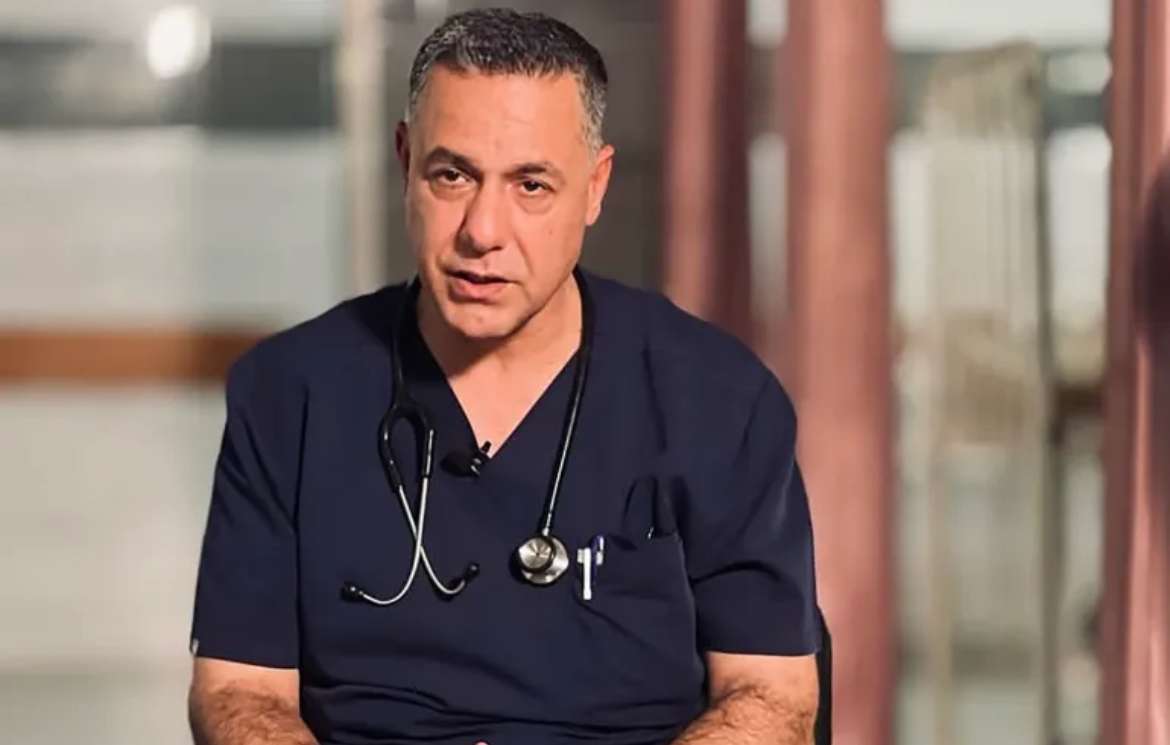
Above photo: Dr. Hussam Abu Safiya, Director of the Kamal Adwan Hospital in Beita Lahia in northern Gaza. Photo via social media.
Why has the New York Times refused to cover his case?
One year ago, an iconic photo from Gaza went viral of Dr. Hussam Abu Safiya walking through rubble in Gaza to be detained by Israeli forces. Today, Safiya is still being held without charges, but you wouldn’t know it from reading the New York Times.
One year ago, a iconic photograph from Gaza went viral worldwide. It showed a man in a white physician’s coat walking, unarmed, through a destroyed landscape of rubble toward two Israeli army tanks.
That man was Dr. Hussam Abu Safiya, a pediatrician who was the director of the Kamal Adwan Hospital in northern Gaza. He was walking toward his arrest. A year later, Dr. Abu Safya is still in an Israeli prison. He has not been officially charged with anything. His lawyer says he has lost a third of his body weight and suffers from heart problems.
There have been global campaigns for Dr. Abu Safiya’s release. The head of the World Health Organization also issued an appeal. Amnesty International, which declines to represent prisoners who have used or advocated violence, waged a special campaign for him. Colleagues in the medical and public health fields have also demanded his freedom.
But not a single word about this remarkable man has appeared in the New York Times since January 7, 2025, when the paper published an article that did report his arrest — but included in the very first sentence an unproven Israeli charge that “militant groups had used the (Kamal Adwan) hospital as a command center.”
The Washington Post has also completely ignored Dr. Abu Safiya since his arrest, even though it had previously quoted him several times about children in his hospital suffering and dying from malnutrition.
In today’s media landscape, the New York Times and the Washington Post are more important than ever in setting the reporting agenda in the United States. The cable news networks lift many of their subjects from the flagship papers, especially the Times, instead of doing their own reporting. Regional newspapers like the Chicago Tribune and the Los Angeles Times that once provided something of a counterweight have been forced to close most of their overseas bureaus, so the American audience is dependent on a shrinking handful of reporters.
Dr. Hussam Abu Safiya is not an obscure person. He is prominent within Gaza, and he has strong connections with international colleagues in the medical and public health fields. Anyone with a cellphone could have reached plenty of people who could have been the sources for a profile. Articles could have included details such as the fact that he stayed at his post even after his own son, Ibrahim, had been killed in an Israeli air attack, along with dozens of other staff at his hospital.
Instead, he has become an unperson. Why? We can’t be certain, but an educated guess is that Dr. Abu Safiya — who is, let’s remember, a pediatrician — could have spent the past year giving expert moving testimony about how Israel’s war on Gaza was starving children to death. He could have rebutted those offensive reports in certain American media outlets that tried to claim that kids in Gaza who died had pre-existing conditions, and weren’t actually all that hungry.
So Israel understandably wanted to silence him, and has kept him incommunicado, without charges, for a year.
But why did the U.S. press help suppress his views? New York Times veterans will confide that 90 percent of their self-censorship around Palestine is unspoken. Reporters and editors there are understandably ambitious, and intelligent, and they don’t need to be told that getting a reputation as “anti-Israel” or “Pro-Palestinian” could damage or even end their careers.
The U.S. press self-censorship is even more pathetic when you contrast it with how a leading Israel paper, Haaretz, did in fact cover the story. In July, for instance, reporter Nir Hasson spoke to Dr. Abu Safiya’s lawyer, Gheed Kassem, who charged that her client was “suffering severe hunger and abuse” in the Israeli prison. She also said he had been beaten, had an irregular heartbeat, and that he and other prisoners were in a cell that is “underground, depriving him and his cellmates of daylight.”