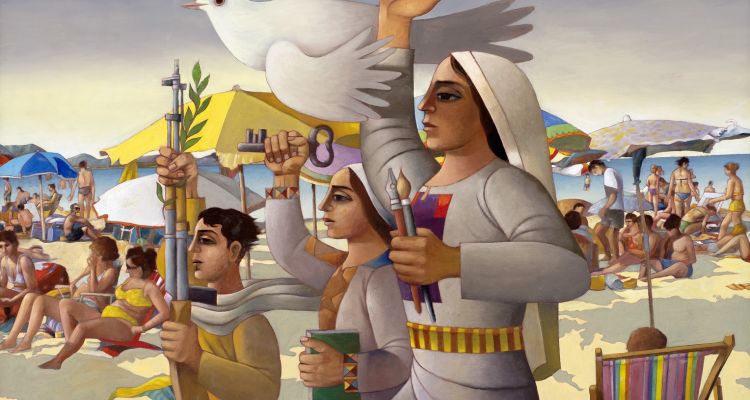
Above photo: Sliman Mansour (Palestine), The Sea Is Mine, 2016.
7 October 2025 will mark the second anniversary of Israel’s ongoing genocide in Gaza.
At least 66,000 Palestinians have been killed in Gaza during this time – 30 out of every 1,000 people.
7 October 2025 will mark the second anniversary of Israel’s ongoing genocide in Gaza. The World Health Organisation’s data page on Palestinian casualties, regularly updated using figures from the Palestinian Health Ministry and UN agencies, shows that around 66,000 Palestinians have been killed in Gaza over the last two years – 30 out of every 1,000 people who were living in Gaza (these numbers, however may be too low, as the ministry has often admitted that it has no capacity to keep up with the flow of death and does not know how many people are buried beneath the tonnes of rubble).
The UN children’s agency, UNICEF, calculates that 50,000 Palestinian children have been killed or injured. As Edouard Beigbeder, UNICEF’s regional director for the Middle East and North Africa and a twenty-year veteran at UNICEF, stated:
These children – lives that should never be reduced to numbers – are now part of a long, harrowing list of unimaginable horrors: the grave violations against children, the blockade of aid, the starvation, the constant forced displacement, and the destruction of hospitals, water systems, schools, and homes. In essence, the destruction of life itself in the Gaza Strip.
Beigbeder’s statement was based on an assessment of the facts over the last two years. Indeed, the year before, Commissioner General of the UN’s Palestine agency (UNRWA) Philippe Lazzarini said that every day, ten children lost one or both legs due to Israel’s bombardment. A few months later, Lisa Doughten of the UN’s Office for the Coordination of Humanitarian Affairs told the UN Security Council that ‘Gaza is home to the largest cohort of child amputees in modern history’. These stories received little to no attention in mainstream media outlets.
On 16 September, the UN Independent International Commission of Inquiry on the Occupied Palestinian Territory published a seventy-two page report packed with facts that concluded ‘on reasonable grounds’ that the Israeli government, its high officials, and the military had committed and are continuing to commit acts (actus reus) of genocide with the intention of committing these acts (mens rea). This judgment is far more encompassing than the International Court of Justice’s January 2025 finding of ‘plausible’ evidence of genocide. The commission is led by Navi Pillay, a former judge on the South African High Court and at the International Criminal Court who served as UN high commissioner for human rights from 2008 to 2014. She was clear and direct in her press statement following the release of the report: ‘The Commission finds that Israel is responsible for the commission of genocide in Gaza. It is clear that there is an intent to destroy the Palestinians in Gaza through acts that meet the criteria set forth in the Genocide Convention’.
There is no need to argue the case further. These are the strongest words possible.
In mid-September, I visited Palestinian refugee camps in Lebanon, where the mood oscillates between despondency and resilience. At least four generations of Palestinians live in three of Lebanon’s largest Palestinian camps: Ain al-Hilweh, established in Saida in 1948 by the International Committee of the Red Cross or ICRC; Shatila, established in Beirut in 1949 by the ICRC; and Mar Elias, established in Beirut in 1952 by the Congregation of St. Elias.
- The Nakba (Catastrophe) generation, who came as children or young adults mostly from what is now northern Israel into Lebanon in 1948.
- The second generation of Palestinian refugees, the first to be born in the camps. They formed the core of the armed resistance as the fedayeen (fighters) through various new Palestinian political organisations such as Fatah (founded in 1957), the Palestinian Liberation Organisation (founded in 1964), and the Popular Front for the Liberation of Palestine (founded in 1967).
- The third generation, born in the 1970s and 1980s, who came of age during the Israeli occupation of Lebanon (1982–2000) and had their political teeth cut in the first Intifada (1987–1993) and the second Intifada (2000–2005). Many of them drifted from the organisations of the previous generation and went into the Palestinian Islamic Jihad (founded in 1981) and Hamas (founded in 1987).
- The fourth generation, born in the 1990s and after, who grew up at a time of shrinking opportunities in the camps and with a growing sense of futility and anger.
Four generations have lived in these camps, far from their homes in Palestine, since 1948. They look south and wonder when they will be able to exercise their right to return, a right that was guaranteed in UN Resolution 194 in December 1948.
Whether in the West Bank, Jordan, or Lebanon, the sense of absolute anger and hopelessness in the camps is overwhelming. The Palestinians who live there watch the images coming from Gaza, the absolute destruction and unrelenting genocide. It feels as if they can do nothing. The urge to pick up the gun and fight to defend the people of Gaza is overwhelming but impossible. They feel taunted by the Israelis, whose cold-blooded murder of Palestinian children takes anger to the boiling point. A few of these young people took me aside at Shatila and showed me a viral video of a Chinese professor, Dr. Yan Xuetong of Tsinghua University, arguing with an Israeli military representative, Colonel Elad Shoshan, at the Xiangshan Forum in Beijing in September 2025.
When Colonel Shoshan tried to defend the genocide, Dr. Yan interrupted and said ‘your government has no legitimacy [or] the right to decide or define what is fact’. Dr. Yan cut off Shoshan’s mumbles about terrorism with the direct statement that there is just ‘too much propaganda’, and ‘no one believes it except a few Israelis’. Dr. Yan’s anger pleased the young Palestinians, who saw their own feelings mirrored in his words and conviction. They have no time for splitting hairs. They want the violence to end and Palestine to be free.
Meanwhile, in Gaza City’s Midan al-Jundi al-Majhool (Square of the Unknown Soldier), the sound of music wafts through the air. Ahmed Abu Amsha, a music teacher at the Edward Said National Conservatory of Music who has been displaced at least twelve times during the genocide, gathers children to form a group called Gaza Birds Singing. Surrounded by the sounds of drones, they took their ambient buzz to build their own harmonies around – the sonic canvas of guitar and singing built around the drone.
One of their most popular songs is Sheel sheel ya Jamali (Carry, Carry, O My Camel), a familiar Palestinian chant:
Carry, carry, O my camel,
Bear the load in God’s name.
The martyr’s blood is perfumed with cardamom,
O night, give way to dawn.Woe, woe upon the tyrant,
God’s own judgment will fall.
No shadow can hide the stars of night –
I cry out for him.
We must bring down the tyrant.