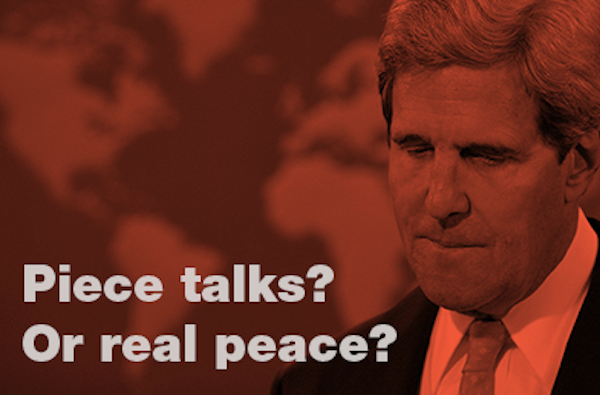
Israel’s sudden withdrawal from peace talks and its threat to punish the Palestinians for the Fatah-Hamas reconciliation agreement is a tactical move meant to deflect from the main cause of the failure of decades of peace talks —Israel’s ongoing settlement expansion and the entrenchment of the occupation, materially and diplomatically supported by the United States.
Given decades of failed US-orchestrated peace talks that have deepened the hold of Israel’s occupation, Jewish Voice for Peace will be grateful for an official end to the current round of talks. They appear to be all but dead, and show virtually no promise of achieving a just agreement.
We do believe a fair and lasting resolution will be possible one day when Israel and Palestine sit at a negotiating table with relatively equal power. But today is not that day. Until the balance of power changes, negotiations will only lead to more of the same: failed diplomacy with terms dictated to the Palestinians by the occupying power, Israel, and its unconditional backer, the United States.
Is a Fatah-Hamas reconciliation bad for peace?
Israeli Prime Minister Benjamin Netanyahu claims that in announcing the reconciliation agreement, the Palestinian Authority has chosen “Hamas over peace.” To the contrary, serious observers have long noted that if Israel is serious about diplomacy, it should welcome all parties to the table, whether or not they are in agreement. In fact, Netanyahu knows this well, as his government has negotiated with Hamas directly in the past.
The division of the two political parties, Hamas and Fatah, which was deliberately encouraged by Israeli and US policy, has weakened the Palestinian ability to negotiate with Israel. Without this reconciliation, PA Chairman Mahmoud Abbas could not legitimately claim to represent all of the Palestinian people under occupation, thus making any agreement to which the PA alone was a party illegitimate, and by definition unsustainable. Ironically, Netanyahu in the past claimed he couldn’t negotiate with the Palestinians because they were not united – now he says he can’t because they are.
Governments negotiate, not political parties.
Both Israel and the United States have set forth standards that negotiating parties must meet in order to sit at the table—rejection of violence, recognition of Israel, and respect for prior agreements. The Palestinian Authority has agreed to abide by these standards, but it is important to note that Israel itself cannot meet them: Likud, Prime Minister Netanyahu’s own party, flat out rejects a Palestinian state in its charter (as do other Israeli parties); Israel has for decades used disproportionate force against civilians; and it willfully ignores international law and prior agreements.
So why are these standards invoked only against one side and not the other? Because, as any map of illegal settlements will show, these talks have been a sham that have only entrenched Israeli power and its occupation.
Hamas, like Likud, has problematic principles, and has also taken indefensible actions, including committing violence against civilians. But as representatives of the people of Gaza under occupation, Hamas would be a crucial party of any negotiation that would actually be implementable.
The bottom line
The only peace process that will work is one that recognizes and compensates for the massive power imbalance of the occupier and the occupied.
The framework of the current peace negotiations does not recognize that imbalance. When the official “peace process” ends, it may finally be possible to work toward negotiations where Israel and the Palestinians come to the table with equal power, and the U.S. no longer plays the role of Israel’s enforcer.
That is why we believe that the Palestinian-led Boycott, Divestment and Sanctions movement, and other non-violent tools that create real consequences for Israel’s continuing violations of human rights and democratic principles, are an essential part of changing the balance of power and moving toward negotiations that could end in a just peace.
Statement on Peace Process, 4/11/2014
Download statement as PDF here. Download JVP talking points here.
Poof.
It wasn’t exactly poetry, but Secretary of State John Kerry’s testimony to Congress this week on the stalled peace talks might go down in history as a fundamental turning point in the last 20 plus years of US-orchestrated negotiations between Israelis and Palestinians. (1)
For the first time— and despite later efforts to backtrack— a US Secretary of State admitted it was the Israelis who derailed talks.
Kerry couldn’t have been clearer about the sequence of events. First Israel refused to release the last group of Palestinian prisoners they had promised to free, then they announced construction of 700 new settlement units, and only then did the Palestinians respond with an announcement that they would attempt to join 15 international human rights conventions.
The US and Israel vigorously criticized that move, prompting many to ask: what kind of “peace process” considers signing on to covenants promoting the rights of children, the disabled, and others a threat to peace? (2)
Of course, unilateral Israeli actions to undermine peace go back much further.
Since the Oslo Accords, the number of Jewish settlers on Palestinian land has more than doubled and today there are some 650,000 settlers in the West Bank and East Jerusalem. (3) In fact, Benjamin Netanyahu campaigned for re-election on a promise of one million Jews living in “Judea and Samaria”. (4)
Rather than holding Israel accountable, the United States has repeatedly rewarded the Israel government whenever it violated the law or agreements, now fueling the occupation with $3.2 billion in annual military aid.
During these talks, the United States is acting like a broker—one representing Israel’s interests.
The losers in this peace scam? The Palestinians most of all, but also every Israeli who wants a lasting and just peace. And every US resident who wants our tax money to be used for freedom and democracy, not occupation and apartheid.
What about the peace framework that Kerry wants as a basis for negotiations?
The terms Kerry and Israel set forth have nothing to do with equality – they’ll require Palestinians to sit at the back of the bus.
But they give us an idea of what will be on the table should talks limp along.
They include an unprecedented demand that the Palestinian Authority recognize Israel as a Jewish state. That’s code for condemning Israel’s 25% of citizens who are non-Jewish to second and third class status, and denying the internationally recognized rights of Palestinian refugees. (5)
And the land being negotiated for a future Palestinian “state”?
It looks more like the holes in a piece of Swiss cheese, thanks to decades of US-enabled settlement expansion. Put another way, whatever the rhetoric of a “two-state solution,” Israeli policies have already created a de-facto single state including all of Israel, the West Bank, Gaza and occupied East Jerusalem, albeit one built on the premise of separate and unequal lives for Jews and non-Jews. This is the very definition of apartheid.
So what next?
At Jewish Voice for Peace, we believe that the struggle for freedom and self-determination will still end, like similar struggles in Northern Ireland and South Africa, at the negotiation table. But that can only happen when all parties can sit down together with equal power.
Israel has one of the strongest militaries of the world, the only nuclear arsenal in the entire Middle East, the unconditional backing of the world’s sole super power, and is the 24th wealthiest country in the world, while the Palestinians across the table remain stateless, impoverished, occupied, or second-class citizens inside of Israel.
But the balance of power is changing.
And the engine of that change is the unstoppable movement of nonviolent resistance by Palestinians and their allies – including Jews of conscience – around the globe. Education, lobbying, the involvement of international legal bodies, demonstrations in the streets in Israel and Palestine, have all made a difference and will continue to grow.
And where our governments have thus far failed us, more and more people everywhere have begun to stand up and use nonviolent, economic power to build pressure on Israel to do the right thing.
The successes of the Palestinian-led nonviolent movement for Boycott, Divestment, and Sanctions are growing, with billions of dollars and major multinational corporations already impacted. That pressure has already been felt at this round of talks. That pressure is so significant that Prime Minister Netanyahu mentioned BDS 26 times in his speech to AIPAC, the US largest pro-Israel lobbying organization.
The Boycott, Divestment and Sanctions movement is where the Civil Rights movement was when the Montgomery Bus Boycott began.
This movement for us as Jews is a form of tochecha, the Jewish tradition of sacred rebuke, which comes from a place of love and is the religious obligation to remind one’s friends to live by their values. It is a nonviolent and principled way to liberate our own community from the dehumanizing role of oppressor.
Can BDS really work? We think so.
Israeli government officials agree. Israeli finance minister Yair Lapid warned that even a limited EU boycott could cost the Israeli economy over $5 billion dollars a year.
Foreign Minister Tzipi Livni put it even more directly: “The boycott is moving and advancing uniformly and exponentially…Those who don’t want to see it, will end up feeling it.”
Already impacted, even Israel’s business elite is organizing to demand a negotiated agreement.
Certainly, BDS is working better than any strategy has before. It’s a movement rooted in Palestinian civil society – women’s groups, trade unions, students – and so it has no leader that can be stopped. No single funder that can be cut off.
It is fueled instead by the same love for justice, equality, and human rights that has fueled every successful justice movement the world has ever seen.
But why BDS to get to the negotiating table?
Martin Luther King famously wrote in his “Letter from a Birmingham Jail”:
“You may well ask: ‘Why direct action? Why sit-ins, marches and so forth? Isn’t negotiation a better path?’ You are quite right in calling for negotiation. Indeed, this is the very purpose of direct action. Nonviolent direct action seeks to create such a crisis and foster such a tension that a community which has constantly refused to negotiate is forced to confront the issue.”
That is precisely what we are doing.
And we ask you to continue to join us in this historic movement at this historic moment. So that all who live in Israel and Palestine, in whatever configuration both peoples choose, can live as equals, with the same opportunities to raise families safely, go to school, and build a future of equality.
Whatever happens in the coming days and weeks, we have turned a corner, and there’s no going back.
We invite you to join one of the fastest growing justice movements the world has seen.
Cecilie Surasky, Deputy Director
Jewish Voice for Peace.
1) http://www.nytimes.com/2014/04/09/world/middleeast/israeli-settlement-plan-derailed-peace-talks-kerry-says.html
2) http://mondoweiss.net/2014/04/absolutely-palestine-process.html
3) http://www.oxfam.org/sites/www.oxfam.org/files/oxfam-oslo-20-factsheet.pdf
4) http://www.haaretz.com/opinion/israel-going-for-one-million-jews-in-the-west-bank.premium-1.508510
5) http://en.wikipedia.org/wiki/Demographics_of_Israel
6) IMF 2013
The US government tries to negotiate a peace agreement while favoring one side. Israel establishes more ‘facts on the ground.’ It is up to all of us to work for real peace with justice, not piece talks with settlements.