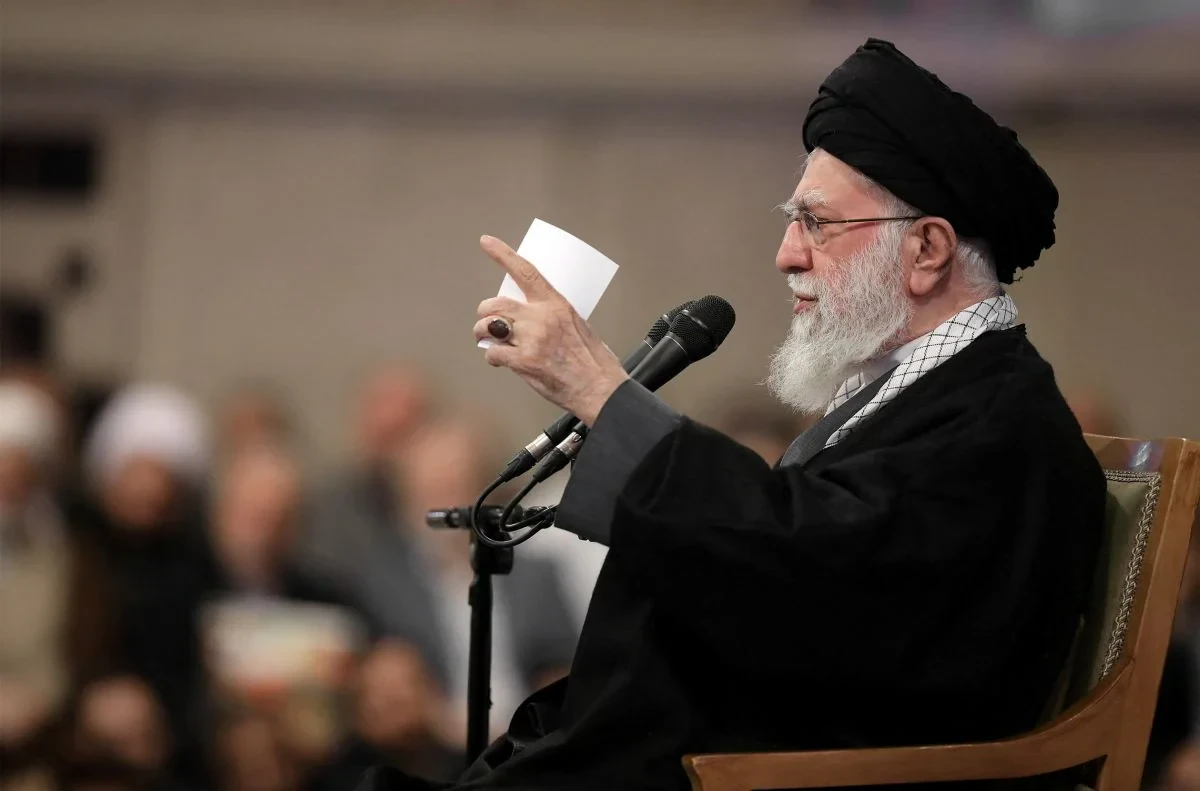
Above photo: Supreme Leader’s Office.
The US president has repeatedly threatened to bomb Iran.
Since unrest erupted across the country weeks ago.
Iran’s Supreme Leader Ali Khamenei vowed in a speech on 9 January that Tehran “will not back down” in the face of US pressure and threats, while strongly condemning foreign-backed rioters causing unrest in the country.
“Everyone should know that the Islamic Republic came to power with the blood of hundreds of thousands of honorable people and will not back down in the face of saboteurs,” the supreme leader said.
“Our nation does not tolerate mercenaryism (working) for foreign powers. Whoever you are, when you become a mercenary for a foreigner, when you work for a foreigner, that country considers you rejected,” he added, stressing that Iran will “not tolerate agents supported by foreign powers.”
“Last night in Tehran, a group of vandals destroyed public property belonging to themselves to please the president of the United States. If he can, he should manage his own country,” Khamenei went on to say.
He slammed US President Donald Trump, calling him “arrogant” and accusing him of having “blood on his hands.”
“That person who sits there with arrogance, judging the whole world, should also know that usually the tyrants and arrogant powers of the world – Pharaoh, Nimrod, Reza Khan, Mohammad Reza, and the like –were overthrown exactly when they were at the peak of their pride. This one will be overthrown as well.”
“This person said, ‘I gave the order; I commanded during the war,’” he added, referring to Trump’s comments about the 12-day US-Israeli war on Iran in June. Before the war, the US president pretended to be opposed to an Israeli attack – stressing the need for diplomacy while secretly planning the June assault with Israeli Prime Minister Benjamin Netanyahu.
“So, he confessed that his hands are stained with the blood of Iranians. Then he says, ‘I am a supporter of Iran.’ And a handful of inexperienced and thoughtless people believe it and act according to his wishes,” Khamenei went on to say.
Protests erupted in Iran around two weeks ago due to a collapse in the local currency, resulting from years of harsh US sanctions.
While many of the protests remained peaceful, many others quickly turned violent – with armed rioters repeatedly attacking security forces over the past several days.
Western-based rights groups say 42 have been killed. Iran has not released any official death toll.
Over six members of the Iranian police and security forces have been confirmed killed by rioters, while at least seven rioters have been shot dead by authorities. Local reports have said that rioters were also responsible for several civilian casualties.
Baloch separatist militia Jaish al-Adl this week claimed responsibility for a drive-by shooting that assassinated Iranian police commander Mahmoud Haqiqat.
On Thursday evening, a security guard was killed by rioters, and his body was set on fire. Over 600 policemen and Basij officers have been injured since the start of the unrest.
Iran’s Islamic Revolutionary Guard Corps (IRGC) announced on 8 January that two of its members, Mohammad Sheidaei and Mohsen Jamali, fighters from the 29th Hazrat Nabi Akram Division, were killed in Kermanshah during clashes with armed separatist groups amid unrest in the province.
According to the mayor of Tehran, 42 buses and ambulances have been set ablaze, while arson attacks have targeted 10 government buildings and 24 residential homes in the capital.
He added that riot leaders and anti-government militants used protesting teenagers as “human shields.”
Iran’s National Security Council said it will take decisive legal action against armed vandals and those disrupting public security, while urging families to remain vigilant and prevent the exploitation of youths by hostile groups.
According to local reports, videos were found on the phones of some protesters, including instructional messages from what appeared to be foreign intelligence. The messages guide protesters on how to act if caught by security forces, while urging young anti-government protesters to put pictures of Khamenei as their wallpaper on their phones in order to disguise themselves as pro-Islamic Republic.
At least 11,000 Iranians took to the streets on 8 January in multiple areas across Iran, including Mashhad, Lordegan, Hamedan, and Kermanshah.
Since the protests began, Trump has repeatedly threatened to attack the Islamic Republic.
“We’re watching it very closely. If they start killing people like they have in the past, I think they’re going to get hit very hard by the US,” Trump said recently, after vowing days earlier that Washington will “rescue” Iranian protesters.
The Mossad also publicly urged Iranians to go out in the streets, saying, “we are with you.” US Senator Lindsey Graham said this week that Khamenei will “wake up dead” if protesters are killed.
According to a report by Israel’s Channel 12, Tel Aviv is preparing for the possibility of a “sudden” conflict with Iran.
Netanyahu visited the US recently and discussed potential new strikes on the Islamic Republic with Trump. During a press conference, the US president said he would potentially support a new Israeli attack.
The Iranian military warned on 7 January that Tehran could potentially launch a pre-emptive attack on Israel in response to the escalatory rhetoric recently from both Tel Aviv and Washington.