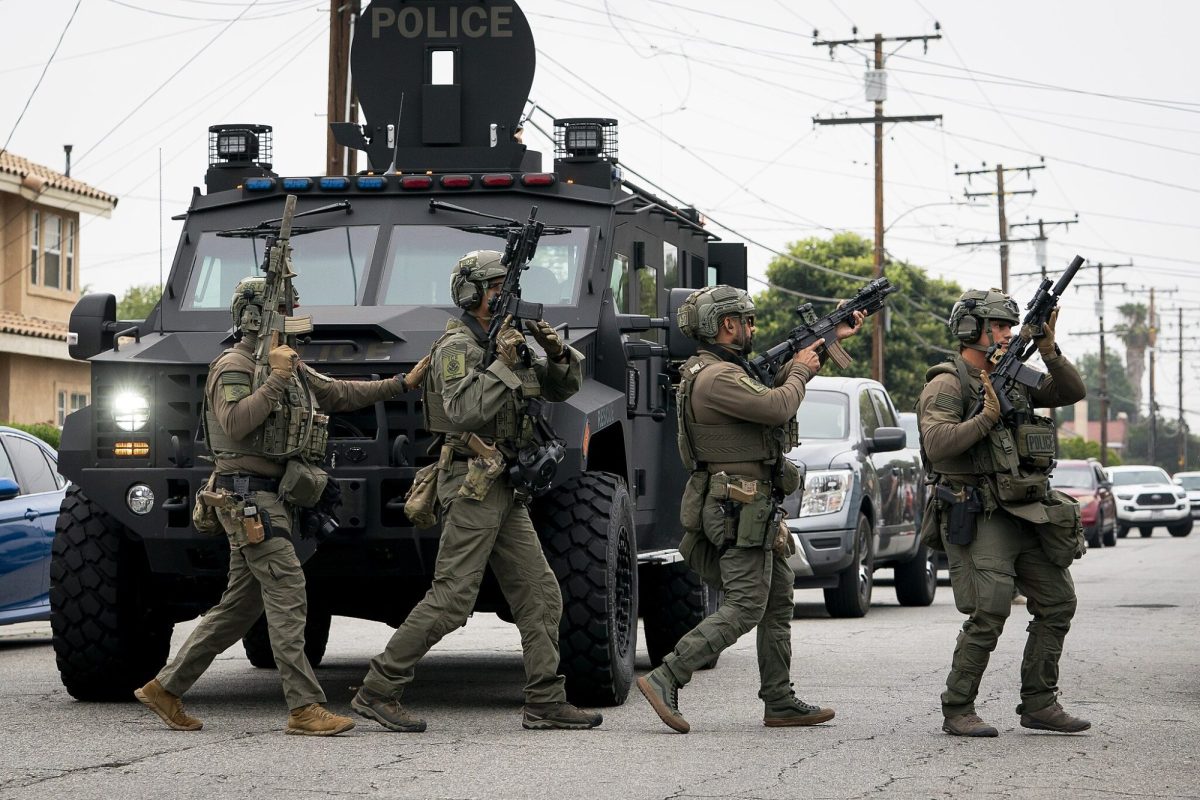
Above photo: Department of Homeland Security (DHS) Secretary Kristi Noem participates in U.S. Immigration and Customs Enforcement (ICE) Enforcement and Removal Operations (ERO) in Los Angeles, California, June 12, 2025. DHS photo by Tia Dufour.
Walking through a Home Depot parking lot while being brown raises enough reasonable suspicion in an immigration agent’s mind to cause my detention for a citizenship check, as Supreme Court Chief Justice John Roberts and the Five Supremes recently ruled. The 6-3 decision gave agents wide latitude to conduct indiscriminate immigration stops of Latinos suspected of living in the U.S. illegally, even if we are citizens.
Concurring with the court’s ruling, Justice Brett M. Kavanaugh wrote that ethnicity alone can’t be grounds for reasonable suspicion, but it can be a “relevant factor” when considered with a combination of other factors. But take it from someone who grew up in South Texas and has had interactions with Border Patrol agents throughout his life — a person’s ethnicity is often the only requisite for a citizenship check.
It’s safe to say that five of the Supremes have no empirical knowledge of racism, while the sixth appears to be in denial of how his ethnicity has impacted his life for the bad and good. In any case, Roberts and the Five Supremes have legalized the use of ethnicity as grounds for stopping and questioning Latinos about their citizenship. A head spinning move after ruling in June 2023 that it’s illegal for colleges and universities to use race as a factor in their considerations for admissions.
Conservatives use race as a cudgel contradictorily in each case. In one, agents can use it legally to profile an entire group of people, in fact millions, as possible suspects, if not criminals, and in the other, it’s used to address white grievance by criminalizing affirmative action.
The court acted on an emergency request by the Trump Administration to lift a Los Angeles federal judge’s order prohibiting immigration agents from making indiscriminate stops of Latinos based on four factors: skin color, speaking in Spanish, speaking English with an accent, and assembling in such day-labor places as Home Depot parking lots.
Kavanaugh’s written opinion said these factors create reasonable suspicion about someone’s immigration status, and their physical appearance may be a trigger to question them. It’s a conservative ethos that some people just don’t look like “Americans.”
But stop and consider this scenario for a moment. Many Anglo kids from my generation who grew up in my hometown speak border Spanish as well as I or any of my Tejano friends. If one of my Anglo friends and I were heard speaking Spanish in a Home Depot parking lot during an immigration raid, which one of us do you think would be detained and questioned by immigration agents?
The Trump Administration’s aggressive enforcement action against illegal immigration includes deporting people without due process and confining them in concentration camps. One of the architects of the administration’s solution to the illegal immigration problem is Stephen Miller, who set an arrest quota of 3,000 immigrants per day.
But Miller’s quota comes with a cost to civil liberties, as noted in a dissent by Justice Sonia Sotomayor, one of three liberals who dissented from the majority’s ruling, and also in accounts of Latinos detained or arrested by immigration agents.
“We should not have to live in a country where the government can seize anyone who looks Latino, speaks Spanish and appears to work a low wage job,” she wrote. “Rather than stand idly by while our constitutional freedoms are lost, I dissent.”
I’ve never been seized, but I have been stopped and questioned about my citizenship.
In the days when I covered immigration and the border as a newspaper reporter, the story line from Border Patrol officials was that physical appearance only played a minor role in an agent’s decision to question someone about their citizenship. Growing up in South Texas, I knew a different practice.
On May 8, 1967, 10 ten days before I arrived in Vietnam for a 12- month combat tour, my father drove us to Houston to watch the Astros play the Los Angeles Dodgers at the Astrodome. My dad was a federal civil servant at the time, a World War II combat veteran and had briefly worked as a detention officer for the old Immigration and Naturalization Service. We were stopped by Border Patrol agents at the Sarita, Texas immigration checkpoint on U.S. Highway 77 and were questioned.
The questioning was combative. My father’s driver’s license and U.S. government issued ID and my driver’s license and military ID were not sufficient to convince the agents that we were Americans. Nor was our explanation that we were going to Houston to see a baseball game. We were answering their questions in English. After 15 minutes or so we were sent on our way.
In 1971 I took my wife, who was born in Los Angeles and grew up in Orange County, to visit my family in Texas. As we approached the Border Patrol checkpoint in Sierra Blanca on Interstate 10 east of El Paso, a car with a white family passed on the right, and as we slowed to the checkpoint, I was behind a Datsun pickup with a camper shell that had black and white Iowa license plates.
The agents waved the car with the white family and Datsun truck through without questioning the occupants but one raised his hand as our car approached. My reaction was instant and visceral. I didn’t spend 12 months in combat to return as a second class citizen. I rolled the window down and before the agent, a Latino, could speak and asked why he didn’t question the folks in the other vehicles.
The startled agent said he had a right to stop and question me. Our nine month old baby was sleeping in the back seat, and he asked if she was a U.S. citizen. My wife, who speaks limited Spanish, gasped when the agent directed his attention to our baby.
My brothers and I spent summers working in the fields in our youth. At the time, most Border Patrol agents were Anglos. When they descended on a field they would usually question the children first, in English. What grade are you in? What’s your teacher’s name? What’s the name of your school? What town do you live in?
It was a purposeful strategy. If the kids were of school age and didn’t speak English there was a good possibility that they were undocumented and their parents and other family members were probably working in the same crew and were also undocumented.
In a scene from the 1985 movie Born in East LA, an authoritarian cop hiding behind mirrored sunglasses asks Cheech Marin “where were you born?” This scene triggered a flashback to my cotton picking days the first time I watched it. The movie was a spoof of immigration agents rounding up Latinos — undocumented and citizens alike — in East Los Angeles. The spoof has become reality in Southern California and Latino communities throughout the country, but immigration agents now wear masks under sunglasses to completely hide their faces.
Today’s ICE raids are reminiscent of Operation Wetback, a short lived 1954 enforcement and deportation program by the administration of President Dwight D. Eisenhower that targeted undocumented mostly male, Mexican farm workers. The operation focused mainly on the southern border and began in California.
In Texas, the roundup began in the Rio Grande Valley, a heavily Latino area where I grew up. Teams of Border Patrol and immigration agents stormed through neighborhoods, downtowns and agricultural fields asking Latinos, including citizens, to produce proof of legal residency or citizenship. Agents also set up roving highway roadblocks. There were reports that Border Patrol agents in South Texas were charging Mexicans a $10 deportation fee. As has been the case in Trump’s immigration raids, U.S. citizens were also deported.
I was seven years old at the time and remember American citizens living in fear of the Border Patrol. The only difference between the racism then and now is that in 1954 it wasn’t accredited by the Supreme Court.
As noted earlier, it’s unlikely that Chief Justice Roberts and the others have ever been victimized by racism or singled out for any reason by law enforcement. Their lifting of the Los Angeles federal judge’s order prohibiting what attorneys for Latino plaintiffs called “blatant racial profiling” by immigration agents reveals a mindset that says this is just a fact of living in a democracy. Bad things can happen. U.S. citizens who are stopped and made to prove they aren’t living here illegally are merely inconvenienced. They are collateral damage that sometimes occurs in a democracy where there is liberty and justice for all.
Just ask Justice Kavanaugh. His answer: “For stops of those individuals who are legally in the country, the questioning in those circumstances is typically brief, and those individuals may promptly go free after making clear to the immigration officers that they are U.S. citizens or otherwise legally in the United States.”
And if one is roughed up by federal agents during their detention, Kavanaugh suggested that it’s no big deal. Just sue them. “To the extent that excessive force has been used, the Fourth Amendment prohibits such action, and remedies should be available in federal court,” he wrote.
This is Kavanaugh’s kumbaya view of the dynamic in the immigration debate in the U.S.; immigration agents act with judiciousness and within reason with Latinos.
Jason Brian Gavidia, a U.S. citizen and plaintiff in the case filed in Los Angeles federal court, would beg to differ. His experience with federal agents was reported by the New York Times.
Gavidia runs a body shop in Montebello, a city in East Los Angeles County, where federal agents descended in June and questioned him. He told them he is a U.S. citizen, born in East Los Angeles but couldn’t tell the agents the name of the hospital where he was born. Agents then threw him against a metal fence, twisted his arm and took away his cell phone. The incident was captured on video.
A witness to the incident commented on the video that agents descended on Gavidia simply because of his skin color.
“I’m an American, bro,” Gavidia told the agents and offered to show them his ID. They took his cell phone and ID and later returned the phone but kept the ID and released him.
The Times quoted Gavidia talking about the agents from a video he took after he was released: “That’s the new gang of L.A. right there. This is not fair at all, bro. We’re all American here, man.”
Gavidia’s isn’t an isolated case. Consider Andrea Velez’s encounter with ICE agents. She was charged with assaulting an ICE officer and interfering with an arrest but the charges were later dropped. Velez, a U.S. citizen and Los Angeles resident, believes she was targeted for no other reason than she is Latina.
Trump’s emergency request was heard on what’s commonly called the Supreme Court’s shadow docket, a place where Trump finds favorable outcomes when he rails against an unfavorable ruling against his administration by a lower federal court. The emergency usually is that Trump simply doesn’t like a lower court judge’s ruling, and usually by a 6-3 vote Roberts and the Five Supremes give him relief without explanation to the public or judges whose findings they’ve put on hold.
The six justices are in effect a Trump court within the Supreme Court. In less than the almost eight months that Trump has been in office, he’s filed 25 emergency requests, according to Reuters. The court only rejected two cases. One was declared moot and the administration withdrew two applications.
During Biden’s four-year term, his administration filed only 19 emergency applications in the Supreme Court and the court granted relief in 10 cases, according to Georgetown law professor Steve Vladeck.Vladeck also reported that the first Trump Administration filed 41 emergency applications in four years. The Bush and Obama administrations filed only eight applications in the 16 years they were in office.
In less than eight months of his current term, Trump has filed more than half of all the emergency applications he filed on the Supreme Court’s shadow docket during the four years of his first term. Hey, as long as John Roberts and the Five Supremes keep giving him what he wants, why stop? Right?