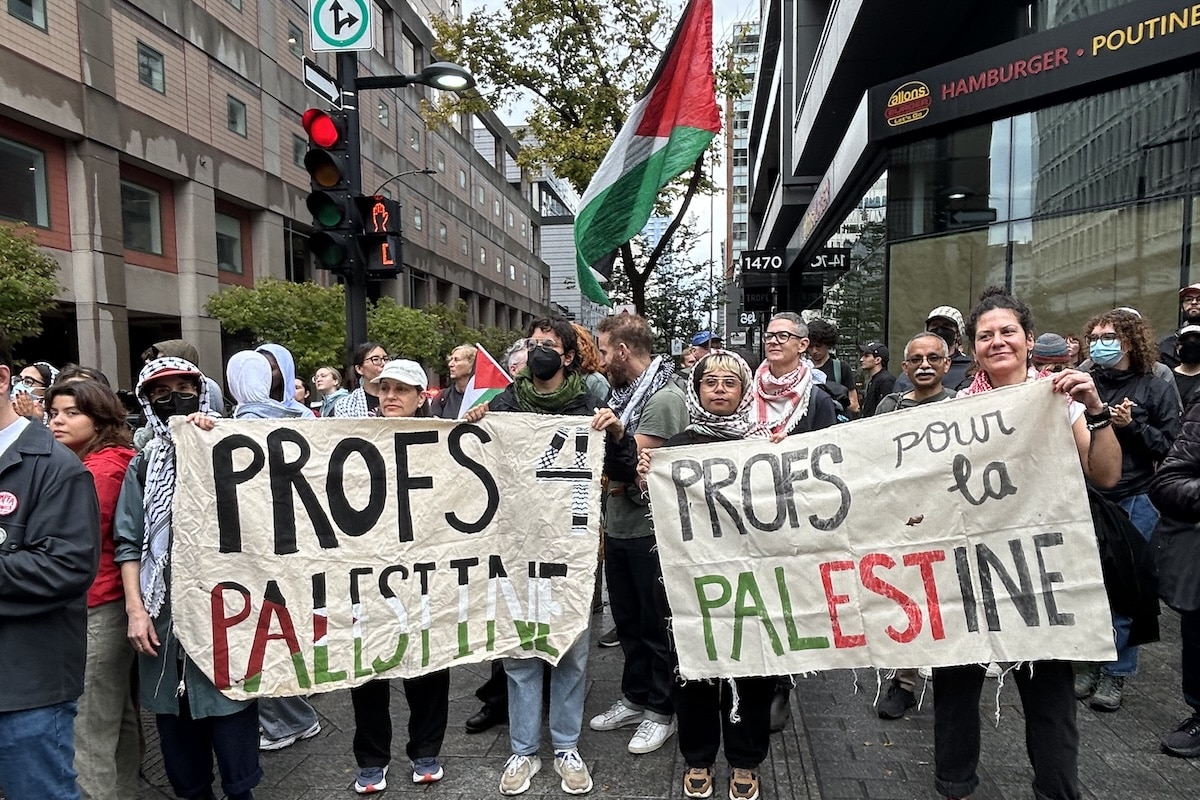
Above photo: Professors from McGill and Concordia, October 7, 2025 supporting the student strike for divestment and against genocide.
In a 114-8 vote, the McGill Association of University Teachers endorsed the academic and cultural boycott of Israel.
The win came after years of organizing, demonstrating the collective power of professors, librarians, and students against genocide.
On October 10, 2025, the McGill Association of University Teachers (MAUT) succeeded in passing a resolution at a special general meeting endorsing the academic and cultural boycott of Israel. The resolution calls for the association to “take all necessary steps to implement the boycott of Israeli academic institutions, while ensuring that the boycott applies to institutional partnerships and agreements, not individual Israeli academics.”
This principled stance taken by full-time professors and librarians is a major victory at a university where such an action was thought to be impossible until recently. An article in the student-run McGill Tribune the day after the vote characterized this vote as “historic,” another calls it unprecedented. With this huge victory, the faculty association joins at least 20 other such associations in Canada, as well as others across North America and the world. As a recent article in the Guardian points out, “boycotting Israel has gone mainstream.”
This endorsement by a large group of professors and librarians across the university demonstrates that solidarity with Palestine cannot be silenced. It may be difficult to hear our unwavering voices – especially in an atmosphere of repression well-documented by the report “Palestine on Campus,” but we keep pushing ahead and it only gets louder.
Conventional wisdom held that it would be impossible for professors to endorse the academic boycott at McGill, an institution that has proudly accepted donations from prominent Zionist donors who actively support the state of Israel. One example is the well-known Quebecois donor, Sylvan Adams, a self-proclaimed “ambassador of Israel” in Canada. With the world increasingly cutting ties with the state of Israel and implementing boycotts, McGill doubled down and continued to build a sports centre in Sylvan Adams’ name, while devoting a section of the centre’s website to his biography, giving him unusual attention in a university context, especially at McGill. The so-called, “McGill University -Tel Aviv University Collaborative Sport Science Grants” are advertised on the centre’s website, exemplifying the type of activities tied to the state of Israel that the boycott aims to stop.
It is in this context of complicity, marked by retaining as well as establishing new exchange programs during this period, that professors accelerated their efforts to endorse the boycott.
Movement building at McGill
Many believed that we would not have enough support and that professors would shy away from it because of intimidation. But in the end the campaign victory was the result of a long period of organizing and building solidarity between and among professors, librarians, and students, as well as across other sectors of the university, including healthcare workers, lawyers, and non-academic workers.
Crucial to our support network and solidarity-building was the role of students and decades of local, collective, mutually supportive work with them. We had worked in support of the Palestinian students and diverse student bodies in the solidarity movement, and joined efforts with students in the so-called “printemps érable” or student strike of 2012. Whether as professors, actively participating in a large movement, or engaging in distinct actions that build and bolster solidarity, these forms of learning in action were crucial to our formation as professor-organizers.
At McGill where we work, we were also part of many campaigns over the years. Alone and with colleagues at Concordia University, which is 10 minutes away, professors worked closely with students, supporting their projects, participating in their strikes, mobilizing professors to show up to their events or/and tie their projects to theirs, as well as recognize their collective decisions and that their right to strike is not undermined by the university’s administration. Meanwhile, we also built strong ties with local Palestinian community associations and leaders.
What would have seemed impossible at McGill–often characterized by a politically apathetic student body–has now happened twice in one year; students have gone on strike for Palestine. The mood on campus has substantially changed, as a record number of students voted on and then ratified, in an online process, a strike in solidarity with Palestine on October 7, 2025. Professors and librarians from McGill, Concordia, and Dawson College stood proudly together and with students on this strike day.
Escalating against genocide
The tradition of working together in the Palestinian solidarity movement, as students, professors, and librarians has long origins, but was intensified and diversified from October 2023 onward. The furious pace of organizing worked to keep up with the escalating horror in Palestine, especially in Gaza, when new red lines were being crossed daily. In October 2023 and after, the droves of people, pouring into the streets around the world and in Montreal, in solidarity with Palestine, was notably led by the youth.
On campus, those of us with more experience worked to keep up with the students’ pace. We were focused on navigating the new challenges of organizing together with the many people who are joining the movement; holding our local, provincial, and national governments–along with our universities– accountable; and formulating ways to resist the repression and censorship the movement was facing.
For two years, starting October 2023, campus organizing for Palestine at McGill reached unprecedented levels. The student union passed a policy against genocide, affirming BDS, supported by professors, and built and maintained a 75-day encampment, while holding two strikes, one on April 2, 2025 and the most recent one on October 7, 2025 just days before the professors and librarians’ vote on the boycott.
As we reflect on what we are doing in this moment after our successful boycott vote, we want to underline how much invisible labor goes into the successful organization of solidarity movements. We never want to lose sight of our goal–supporting the liberation of Palestine–nor elevate our own hard work above the on-the-ground resistance. It is nonetheless important to underscore the work that is unnoticed. The support of librarians, for example, was crucial in this boycott, though they are often ignored with focus being placed on professors.
The vote is just the beginning
As we approached the MAUT general meeting vote we were told that it would be nearly impossible to meet a quorum of 100 people. A meeting during the same week drew about three dozen people. Supportive colleagues encouraged each other not to be disappointed if we did not manage to have enough people for quorum and therefore a binding resolution.
In the end, this proved not to be the case. The attendance at the time of the vote was 114 full members, 2 abstentions, 8 votes against, and the overwhelming majority of 104 people in favor. The moment the vote was announced people burst out in applause. Our minds went immediately to our Palestinian colleagues, friends, and family–thinking about this very small gesture of support toward them, which we have worked so hard to fulfill. We also immediately thought about the colleagues, friends, and family we have lost in Gaza, and the destruction of all of the universities and most of the schools they worked in.
The resolution itself for Gaza, for Palestine, standing against genocide by calling for this boycott was a deeply collective effort. The twelve colleagues who proposed the motion came from six faculties, and there was support from at least two others based only on people we talked to. Many colleagues could not attend the meeting but we still had an unprecedented turnout at our vote. At least two colleagues we spoke to directly told us they had changed flights, another four shifted other travel arrangements to be at the vote in person. People told us directly and clearly that they were moved and motivated by the ongoing situation in Gaza and because they wanted to firmly, loudly, and clearly stand against genocide.
On October 10, we affirmed our commitment to hold our university accountable to us as professors and librarians by exercising a boycott against Israeli academic and cultural institutions, and now we begin working to implement this boycott and work together to support the struggle for freedom and liberation in Palestine.
As professors and librarians, we most often work in different capacities and diverse ways. Our experiences in the last twenty years, but especially the last two years, has shown us the power of collective organizing; the necessity of building solidarity together and among each other in various departments and faculties, and across our associations and unions. We must work together with colleagues in other universities and institutions. Crucially, we must build our work in support of students and alongside students and other youth. Our struggle is far from over, it has only just begun.