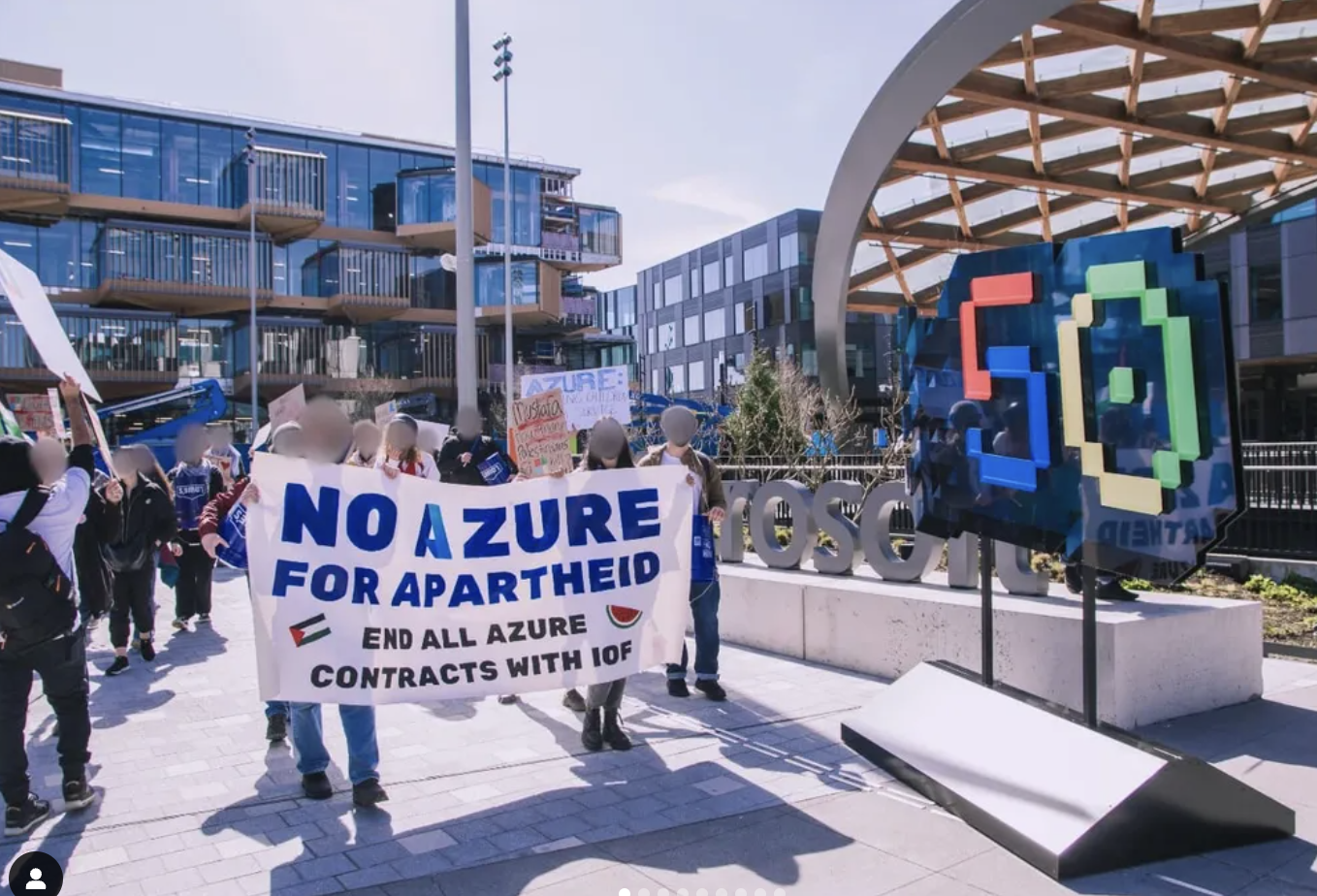
Above photo: Protest outside Microsoft 50th anniversary event. No Azure for Apartheid social media.
Mondoweiss talks to former Microsoft employees fired for protesting the company’s role in the Gaza genocide.
Last fall, Microsoft fired software engineer Hossam Nasr and data scientist Abdo Mohamed after they held a vigil for Palestinians killed in Gaza outside the company’s headquarters.
Nasr and Mohamed are members of No Azure for Apartheid, a group calling on Microsoft to stop providing its cloud computing to the Israeli military.
“As technology workers, we are hyper aware of the fact that our work—especially with the advancement of AI and cloud technologies—has the potential to enable any company and any organization to inflict harm and violate human rights,” reads a petition circulated by the organization. “The products and services we build are being used and distributed around the globe to surveil, censor, and destroy. We cannot stand by while our labor is utilized to aid in the oppression of innocent people.”
The Palestinian BDS National Committee, which recently made the company a priority boycott target, Microsoft is “perhaps the most complicit tech company in Israel’s illegal apartheid regime and ongoing genocide against 2.3 million Palestinians in Gaza.”
In March, No Azure for Apartheid members shouted down Microsoft president Brad Smith and former CEO Steve Ballmer during a Seattle event, after rallying outside the building.
View this post on Instagram
A post shared by 🇵🇸 عين على فلسطين | Eye on Palestine (@eye.on.palestine)
Last month, Microsoft fired two employees for disrupting its 50th-anniversary event in protest of the Israeli business dealings. One of those workers was Vaniya Agrawal, who had already been given her two weeks’ notice, but got an email after the protest informing her that she was being let go immediately.
Mondoweiss U.S. correspondent Michael Arria spoke with Nasr, Mohamed, and Agrawal about the growing campaign.
This disruption was the second one in a month, and there have been a number of other actions and protests recently. Can you talk about how support for this movement has grown? I am also wondering if you’ve heard anything from the company since being fired?
Agarwal: The disruption was April 4th. On April 7th Ibtihal [Aboussad] and I were both terminated, effective immediately. Since then we have not heard anything from Microsoft, no statements. No public statements, no private statements. Completely in the dark.
Looking across social media, I think as our movement has picked up awareness and people have come to understand more about Microsoft’s complicity in Israel’s genocide, you’ve seen people calling out Microsoft across social media platforms and like Instagram and LinkedIn. You’ve even seem people commenting on the company’s YouTube, although Microsoft has responded by deleting or shutting down comments.
So even on that front, there’s been no accountability, no statement, no explanation from them at all.
Nasr: Over the past year, we have been building over the past year or so, and have been able to, in my opinion, put a crack in the fortress that Microsoft has built through its PR team.
Microsoft has built this image of being the good tech company, the ethical champion of human rights, and so on. And a lot Microsoft’s work is building this image that it’s more moral than other tech companies. It’s become clear that through their partnerships with the Israeli military, through through their complicity in Israel’s apartheid and genocide regime, that is that image is no longer present among both workers and the public.
I think workers in particular, have been able to learn about the extent of Microsoft’s complicity through leaks and articles that have come out in the press recently from+972 Magazine, Drop Site News, The Guardian, and the AP, coupled with Microsoft’s internal attempts at silencing dissent, ignoring workers who dare to speak up, retaliating against them, firing them even.
It also shows that this bloody partnership is untenable to the public. Microsoft was just listed as a priority boycott the day before the disruption on April 4th.
I think that the partnership between the worker organizing and the mass engagement through boycotts, through rallies, through all kinds of public pressure is the only way to put pressure on these companies to end the bloody partnership with the Israeli military.
I believe we have reached that tipping point in many ways. Like I think now, the amount of interest that we’ve seen since April 4 has been enormous. We’ve doubled the internal signatures we have on the worker petition just over the past couple weeks since the disruption happened.
Dozens of workers have either reached out to the campaign, saying they want to quit Microsoft. They don’t believe that their work is ethical or moral anymore. It feels like a watershed moment for the campaign and for Microsoft worker organizing on a wider level.
Mohamed: Every time the media has asked Microsoft to comment on its lucrative contracts, its firing of workers, or to comment on No Azure for Apartheid’s demands, Microsoft has used this tactic of declining to comment and stalling out.
They’ve promised to answer, but completely dodged these questions publicly, which speaks to how Microsoft is trying to use this tactic of complete silence, to avoid addressing this.
When we would bring up these articles and research incidents around Microsoft contracts with the Israeli military, the questions would get deleted. At AMAs, the questions would get ignored, the threads would be closed.
It’s this dual-sided approach where you are repressing internally and completely avoiding publicly commenting in the hopes that the movement will slow down. However, as we have seen time and time again, the more Microsoft has repressed and declined to comment, the more pressure that mounts on the company, the more workers that are mobilized and agitated to take action.
In the BDS call, they refer to Microsoft as perhaps the most complicit tech company in Israel’s apartheid regime. I was wondering if you could talk about the company’s connection to Israel? I also saw that one of your demands is transparency, so I assume the extent of these contracts isn’t actually known.
Nasr: This aspect of transparency is often overlooked. All the information we have about contracts has come through leaks or investigations that contain either Microsoft sources or sources from the Israeli military.
Microsoft has never disclosed and has never been open about its partnership with the Israeli military, unlike other companies like Google and Amazon, who, despite still being very secretive about the nature of their contracts, haven’t really hidden them.
Internally, this translates into workers at Microsoft not knowing that they are being used. They don’t know their work could end up directly involving them in the murder of Palestinians in Gaza.
There is an issue around employee consent. Even weapons manufacturers at least offer their employees the option to consent to working on military or dual-use products. That’s not the case on Microsoft. In fact, often, we hear from colleagues overseas, who say they are being forced to work on support tickets from the Israeli military or face consequences.
Those support tickets that come from the Israeli side are often obfuscated, and the military uses fake names to hide where they are actually from. Many workers end up saying they feel tricked by this. They feel betrayed, like they were forced to contribute their labor a genocide.
Microsoft Azure and AI run the most sensitive and confidential workloads for the Israeli military. It’s essential to the acceleration and the exacerbation of the world’s first AI-assisted genocide that Israel is carrying against Palestinians and Gaza. Microsoft provides cloud AI translation and storage services and it stores mass surveillance data collected from the Palestinians. 13.6 petabytes worth, each petabyte being a thousand terabytes.
Microsoft then, provides translation services to translate the surveillance data from Arabic to Hebrew, and then feeds that data into AI targeting systems that decides who gets to live and who gets to die, that labels Palestinians as terrorists, and that tracks Palestinians, waiting for an opportune moment to kill them.
Microsoft Azure also runs the target bank for the Israeli military and the civil registry. for the Palestinian population through a system called the Rolling Stone. Microsoft Azure also runs an app that handles permits for Palestinians living in the West Bank. So it enforces Israel’s apartheid regime against the Palestinian people.
Broadly speaking, Microsoft Azure is seen as the most trusted cloud and AI partner to the Israeli military. It’s being treated by the Israeli military as a weapon in its own right. Senior officials in the Israeli military are quoted as saying that if it were not for these civilian cloud services provided by companies like Microsoft, Google, and Amazon, they would not have be as effective.
Agarwal: Microsoft is unique in that it embeds workers in these Israeli military units to work on sensitive and highly classified projects like surveillance systems. It’s not just the cloud that is a huge, huge part of it; it also extends beyond that into consulting services and things like that.
Microsoft staff and contractors provide specialized consulting and tech support, both remotely and physically, on military bases. There are government partnerships, policy and prison partnerships, illegal operations on illegally occupied land, including settlements, and the list just goes on. All of these are detailed and in the BDS Complicity Report on Microsoft.
You’ve addressed this a little already, but how aware do you think workers are about all these things?
Mohamed: Microsoft spent a lot of money and resources early on to hide contracts and its complicity. When we consider the relationship between the company and Israel, it goes back over 30 years, and they’ve done a lot of work to hide that fact.
Since we launched our campaign and released the first paper detailing Microsoft’s complicity, we have also done the sustained work of putting on town halls for the workers, doing social media exposés, writing these white papers, and even sending company-wide emails to thousands and thousands of workers on how this technology is being used.
Like most corporations, Microsoft has standards of business conduct, trust codes, anti-corruption commitments, and so on. I assume this relationship violates its own internal rules and I know companies have severed relationships with countries over much less than Israel has done.
Nasr: I think the crazy part here is that we’ve seen other companies try to walk back their commitments to such principles. We see how Google has completely betrayed their commitment to not using their technology for military purposes. Even Open AI, a company that was once heralded as this utopian AI company has also recently walked back the restrictions on using their technology for military purposes and added a clause that allows it for “national security reasons.”
Microsoft is actually selling open AI technologies to the Israeli military, but it still maintains this facade of being committed to human rights. Their own AI policies have very clear restrictions about using the technology to harm others, let alone to commit genocide.
This is one of the biggest gaps I have seen between purported values and how the technology is actually being used. It’s a blatant violation of Microsoft’s own policies.
They’ve just completely failed to address this every time they’re asked to comment. They just ignore these issues when they’re raised. Workers have tried go through the appropriate reporting channels for these sort of violations and it’s gone nowhere.
Funnily enough, there was this phone number provided by the company for workers to report potential human rights violations connected to the technology. One of our members tried to use that phone number to report the Israeli military, and it just went straight to voicemail, and they were not even able to file the complaint.
Mohamed: There are human rights statements and the responsible AI protocols that Microsoft promotes as part of its image.
We have also seen Microsoft ignore statements from the UN Special Committee that was asking companies to look into their relationship with the apartheid regime and divest. We see Microsoft making all these commitments to the Universal Declaration of Human Rights and other guidelines, and taking no action.
We can look back at Microsoft’s history. It divested from apartheid South Africa in 1986. It took action to end sales to Russia amid the invasion of Ukraine. We also know that Microsoft once divested a nearly $70 million investment from an Israeli cyber-surveillance start-up under internal and external pressure.
So there’s a precedent, and Microsoft could divest. It could choose to uphold the human rights statements or its own standards, but it’s choosing to ignore them and prioritize the bottom line. You are seeing Microsoft actively choosing profit over human rights.