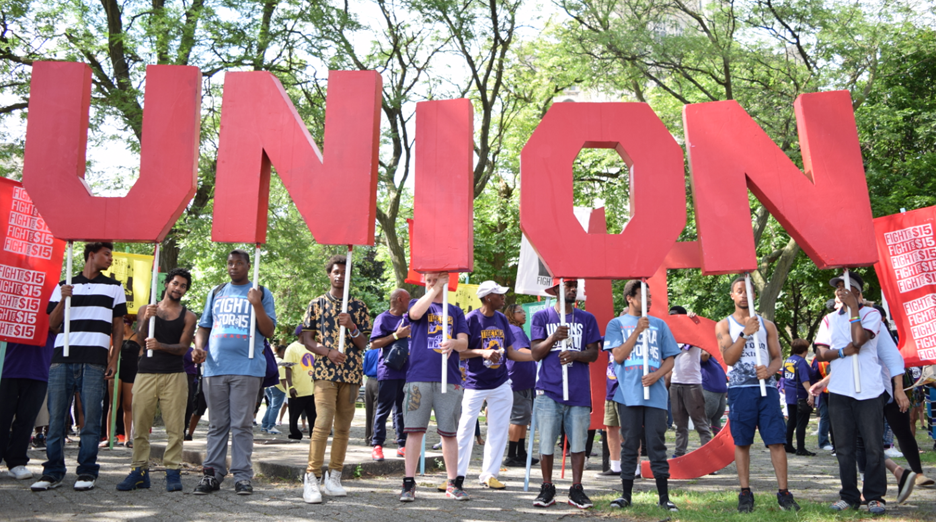
Above photo: Pro-labor activists at a climate protest before the 2019 Democratic debate in Detroit. Andrew Roth/Michigan Advance.
Health care and service workers drive new organizing wave.
Michigan now has a more receptive environment for labor organizing and collective bargaining following the repeal of Right to Work laws within the past few years, and previous failures to retain unions in the private sector, according to a new report from Wayne State University’s Labor Workshop.
One area of potential labor growth is in the health care sector, with a recent uptick of union organizing petitions. But the report also noted new challenges and political strain are on the horizon, including budget cuts, unfair labor practices and new anti-labor laws considering signals from federal and state leaders.
Still, researchers said that the Michigan labor movement netted important recent wins in complaint cases decided by the National Labor Relations Board and the Michigan Supreme Court. Additionally, union representation petitions in the health care sector continue to grow, the report noted, with an influx of increasingly progressive locally-based and nationally-affiliated campaigns emerging amid what Wayne State researchers called “new and militant contract battles.”
Michigan now has a more receptive environment for labor organizing and collective bargaining following the repeal of Right to Work laws within the past few years, and previous failures to retain unions in the private sector, according to a new report from Wayne State University’s Labor Workshop.
One area of potential labor growth is in the health care sector, with a recent uptick of union organizing petitions. But the report also noted new challenges and political strain are on the horizon, including budget cuts, unfair labor practices and new anti-labor laws considering signals from federal and state leaders.
Still, researchers said that the Michigan labor movement netted important recent wins in complaint cases decided by the National Labor Relations Board and the Michigan Supreme Court. Additionally, union representation petitions in the health care sector continue to grow, the report noted, with an influx of increasingly progressive locally-based and nationally-affiliated campaigns emerging amid what Wayne State researchers called “new and militant contract battles.”
That shows Michigan health care workers are becoming more cognizant of their labor’s value to their employers and the communities they serve.
“New developments in the economic landscape gave rise to increased labor activism, augmenting the state’s reputation as a labor hub, as industries and workplaces continued to expand,” the report said. “Chief among these changes has been the expansion of union representation in higher education and more active labor representation among health care workers. Also, relatively new on the labor front are the expanded efforts of low-wage, temporary, and precariously employed service workers in retail, food and beverage service, and transportation.”
On the medical front, Wayne State’s research shows that Michigan has a long history of being friendly toward health care organizing. Its growth as an industry has emerged as manufacturing in the state reduces volume, with health care now not too far behind as one of the largest state industries.
With 13.5% of Michigan’s workforce belonging to a union and 14.7% of the total workforce being actively represented by a union, health care organizing remains strong and has room to grow.
As of 2025, the sector has 25 unique health systems, and overall, health care workers have tended to affiliate with non-traditional health care unions, like Teamsters, the UAW and the American Federation of Teachers.
The report hailed organizing efforts at Corewell Health.
Per the report, Metro Detroit stands out as the central hub for union organizing in the state, with a disproportionate share of the state’s union locals and a Detroit-centric base for unique union types.
Other strong pockets of union organizing include Lansing, Saginaw, Grand Rapids and Muskegon.
Although organized labor fought for the the earned sick time and wage increase ballot measures in 2018, which were the subject of a protracted legal fight over the Michigan Legislature’s “adopt and amend” tactics that gutted the measures, the report did highlight the legislative deal that kept some of those measures intact while softening them at the behest of employers and tipped-wage workers across the state.
From 2020 onward, several federal actions have shaped the dynamic in Michigan, but the resurgence of President Donald Trump is challenging that trend.
On Right to Work laws, Wayne State’s research shows that Michigan is still recovering from the era of lower wages due to lack of union representation and restricted collective bargaining. Since its repeal took effect in 2024, Michigan saw a 17,000 person increase in union membership
There are areas of improvement, however, as only 13.4% of all Michigan employees are unionized, according to the Bureau of Labor Statistics. That figure is well above the national average, though.
Some of that could change if Republicans take back control of the Michigan Senate next year and also take the governor’s office, assuming that the GOP holds the House, as well.
Both House Speaker Matt Hall (R-Richland Township) and Senate Minority Leader Aric Nesbitt (R-Porter Township) have said the Democratic trifecta of the past few years was wrong to repeal the law. Hall would likely remain as House speaker if the Republicans remain in control of the lower chamber. Nesbitt is angling for the GOP nomination for the governor’s seat. And state Sen. Thomas Albert (R-Lowell) has already introduced a GOP Senate plan to reinstate Right to Work, which currently has no path forward with Democrats still in control of the upper chamber.
That said, the repeal hasn’t protected every union member in the state of Michigan. The U.S. Supreme Court’s decision in Janus v. AFSCME from 2018 placed Right to Work-style restrictions on public employees. Of note, private sector employees benefitted from the repeal, but laborers like school employees, state workers, police officers, firefighters, nurses, janitors and secretaries in government positions did not.
“As we have shown, Michigan union density has been recovering in the last few years,” the report said in conclusion. “The state labor movement is regaining ground. As the movement continues to grow, there will be uncertainty; but the trends leading into 2025 show a renewed spirit in Michigan unions.”