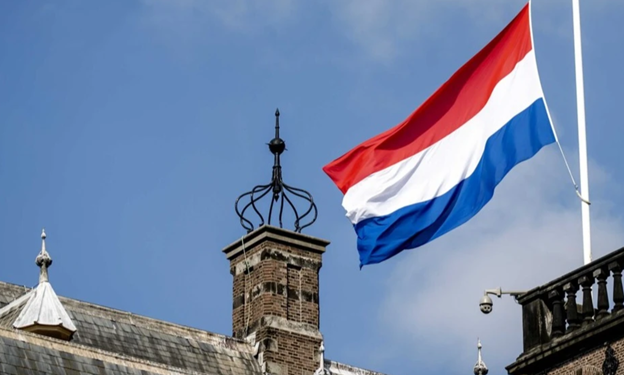
Above photo: ANP.
The Netherlands joins a small bloc of EU states responding to pressure from diplomats, rights groups, and an ICJ ruling to end complicity in Israel’s occupation.
The Netherlands is moving ahead with a partial trade ban targeting imports from illegal Israeli settlements in the occupied West Bank, Dutch Foreign Minister David van Weel said on 10 November during a visit to the region.
Van Weel confirmed that while a wider package of sanctions on Israel has been paused following last month’s ceasefire in Gaza, work continues on legislation specifically addressing settlement products.
“The Netherlands is still working on legislation to bar imports from illegal settlements in occupied Palestine,” he said, adding that the measure responds to expanding settlements and what he called “spiralling Israeli violence” that threatens the viability of a two-state solution.
He told The Guardian that “now we deem it is not a time to increase sanctions on Israel because we want to see the peace plan implemented and we want to also encourage Israel to play a positive part in this.”
“At the same time, we’re not blind to any movements on the West Bank that might move the two-state solution further [away],” he added.
Nine EU member states – Belgium, Finland, Ireland, Luxembourg, Poland, Portugal, Slovenia, Spain, and Sweden – have urged the European Commission to draft proposals to end trade with Israeli settlements.
Spain and Slovenia have already banned exports from those areas, while Ireland’s Cabinet has formally backed legislation to block settlement goods, and Belgium continues to develop its own measures.
Van Weel said the process of developing a legal basis has been slow, as trade policy falls primarily under EU jurisdiction. “It’s not easy to make a carve-out,” he explained. “We cannot just stop [all imports from illegal settlements] immediately because there is currently no legal basis for that.”
Attacks by settlers and Israeli forces on Palestinians in the occupied West Bank have surged, with UN data showing an average of eight daily incidents in October 2025 – the highest since records began around 20 years ago.
Nine EU countries previously called on the European Commission to explore ways of cutting trade with settlements after the International Court of Justice (ICJ) ruled Israel’s occupation illegal and said states must not aid or recognize it.
Former EU envoy Sven Kuhn von Burgsdorff said the settlement ban should be part of a larger policy shift that includes suspending Israel’s preferential trade arrangements, sanctioning far-right Ministers Itamar Ben Gvir and Bezalel Smotrich, and ending Israel’s participation in the Horizon research program.
“Business as usual is over … Time for impunity is over,” von Burgsdorff said.
Despite European condemnations of Israel for its genocide of Palestinians in Gaza, EU states remain among the biggest buyers of Israeli weapons and defense systems, buying over $8 billion worth last year, Bloomberg reported on 11 September, noting that “demand is only likely to grow” as NATO members boost defense spending.
In parallel, Israeli trade data also shows that several Arab and Muslim nations continue to prop up Tel Aviv’s economy despite public outrage over Gaza.
Turkiye, the UAE, Jordan, Egypt, Morocco, and even Algeria have all sharply increased exports to Israel since 2020, with Turkish goods alone valued at $5.7 billion that year.
Much of this trade involves metals, machinery, and oil routed through the Turkish port of Ceyhan, underscoring how regional commerce still sustains the occupation state’s war economy.