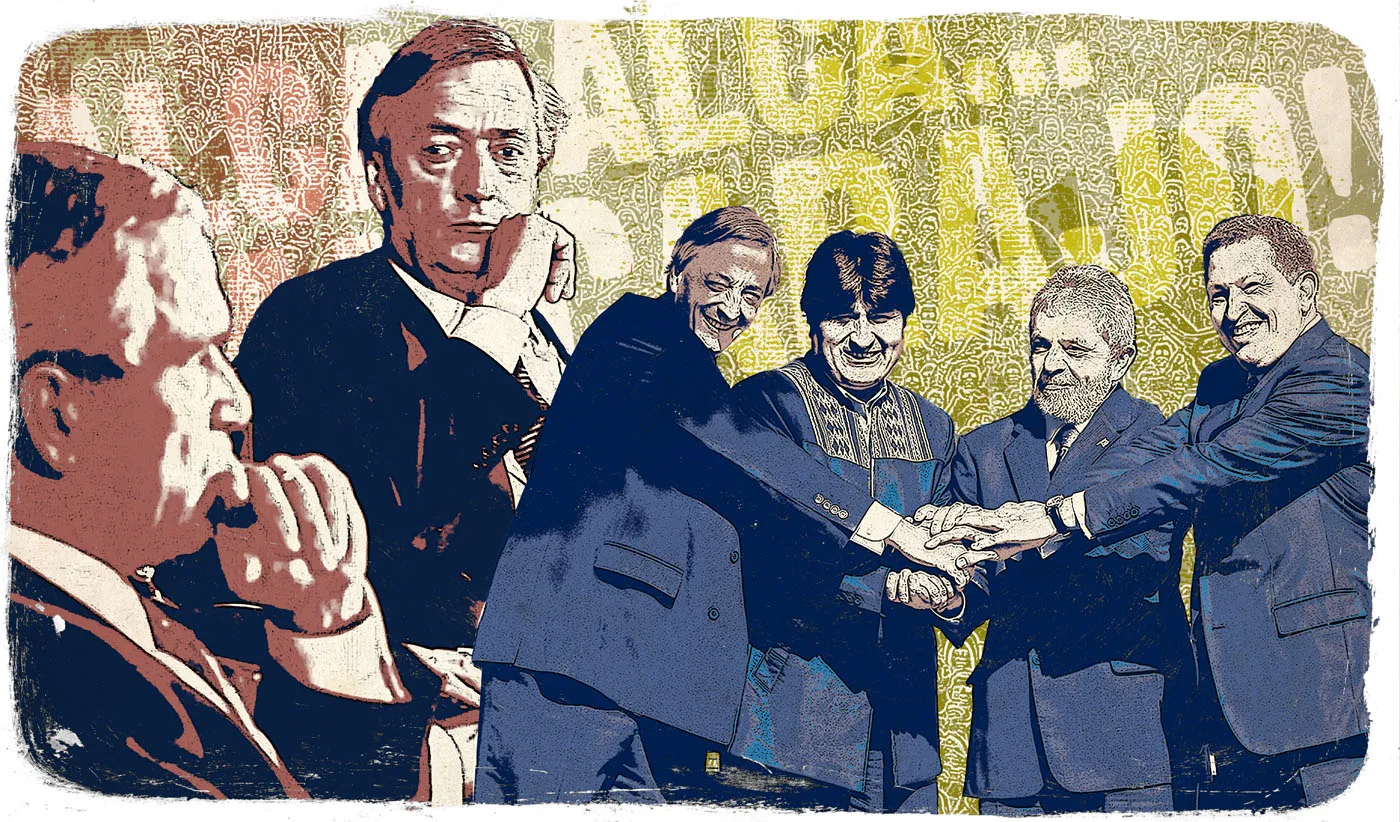
Above photo: Banner commemorating the 15th anniversary of the “No to FTAA” movement, depicts several prominent Latin American leaders who opposed the free trade agreement, including Néstor Kirchner, Hugo Chávez, Evo Morales, and Luiz Inácio Lula da Silva. PCCE.
On November 5, 2005, the history of Our America took an unexpected and perhaps irreversible leap forward in emancipation.
On that spring day in Mar del Plata, Argentina, five South American presidents joined together to say “No to the FTAA,” and, in that gesture, they thwarted the old and cherished project of the United States that aimed to definitively take over our region, now in a legal manner.
The epic story of our South American leaders is no small feat. After the collapse of the Soviet Union in 1991, the United States, with no challenges in sight, saw itself as the arbiter of global truths and decisions. Within this context, a single, monolithic way of thinking took hold globally, its motto being “There is no alternative” (TINA); its doctrine asserting that neoliberalism was the best and only possible economic system for the entire planet.
The United States then set out to fulfill its long-standing objective of having total control over our countries and our resources by establishing a continental market, without barriers, stretching from Alaska to Tierra del Fuego, but excluding Cuba. It called it the Free Trade Area of the Americas (FTAA).
That overbearing hegemony, represented at that time by President George Bush Jr., was challenged by none other than Argentina’s Néstor Kirchner, Brazil’s Lula da Silva, Venezuela’s Hugo Chávez, Uruguay’s Tabaré Vázquez, and Paraguay’s Nicanor Duarte Frutos at the Mar del Plata summit.
The asymmetry between the economy of the world’s leading power and that of the rest of the countries of the Americas was so scandalous that, had the FTAA been signed, the economic, financial, and—as we are seeing these days in Argentina—political servitude of our nations to Washington would have been absolute.
The United States took the first step in 1994. That year, President Bill Clinton signed the North American Free Trade Agreement (NAFTA) with Mexico and Canada, and established the so-called “Summit of the Americas,” whose ultimate goal was to force the rest of the American countries to sign the FTAA.
A few years later, as the 20th century drew to a close, the first effects of neoliberalism—growing inequality, loss of labor rights, precarious employment, and a lack of social protection—began to be felt in the West. Numerous groups—which called themselves “anti-globalization” movements—began to protest in the streets of the most developed countries and harshly criticize the alleged benefits of the “free market.”
The first major insurrection was in Seattle, US, in 1999. Demonstrations multiplied in several Western cities, but ended abruptly on September 11, 2001 when, following the attacks in Washington and New York, the White House passed one of the most repressive laws of the last half-century for the internal control of its society: the Patriot Act.
The resistance of the south
The ascension of Hugo Chávez to the presidency of Venezuela in February 1999 brought about a complete shift in the American panorama, and was key for the region to be able to show its own profile and break with the automatic alignment with Washington.
At the Third Summit of the Americas in Quebec in 2001, two events foreshadowed the future failure of the FTAA and the progressive loss of US influence in Latin America, and, subsequently, in the world. The first was the magnitude of the protests at the so-called “People’s Summit,” massive gatherings that took place alongside the presidential summit.
Despite the Canadian government’s heavy-handed crackdown on protesters, the meeting of leaders had to be postponed for several hours, as many of them—the most unpopular—were unable to leave their hotels surrounded by crowds.
The second fact is even more important: for the first time at this type of summit, a president, Hugo Chávez, signed the final declaration in dissent, clarifying that he did not agree with the FTAA because it was an unequal, harmful pact, that held only negative effects for our countries.
When the Fourth Summit of the Americas was held in Mar del Plata in 2005, the conditions were prime for our governments—with the massive support of social organizations at the People’s Summit—to stage an unprecedented anti-imperialist and sovereign act. After many decades, our region was regaining its dignity, and several Latin American countries were demanding respect and autonomy.
President Kirchner, as host, bluntly exposed at least two essential points of opposition between the aspirations of our countries and the proposals of Washington. First, Washington’s insistence on an integration with inequality, and second, their imposition of neoliberalism as an economic system.
“Equality is a valuable and necessary concept, but it only applies to those who are equal,” Néstor Kirchner began, under Bush’s furious gaze. “Equal treatment between powerful and weak countries; between highly developed and emerging economies, is not only a lie, but also a deadly trap,” he added.
“The only possible integration,” Kirchner continued in Mar del Plata, “will be one that recognizes the asymmetries and allows for mutual benefits. An agreement cannot be a one-way path to prosperity. An agreement cannot result from an imposition based on relative positions of power.”
“Argentina’s position of not giving in was always the same,” recalled Jorge Taiana, then-deputy Argentinian foreign minister and national coordinator of the summit. “The line of resistance throughout the negotiations was: ‘There can be no positive mention of the FTAA here because for us the FTAA is not positive.’”
The second major challenge was to directly confront, in front of the US president, the supposed virtues of the free market economy. Bush, between indignation and astonishment, could not believe the equal treatment he received from his Argentinian counterpart.
“Our continent, in general, and our country, in particular, is tragic proof of the failure of ‘trickle-down economics,’” said Kirchner, supported by the approving gestures of Lula and Chávez. “The disastrous consequences that structural adjustment policies and external debt have had on the full exercise of human rights, especially economic, social, and cultural rights, tragically permeate the map of Latin American instability.”
With its own agenda
Argentina, as Kirchner emphasized, was living proof of neoliberalism’s failure, and if the FTAA were approved, the disaster would only multiply. “This isn’t about ideology, or even politics; it’s about facts and results,” Kirchner continued. “Experience shows that the best course of action is to let each country choose its own path to development with social inclusion.”
Hours earlier, in a more populist style, Hugo Chávez had summarized our regional proposal with a phrase that made history: “FTAA, FTAA: to hell with it!” he declared to a cheering crowd at the Mar del Plata World Cup stadium. In addition to social organizations from across Latin America, he was accompanied by the Mothers of Plaza de Mayo; Nobel Peace Prize laureate Adolfo Pérez Esquivel; football idol Diego Maradona; labor leader Evo Morales (a year away from becoming president); Cuban singer Silvio Rodríguez; and many others.
On the ruins of the FTAA, South American unity and sovereign integration projects were consolidated. UNASUR and CELAC were created, an organization that included the besieged Cuba, but not the United States and Canada.
However, as expected, the imperial counteroffensive (already underway with the failed coup against Chávez in 2002) intensified. From soft coups to traditional ones, from assassination attempts against our presidents to persecution and imprisonment, the United States used and continues to use every possible tool to prevent Latin American emancipation and unity.
A different time
In 2025, from 20 years ago with the rejection of the FTAA, Argentina has become the center of global attention; now, for diametrically opposed reasons. The current president, Javier Milei, has bound the nation’s destiny to a dishonorable, voluntary servitude. Because of our country’s strategic location in South America, our resources, and our proximity to Brazil, the United States needs to turn Argentina into a model of submission and surrender.
It is a dark and difficult time, although the winds can change as soon as one observes the international context. Among other things, imperial decline is evident, and the lessons learned by the Latin American peoples during the years of the NO to the FTAA are still there, still alive. The die is cast.