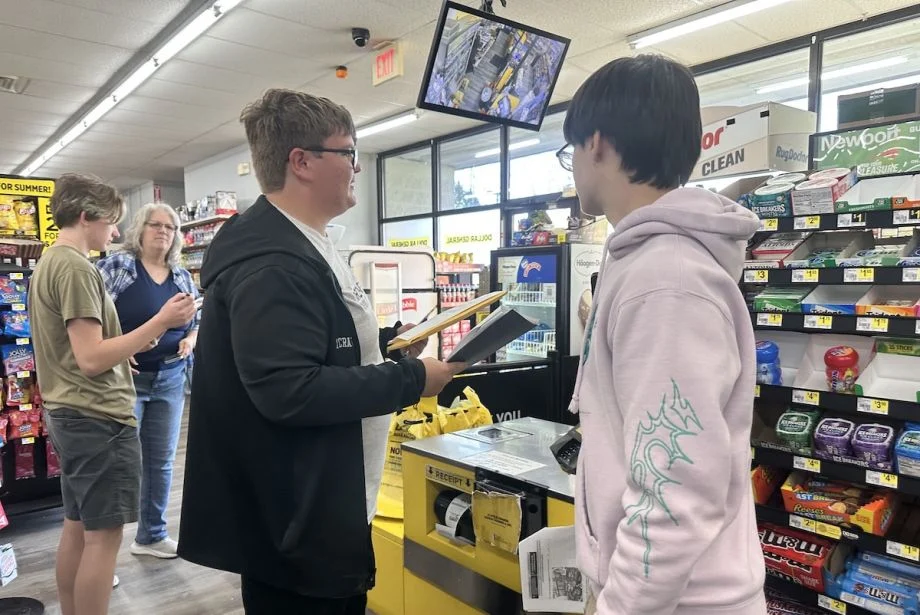
Above photo: CELT students participated in the Kentucky Retail Survey Project by touring and investigating different tobacco vendors across town. Estill Development Alliance.
Kentucky’s Estill Development Alliance uses a holistic approach to combat substance abuse in youth.
And improve overall community health.
While serving a three-year prison sentence for meth trafficking, Matewood Gerald got the call that she’d soon be a grandmother.
Gerald started abusing drugs when she was just 13, and she says everyone in her small town of Irvine, Kentucky, has seen her at her worst. But she had to become the best version of herself for her granddaughter.
“I would lay there and think, is she gonna like me? Am I going to be perfect whenever I get out?” Gerald recalls.
Less than five years later, she is a peer support specialist with Mercy Health Marcum and Wallace Hospital in rural Irvine. It’s the only hospital serving a four-county region, including Estill County. In this role, she and other medical professionals meet with people struggling with active addiction – people who almost always recognize her – and ensure they have clean supplies and are in a safe environment. They always offer rehabilitation services for anyone who’s ready.
Harm reduction measures, like syringe exchanges and narcan distribution, are gaining strength in Estill County. It became a state-certified ‘Recovery Ready’ county last month. The Irvine city council prohibited syringe exchange in 2020, so hospital officials and the Estill County Health Department found creative ways to reach people in active addiction, including a mobile clinic.
“It has not always been popular in our area. Actually, just about six months ago, [syringe exchange] wasn’t even allowed in the city limits,” says Trena Lynn Stocker, president of Mercy Health Marcum and Wallace Hospital in Irvine, Kentucky. “We are now garnering support at the city level. We didn’t always have that. We had a police chief that, at one point, if you had fentanyl testing strips, he was going to get you for paraphernalia.”
Estill County ranked fifth out of Kentucky’s 120 counties for drug overdose deaths per 100,000 residents in 2024. But that’s an improvement – Estill had the highest rate of overdose deaths statewide in both 2021 and 2023.
Across all of Kentucky, too, harm reduction is gaining traction. More than 30 of its counties are deemed ‘recovery ready,’ signifying they run accessible drug and alcohol abuse programs. More than half of the state has implemented harm reduction protocols. These numbers encourage the idea that the Commonwealth is taking steps to protect those battling addiction.
These practitioners explain that harm reduction, which brings resources and life-saving materials to people already abusing drugs, is helping save lives in rural Kentucky. Yet it doesn’t get to the root cause of drug abuse. That’s why Stocker and Gerald showed up on a rainy Tuesday evening to the Estill Development Alliance’s second Parent Cafe.
It’s one piece of the Estill Pathfinder Initiative Coalition (EPIC), a holistic approach to drug prevention in the local youth that’s inspired by an evidence-based model from overseas. Officials say the Development Alliance supports this programming through its unique development model, focused on being a one-stop shop for community health and wellbeing.
‘Give Them Something To Do’
Since 1983, the D.A.R.E program has been the standard for drug prevention across America. Police officers give lecture-style presentations to elementary schoolers about the dangers of drug and alcohol use, encouraging them to ‘just say no.’ D.A.R.E does not address root factors in individual communities or teach its students how to be safe if they do engage in drugs. Critics say that’s why the program has been ineffective. Yet, the curriculum is still actively used in many Kentucky schools.
Suzanne Waite has worked in the Estill County school system for years, so she saw these trends firsthand and sought out a different approach. Two years ago, she came across a better fit for residents’ needs, which inspired her to team up with the Estill Development Alliance and create EPIC.
The Icelandic Prevention Model was first conceptualized in the 1990s, when rates of drinking and drug use among European teenagers were at their peak. About 23% of 15- and 16- year olds in Iceland had reported smoking daily, and 42% had drank alcohol in the previous month.
In response, the Icelandic government decided to implement new regulations for its youth. A mandatory country-wide curfew for children under 16 was set, though that facet of the model hasn’t gained much traction outside of its home country.
What did stick: parental involvement and bolstering recreational programs for students. When Waite founded EPIC in 2023, that’s what she honed in on.
“It’s looking at your community, coming together to address this issue, and looking at things that are more preventative upstream”, Waite says.
The Icelandic prevention model has been adopted by organizations in 19 countries, though EPIC is one of the few official partners in the United States. The process starts with the same in-depth survey that the Icelandic Model uses, provided by a global group called Planet Youth.
Waite’s learned they can’t always take survey responses at face value, as many teens start off afraid to admit their own drug use.
“They do ask the questions in multiple ways, like many tests. It’ll say, ‘have you engaged in drugs?’ [and] 23% of them might say yes,” Waite explains. “But amazingly, 85% know a friend that has.”
She says it’s no wonder why kids turn to substance use instead of recreation. The small town of 2,000 has limited infrastructure; at first glance, it can be hard to find variety in activities, especially for kids.
“There’s no local movie theater. There’s no local bowling alley. There’s no local skating rink. You’ve got to go out of town for all of those things. And there’s not a community center that would just be [for] fun activity,” Waite says. “And then, there’s no public transportation.”
Many of these kids can only congregate with each other at school. So that’s where Waite started: a new leadership club at Estill County High School. In EPIC’s first two years, students launched and took full charge of the “Council of Engineers Leading for Tomorrow.”
“Our schools’ mascots are the engineers,” Waite explains. “Last year’s group, they did a color run to raise some funding [and] raise some awareness … Currently, we got a grant through the Kentucky Retail Survey Project. And we went out into the environment and did an environmental scan of the different tobacco retailer outlets here.”
These students are learning about environmental factors that correlate to certain shops selling tobacco products to underage customers. Another advantage of this ‘environmental scan’ is that they are eagerly engaging with the Estill County community and local leadership.
“We actually got them on the agendas for four different groups in the county,” Waite says. The club was signed up to present this environmental scan at the local city council, fiscal court, school board and Estill Development Alliance’s chamber meeting. “[I told them], ‘OK, you don’t have to do all four. But these are the adults that would like to hear from you and what you found out.’ And they said, ‘we’ll do them all!’”
It gives young students a sense of accomplishment and involvement, especially hard to find in a rural county, she says. That’s what resonated most with EPIC when its leaders learned about the Icelandic Prevention Model from Planet Youth.
“Drug abuse ends up being because something is broken. So, what is broken that you’re trying to fix?” Waite says. “We’re trying to let you see that you don’t have to be dependent upon some substance, to get that feeling of, ‘I feel good about myself,’ if you can get that from people in your life that do care about you.”
EPIC is planning a lot more activities; through a grant with Operation UNITE, she anticipates hosting a youth talent show in the spring, where local musicians will mentor students hoping to perform. And last year, the CELT club began working with Irvine City Council to build a city park on a vacant parcel of land in town.
In the next two years, officials with the Estill Development Alliance also hope to convert their facility into a gathering spot for youth to drop in as they wish. Once that’s complete, their offices will provide yet another service to their community.
Estill Development Alliance
EPIC is one of multiple divisions within the Estill Development Alliance. Even within such a small town, Estill Development Alliance communications director Payten Rice says, the Chamber of Commerce itself is bustling.
“We have about 104 businesses that are members of our chamber that serve to support our local economy. We always are doing events and fundraising in ways [so] businesses can get involved with the community,” Rice says.
In most cases, the local chamber of commerce is more connected to the city or county municipal government, often independent organizations that benefit from government support. The Estill Development Alliance instead hosts the Chamber of Commerce, which Rice says helps the organization avoid any sort of bias.
“It’s a working relationship, but we’re pretty independent,” Rice explains.
The money invested into the Chamber of Commerce gets a positive return; those funds, combined with grants, very limited local government contributions, and personal donations, have kept the Estill Development Alliance’s lights on for more than 20 years.
In turn, it powers the organization’s other divisions, like the outdoor-recreation based Estill County Action Group, the five-county regional leadership group LEAP, and several philanthropic and civic engagement initiatives. One division, the River City Players, leads a community theatre group and supports the revitalization of the local historic theatre.
“There’s not a lot of development alliances that have a very old movie theater that they’re rebuilding. And let me tell you, that’s a passionate group of people,” says Stocker. In addition to her role at Mercy Health, she is also a board member of almost every Estill Development Alliance division.
Stocker explains these branches may seem unrelated, but they all serve the purpose of strengthening the infrastructure and social health of their town. This further contributes to the mission of EPIC.
“We have it here,” Stocker says. “You just have to have some ownership in figuring out what is going on in your community.”
She says Estill County has enough economic momentum; it will take a combination of the preventative work from EPIC and Mercy Health’s harm reduction to help this money go toward local businesses instead of drugs.
“It goes hand in hand because of the amount of money that is being wasted on drugs by community members and the tax on the healthcare system,” Stocker says. “Nobody can get a job – or the money.”
Getting People In The Door
The Estill Development Alliance’s new Parent Cafe program is meant to provide a quiet space for parents to learn about warning signs of early drug addiction in their kids; the event was catered, and childcare was ready. Instead, the library basement sat empty, aside from the EPIC coordinators and Mercy Health members.
That’s a problem for drug awareness and prevention events in any place, Stocker says. Even when hosting events for the community’s only hospital, she says, attendance for these addiction-related events can be extremely volatile. Just last month, she saw it first hand.
“On a miserably rainy evening, [we] had over 160 people come to the recovery rally. But then a week later, we have the memorial event for those that we’ve lost this year [to addiction], and we had six show up,” Stocker says.
EPIC has great participation in the school system through the CELT club, and Waite and Stocker consistently secure new grants– soon they’ll have customized T-shirts, the youth talent show, and more recreational programs for kids to get immersed in.
The next challenge is getting their movement off the ground. EPIC is faced with a community that lacks public transportation and relies on social media algorithms to get the word out about local events. Leaders are working vigorously to build community trust – which is especially difficult in a small town, they explain – and get the word out.
EPIC’s current goal: Find the best way to get people, even adults, excited and ready to participate.
“I wish I knew,” Waite laughs. “(I) sat down with the board members, talked to them about, hey, what else can we be doing … what else have I not thought of?”