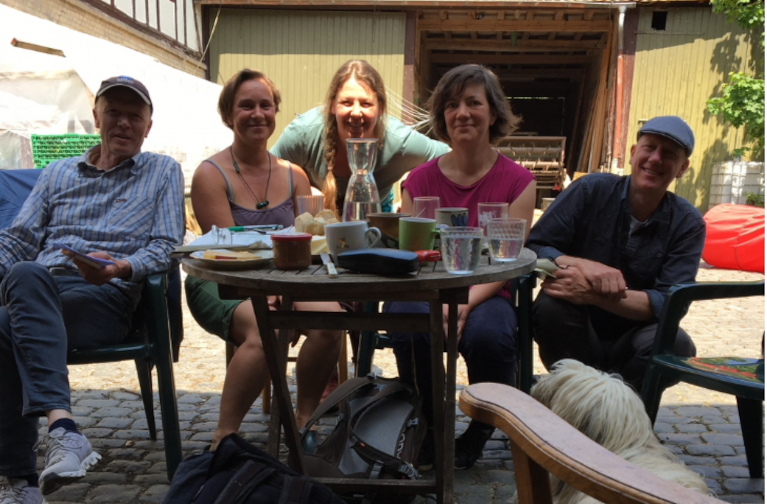
Above image: From left: Hannes Lorenzen (ARC2020); Ann-Marie Weber, Almut Busch and Merle Drusenbaum (kollektiv von MORGEN); and Marcus Nürnberger (AbL), pictured in a farmyard in southern Marburg-Biedenkopf in May 2023. ARC2020.
What happened when we set out to identify and nurture the ingredients of local food system transformation in Marburg, Germany?
This was the aim of the Rural Europe Takes Action – Germany project (2023-2025), through which ARC2020 partnered with kollektiv von MORGEN and AbL Hessen – supported by the Robert Bosch Stiftung – to connect the dots from the local to the European level.
Summer’s flowers hang dried in neat bunches around the workshop room of the Ecological Folk High School in Grzybów, as changemakers from France, Germany and Poland gather in the early days of winter 2024. What can rural communities do in the face of the ecological, social and economic crises society faces today, and what role can cross-border exchange between local actors play? These questions marked the coming together of what we have come to call the rural Weimar triangle, a grassroots counterpart – and perhaps challenge to – the high-level diplomatic agreement between the governments of these three countries. Villages, towns and cities, after all, have a lot to offer in response to today’s global challenges.
As the discussion unfolded, elected representatives from Plessé spoke of the power of inclusive governance processes, the kollektiv von MORGEN team emphasised the need for safe spaces for dialogue between dichotomous views, and the co-founder of the Ecological Folk High School offered an insight into its holistic educational approach and the ecosystem of agroecological and cultural initiatives in Grzybów.
This rural Weimar triangle emerged through ARC’s work in connecting with on-the-ground rural actors in France, Germany and Poland, bridging the gap between EU and local scales and preparing the ground for exchange and collaboration.
Rural Europe Takes Action – Germany was the project that framed our collaboration with two partners working at local and regional level in Germany. The constellation of kollektiv von MORGEN, AbL Hessen and ARC first configured in May 2023, in a farmyard in the south of Marburg-Biedenkopf.
It was a meeting of minds and spirits that already in the autumn of that year bore fruit: together we co-organised the European Action-Gathering for Sustainable Food Systems in Marburg in November 2023. Over a rich few days of field visits and exchanges, with input from over 100 food systems actors from a dozen countries, we cooked up the Marburg Action Plan for Future-Proof Food Systems in Europe.
A tool for change at local, regional and European level, this call for action served as a blueprint for the regional and transnational bridge-building that continued in the wake of the Gathering.
A Regional Dish
One step towards future-proof food systems in Marburg can now be spotted on the menu of several restaurants in the city: a new Regional Dish. Co-created by farmers, restaurateurs, chefs and the city’s marketing department, the “Regio-Teller VO:HEJ” is a play on words, combining the meaning of “von hier” (“from here”) with the way it is pronounced in the Hessian dialect around Marburg.
The dish itself is not one single, static dish, but developed at the discretion of each restaurant as long as it contains at least one regional ingredient – which means it changes seasonally. The organisers kept the requirements attainable in an effort to attract more restaurants to participate, as opposed to having more stringent, perhaps more comprehensive standards, that could exclude potential participants.
One of VO:HEJ’s co-initiators is kollektiv von MORGEN, who worked alongside the CIM Hub, LogRegio, nearbuy, the Food Policy Council Marburg, local restaurants and producers to bring the label to fruition.
Ingredients Of A Local Food Strategy
These steps towards future-proof food systems in and around Marburg are part of the broader picture of change being forged by a mix of local actors, including the food policy council, CSA initiatives and other farmers, the city and various municipal departments, researchers and educators.
Through existing networks, kollektiv von MORGEN aimed to promote the implementation of a municipal food strategy in Marburg, and support the development process using the Marburg Action Plan as a starting point.
However, it soon became apparent that the necessary political mandate for such a strategy was lacking, a challenge compounded by the ongoing rollback in agri-environmental policy that touches politics at all scales.
Strategically, it was more effective to work on the potential ingredients of a future food strategy – out-of-home catering, land leasing in the public interest, food education – through network-building and informal lobbying.
As VO:HEJ shows, creating trusting spaces for formal and informal dialogue can contribute to constructive collaboration between food system actors, local administration and government. Full-time farmers, processors, restaurant owners and consumers often do not have the capacity to coordinate food system transition. This instead is the role of food system facilitators, who can work to nurture relationships with key individuals in local institutions.
Next steps in Marburg will explore how the structural anchoring of food systems can help safeguard progress and the role that communication and education can play in the transition.
And for the rural Weimar Triangle? The future will bring us back to Plessé, France, through ARC’s Rural Resilience project. Our first visit to Plessé in 2021, followed by our first Rural Resilience gathering there in 2022, set the stage for the journey that followed to Marburg and Grzybów. With strong citizen involvement, Plessé has taken ownership of food and farming by creating its own Local Agricultural and Food Policy (PAAC). This shows what is possible for social and ecological transition at municipal level, despite a European Common Agricultural Policy that is largely inhospitable to agroecological transition. At this pivotal moment for EU agricultural policy, Plessé is a fitting place to explore and imagine together what else is possible: agroecological value chains, critical rural infrastructure and a peasant pedagogy for the future. Keep your eyes peeled for a rendezvous in 2025.
Opportunities Missed, But Local Communities Step Up
Local realities are shaped by broader national and European dynamics. The need for an integrated rural-agri-food policy is more urgent than ever – yet it appears increasingly far away from the political agenda.
The Marburg Action Plan for Future-Proof Food Systems calls for EU institutions to establish this framework. But that call remains unanswered. Instead, prevailing policy winds blow towards simplification and economic competitiveness, and far-right political parties are making electoral gains.
The European Commission’s abandonment of the Sustainable Food Systems Framework proposal was a missed opportunity for integrated governance of food and farming systems.
Now, proposals by the Commission to overhaul the Common Agricultural Policy in the post-2027 reform – folding it into a centralised mega-fund, and renationalising key policy decisions – raise many questions for the direction of EU food and farming, including where rural development fits into it all. These proposals are already stoking outrage among farmers, ruralists and environmentalists. Could this be a tipping point for building new alliances around shared goals?
Against this backdrop, the case of Marburg reminds us how local communities are building sustainable food systems for their regions, despite the obstacles. If EU agriculture and rural policies are mishandled in the next cycle, those obstacles will likely intensify – but the changemakers will keep moving.