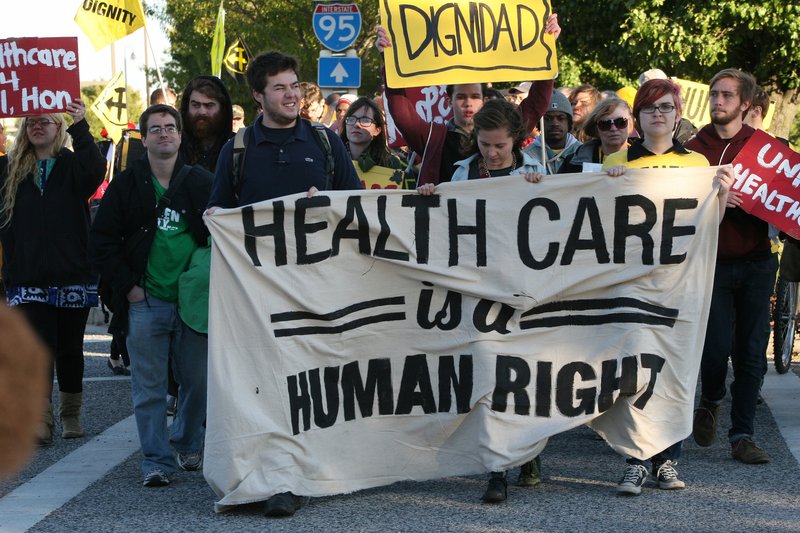
Above photo: A march for the human right to healthcare in Baltimore, Maryland, USA. United Workers/Flickr.
And rejects the international human rights system set up to protect us.
Health care activists in the U.S. have a huge struggle to get the corporate media to take the human right to health seriously. The corporate media reports on some injuries and deaths, but their doom and gloom scenarios typically conclude nothing can be changed in this private, insurance-controlled system, which doesn’t work for the people.
Despite the difficult time we’re in, with millions lacking access to health care, it’s an opportunity for health care activists to increase efforts for a public, not for profit, universal system in the U.S. One way is to use the international human rights system organized through the United Nations to broadcast our message to the rest of the world and to shame the U.S.
Participating as one of many U.N. countries in shared practices can also move us away from being “American Exceptionalists.” Many U.S. health care activists want a relationship of solidarity with people in other countries who have achieved universal, single-payer financed health care systems, which have taken the profit out of health care. We reject our government’s targeting of countries that have achieved the human right to health, like Cuba, Nicaragua and Venezuela, with unilateral coercive measures (UCMs). We don’t support economic aggression, which is illegal under international law and undermines other peoples’ rights to health and life.
The United Nations Charter and the U.N. subdivisions and agencies carrying out the purposes and principles of the Charter provide ways for ordinary people to participate in human rights advocacy. The U.S., a founder and one of 193 member states of the U.N., ratified the U.N. Charter, the cornerstone of the modern international law system, in 1945. Human rights non-governmental organizations in the U.S. were key in securing human rights language in the Charter. Articles 55 and 56 create human rights duties for all states, collectively and individually.
With a view to the creation of conditions of stability and well-being which are necessary for peaceful and friendly relations based on respect for the principle of equal rights and self-determination of peoples, the United Nations shall promote…
- universal respect for, and observance of, human rights and fundamental freedoms for all without distinction as to race, sex, language or religion. (Art. 55)
All members pledge themselves to take joint and separate action in co-operation with the Organization for the achievement of the purposes set forth in Article 55. (Art. 56)
The main subdivision of the U.N. that deals with human rights is the U.N. Human Rights Council (UNHRC), which reports to the U.N. General Assembly. The UNHRC country members are elected by the General Assembly and represent different regions of the world.
In early April 2025, nine U.S. non-governmental organizations filed a joint “shadow report” with the UNHRC. Our special focus was the violation of the rights to life and health in the financing of our health care system.
Shadow reports are designed to inform the UNHRC of the actual experience of civil society, as compared with what the government includes in its report. Our organizations, led by the National Lawyers Guild, were Connecticut Citizen Action Group, Hawai’i Institute for Human Rights, the National Center for Law and Economic Justice, the National Conference of Black Lawyers, National Single Payer, the Poor Peoples Campaign, People’s Action Institute and the Rights and Democracy Institute.
Our groups are part of a national human rights movement involving hundreds of U.S. organizations, which participate in U.N. advocacy. Our report and others provide alternative and supplementary information and testimony on U.S. compliance with human rights standards for the Universal Periodic Review (UPR) of the United States held every 4.5 years. When the UNHRC conducts the UPR, it reviews the entire picture of U.S. obligations arising from treaty and customary international law. The U.S. was the first country to be reviewed in 2006 when the UPR was initiated.
The current UPR, scheduled for November 7, 2025, required our government to file its official report, prepared by the Department of State, in August. (Oddly, the shadow reports are always due before the official reports.)
Our shadow report had several objectives. It elaborated the failure to meet the basic elements of the individual right to health care: universal access (no one left behind, affordable, equitable, and comprehensive); availability of and acceptable, dignified care; equal and non-discriminatory care; the highest attainable quality; system transparency; enabling participation and providing accountability. We gave special attention to the health care system, showing how government support for the private health industry and increasing privatization don’t meet the international standard of adequate, equitable and sustainable financing of the health system. We also discussed the relationship of the right to health and the right to an adequate standard of living and how the problem of inequality worsens the rights to health and life. We asked the UNHRC to make recommendations for: 1) Adoption of national legislation for a universal single payer system which eliminates all for profit, investor-owned enterprises from health care; 2) If private delivery is chosen rather than a national health service, strict regulation of non-profits with a ceiling on incomes of highest paid personnel; 3) Strict regulation and affordable pricing of privately-produced pharmaceuticals and public ownership of some pharmaceuticals; 4) Establishment of democratically elected community and local oversight boards for accountability and community governance; and 5) Protection of self-determination of indigenous peoples and respect for treaty rights.
The U.S. has long participated in the UNHRC, as a member of the Council and in the UPRs. The purpose of the UPR is interactive and meant to encourage compliance. It’s not a judicial process with findings and conclusions of law. The UPR is conducted by a 3-person panel (troika), from three states which are UNHRC members, representing different regions of the world. For the U.S. this year the troika consists of Germany (Europe), Japan (Asia) and Burundi (Africa).
What happens in the process is discussion about the official government report and the shadow reports (which are summarized by UNHRC staff for the review). Suggestions for improvement are made. Recommendations from UNHRC members are provided in writing to each government after the review. The UNHRC website, dated as of 2022, shows 100% participation by all states in the UPR.
After we submitted our shadow report as required by the UNHRC, we waited for the official US government report. Today, November 7, 2025, the UNHRC is reviewing the human rights obligations of the United States but without the participation of the U.S.A.
The fault lies entirely with our government. For the first time ever, our government has refused to participate in the UPR. The Trump administration not only failed for the second time to file a timely report. It didn’t file any report. And now the U.S. has informed the UNHRC we are not participating.
The Council has occasionally postponed a UPR for a state being reviewed to the next session (which would be spring 2026 for the U.S.). Because the UNHRC is holding the review without our government, we can only conclude that there was no willingness on the part of the U.S. to participate at a later date.
Besides failing in its obligations under the Charter to cooperate and participate, both Trump administrations withdrew the U.S. as a member of the UNHRC. While the U.S. role on the Human Rights Council can be criticized, some U.S. governmental engagement in international human rights legal bodies is important. For years, advocates have used U.S. participation in U.N. human rights bodies to advance domestic rights, no matter how difficult the process. (Health care activists, unlike some other U.S. human rights activists, are less subject to the tendency to believe human rights apply only to other countries or to excuse U.S. failings based on arguments that the U.S. is superior.)
The problems health care activists face in the U.S. necessitate more, not less, activity and pressure using the U.N. human rights system. These challenges include mistaken and misapplied international law, such as 1) hierarchies of rights, which contradict accepted legal principles of universality, interdependence, and indivisibility of human rights; 2) refusal to accept the right to health and other economic, social and cultural rights as human rights; 3) refusal to acknowledge the interdependency of the right to health and the right to life; and 4) excusing failure to provide universal access by deliberate misinterpretation of the International Covenant on Economic, Social and Cultural Rights (ICESCR).
The U.S. government adopts its own hierarchy of rights by using the right of religion (of a corporate “person”, not even a human) to defeat a woman’s right to health care for reproductive health, including contraceptives and other family planning. Considering the U.S. record of the greatest number of deaths during the COVID-19 pandemic, thousands of which were preventable if we’d had a universal, single-payer financed system, how can anyone argue that the right to health care is not interdependent with the right to life? The US failure to provide universal access to all human beings during the pandemic, which continues, raises an important legal question. Is the US in violation of Article 6 of the International Covenant on Civil and Political Rights (ICCPR), which protects the “inherent right to life” and prohibits the “arbitrary deprivation of life?” (The ICCPR is a treaty the U.S. ratified, unlike the majority of human rights treaties.)
The reluctance by Republicans and Democrats to acknowledge the right to health and other economic, social and cultural rights as human rights, such as housing and an adequate standard of living, except as sound bites when campaigning, or as slogans with no real content, is well-known.
Whichever party occupies the White House, common patterns arise during the UPR, at the stage when UNHRC members make recommendations and the U.S. government responds. Left out of U.S. government responses to the recommendations for improvement are: problems with the entire private health industry, accountability of insurance companies gaming the system for billions of dollars by upcoding; increasing privatization damaging the sustainable and equitable systems of VA care and Medicare; any commitment to a system guaranteeing universal access. Instead, government officials congratulate themselves for gradual improvement, promise to do better and conflate the right to health care with expanding private health insurance. One of the boldest excuses, which the U.S. has now been making for years is that the US doesn’t need to provide the right to health yet because the ICESCR allows “progressive realization” of economic, social and cultural rights.
The progressive realization excuse comes from a term in the ICESCR, which was added in the 1960s in negotiations (Article 2[1]), so poor countries could have more time to be in compliance. It was never intended as a shield for non-compliance by the U.S., the richest country in the world. To pretend the U.S. cannot afford to make health care a right for every human being in the country using the excuse of “progressive realization” is even more ridiculous in 2025, given the number of states that accept their obligations to respect the right to health and other ESC rights, among them states which are far poorer, such as Nicaragua.
We cannot allow this refusal of the Trump administration to engage with us, the people, and with other states to go unnoticed and unchallenged. The U.S. practice of resigning from UN agencies and bodies when it disagrees with policies or is unwilling to pay dues now has resulted in our withdrawal from both the UNHRC and the World Health Organization, which have important roles to play in global health. As we organize for the right to health, we can also support the U.S. duty to fund the U.N. and speak out in support of the sovereignty of states, which have systems that respect, protect and fulfill the right to health. We can learn from them.
We should also take seriously the need to change our poor record of ratification of human rights treaties, for which the Senate and the Executive are responsible. We are the only U.N. member that has not ratified the Convention on the Rights of the Child, which mandates the right to health care (Article 24). Also, we haven’t ratified the ICESCR (Article 12, right to health), the Convention on the Elimination of All Forms of Discrimination Against Women (Article 12, right to health care), and the Convention on the Rights of Persons with Disabilities (Article 25, right to health), to name some treaties ratified by the majority of states. It’s time to stop making excuses like the U.S. is superior or that it doesn’t matter if the U.S. ratifies human rights treaties. In the end, it turns out that there is a close relationship between U.S. violation of international law and violation of domestic law. It’s our job to end impunity.
See the National Single Payer website, https://nationalsinglepayer.com for our full report.