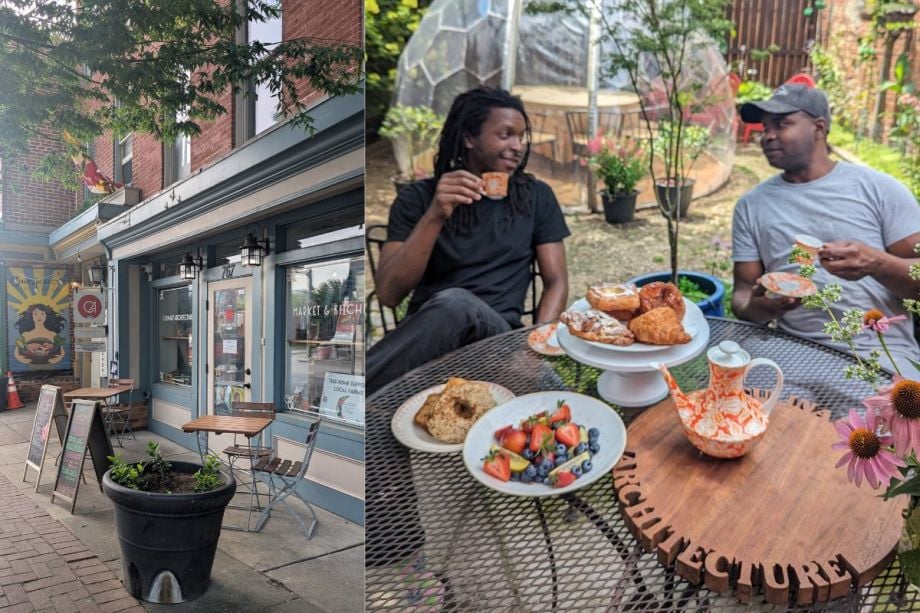
Above photo: At Culinary Architecture in Baltimore’s Pigtown. Sylva Lin.
Part retail space, part incubator for local ventures, Culinary Architecture shows how food-centered businesses can advance lasting neighborhood renewal.
Walking up the stone steps to MFG Toffee & Bark Company a few days ahead of the shop’s grand opening in Baltimore’s Little Italy, chef Sylva Lin inhales the scent of sugar and espresso coming from the kitchen. She’s dropping by to see the fruit of her efforts incubating local food businesses out of Culinary Architecture, the project she launched a decade ago.
After a successful career in catering and professional kitchens, Lin’s entrepreneurial spirit was hungry to create a space that would benefit her neighborhood in Baltimore. She didn’t just want to offer interesting foods. She wanted to connect with neighbors, create good-paying jobs and draw foot traffic to support other businesses on the block.
In 2015, she opened Culinary Architecture, a 900-square-foot gourmet market and incubator space in Baltimore’s Pigtown. In the past decade, it’s emerged as a powerful model for how food-centered enterprises can fuel community resilience and inspire Main Streets across America.
Lin grew up in a family of entrepreneurial immigrants who rebuilt their lives after World War II. While her extended family pursued careers in manufacturing and banking, it was her parents’ path that left the deepest imprint: Both held advanced degrees in science and believed fiercely in the power of education to break the cycle of poverty.
They taught Lin that self-reliance, discipline, and creativity were essential tools for survival and success. “If you can cook, you won’t starve,” they often reminded her. “If you have land to grow on, you’ll be okay.”
She learned to forage for morel mushrooms and make tofu, yogurt and dandelion wine. One day, her mother came home with a free apple press that a local university was giving away, determined to try making apple cider. The experiments in crafting hard cider led to terrible-tasting results, but they taught Lin that trying out new ideas was part of the process.
Those values shaped Lin’s fearless approach to entrepreneurship and laid the foundation for Culinary Architecture: a space where food, education and opportunity come together to nourish individuals and communities.
More than just a place to buy or sell, Culinary Architecture is a vibrant hub. It blends retail sales (both in-person and online) with catering services and hands-on mentorship, creating a multi-faceted economic engine. By providing quality jobs, accessible training and shared commercial kitchen space, it empowers entrepreneurs to launch, grow and thrive.
Main street organizations, city economic development leadership and local philanthropy can all pay attention. As vital as these models are, they are also challenged by economic pressures beyond their control. Local leaders can help these businesses by investing in storefront upgrades, promoting businesses through events and social media, and helping to retain affordable commercial real estate space.
Lin always knew she wanted to run her own business. After college, she enrolled in culinary school, which launched her into jobs at high-end Washington, D.C. restaurants. She then worked as a private chef, a nutritional consultant for major pharmaceutical companies, and a chef nutritional consultant to professional athletes both in Washington, D.C. and Baltimore.
For nearly a decade, she built a catering company on the side while working full-time, steadily laying the groundwork for her future. She intentionally sought out opportunities to deepen her expertise across all aspects of the food industry, developing skills in supply chain sourcing, staff management and marketing, while continually expanding her culinary knowledge.
By 2015, she was ready to follow her entrepreneurial spirit and open her own space, but rents were too high in D.C. She fell in love with the Union Square neighborhood in Baltimore, moved there from D.C., and quickly found Pigtown, a newly-organized main street in Baltimore with very affordable lease rates and a growing identity as a food destination for the region.
Once the route for pigs being herded from the railyard to slaughterhouses, the area was settled by rail yard workers and grew to be a strong working-class neighborhood. A diverse community, it is a mix of row houses, small shops and larger industrial buildings. The population ranges from families living in new townhouses to those struggling with poverty.
Lin moved to Union Square and loved walking down the sidewalk, saying hello to neighbors and hosting rounds of new friends for dinner. Now all she had to do was make her dream a reality.
Having grown up in Ann Arbor, Michigan, Lin found early inspiration in Zingerman’s Deli, a beloved neighborhood market that evolved into a nationally recognized food destination. She loved browsing the shelves filled with unusual vinegars, salamis and smoked fish, offered alongside the deli’s own baked goods.
What truly captivated her was the sense of place: tourists mingled with retirees from the neighborhood, while local kids dropped in for an afternoon treat.
Lin stocked Culinary Architecture full of gourmet cookies and imported foods, like crunchy black sesame butter, truffle brie, miso caramel popping corn and boudin noir. She kept herself busy running catering for local clients, and still working with athletes and medical trials. Lin’s kitchen started to turn out everything from pistachio croissants to sausage rolls.
Culinary Architecture became a destination for people from all over the community, and not just for food. Lin became known as someone who could and would help those around her.
Culinary Architecture reflects the neighborhood it serves: diverse, resilient, full of talent. Its head baker came knocking for work, quickly displayed his production baking experience, and became vital, producing hundreds of loaves daily for the store and Baltimore businesses.
Around the same time, a retired neighbor with a passion for plants sought to stay active and supplement her income. Lin hired her to nurture the garden, which now supplies fresh herbs and beauty to the space.
Another entrepreneur, LC Stephens of the Flour Collection, had spent five years perfecting her cakes in a home kitchen but needed mentorship and a reliable commercial space to grow. Lin welcomed LC into Culinary Architecture, providing a supportive incubator where she could develop her business until she could launch on her own.
During this time, she also met Kathy Filosi Nelson, a retired news professional who had moved with her husband from Annapolis to Lin’s Union Square neighborhood. When Nelson gifted Lin homemade toffee for Christmas, Lin immediately recognized the business potential.
Working with Lin allowed Nelson to produce her toffee in a commercial kitchen and begin to scale without making a major investment. Lin mentored Nelson through branding, marketing and packaging decisions, too. Now after years of working nights in Culinary Architecture’s kitchen, Nelson is opening her own small shop: MFG Toffee & Bark Company.
That partnership is one of many that have defined the evolution of Culinary Architecture into an economic model that could energize neighborhoods nationwide. By empowering diverse community members and launching new ventures, Culinary Architecture proves how food-centered businesses can become engines of opportunity, connection and lasting neighborhood renewal.
Lin’s mentorship and shared kitchen have paid off. She looks at the shining glass of the display cases at MFG Toffee, where toffees and chocolates are set out like jewels for the first customers. The black-and-white sign swings outside the front door welcoming visitors. A new business is ready for primetime.