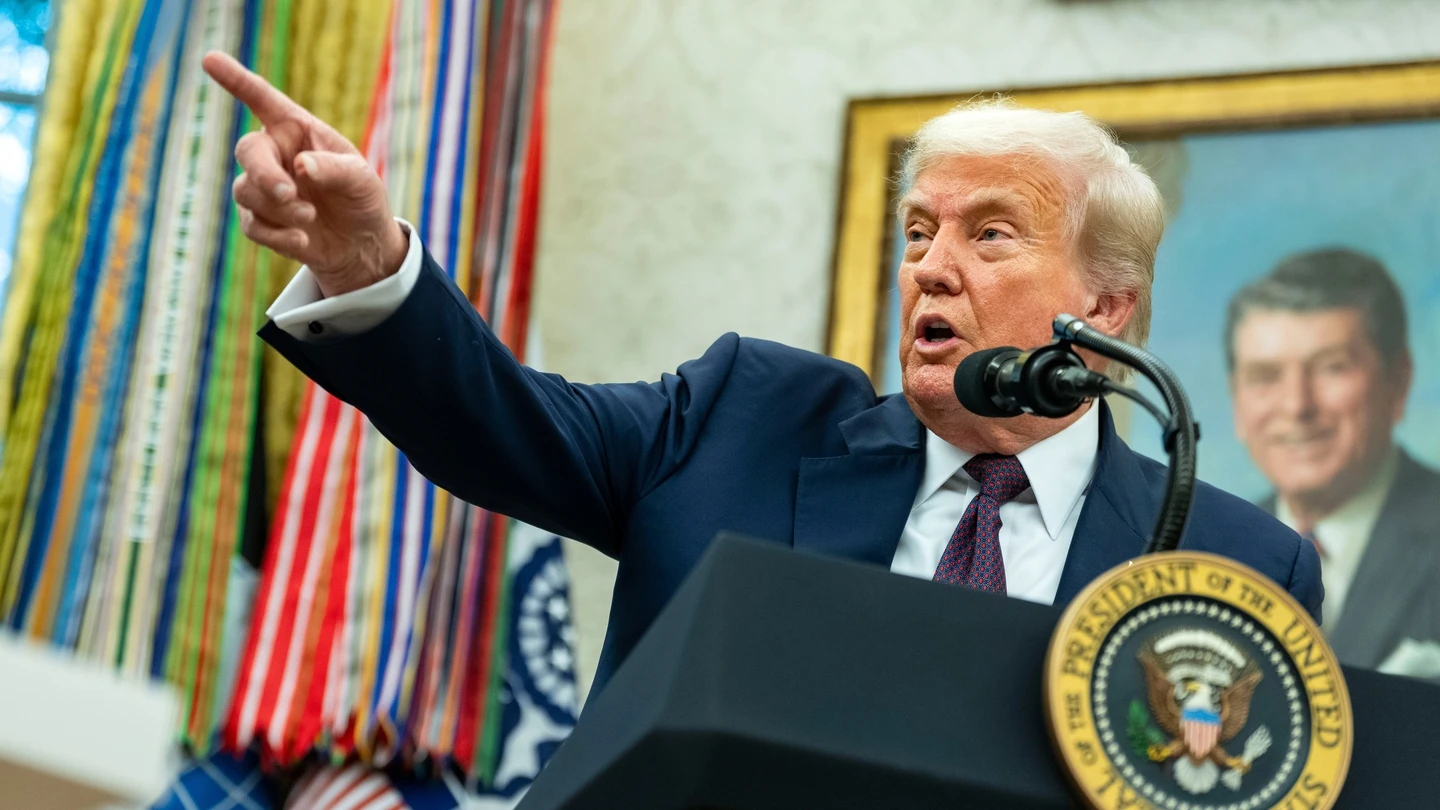
Above photo: RTE.
The US president has also threatened to cancel his expected meeting with Xi Jinping in South Korea.
US President Donald Trump announced new 100 percent tariffs on Chinese goods on 10 October and threatened to cancel his meeting with President Xi Jinping.
Trump said the levies would take effect on 1 November, describing them as “retaliation” for what he called Beijing’s “extraordinarily aggressive” actions.
“It is impossible to believe that China would have taken such an action, but they have, and the rest is History,” he wrote on social media.
Trump’s new, additional 100% tariffs on China, will cost the average US household up to $2600.
Trump is forcing Americans to pay more than twice as much for electronics, toys, sneakers, clothing, appliances & more, right before the Holidays.
This is the real “War on Christmas.” pic.twitter.com/claPplBvkD
— Melanie D’Arrigo (@DarrigoMelanie) October 10, 2025
He added that the new measures would target “any and all critical software” exports, accusing China of holding the world “captive” through its dominance of rare earth minerals.
“There is no way that China should be allowed to hold the World captive,” he said.
Trump told reporters that while he had not canceled his planned meeting with the Chinese president during the Asia-Pacific Economic Cooperation (APEC) summit in South Korea, he is “reconsidering it.”
“I haven’t canceled, but I don’t know that we’re going to have it. But I’m going to be there regardless,” he said.
Financial markets dropped sharply after the announcement, with the Nasdaq losing 3.6 percent and the S&P 500 falling 2.7 percent.
Pres. Trump has reignited his tariff war on China after announcing plans to implement 130% tariffs on Chinese imports. It comes after a stock sell-off, with the Dow losing 878 points, the Nasdaq down 820. @rachelvscott reports. https://t.co/P4qcqxZhdr pic.twitter.com/eaOvGYxC7b
— World News Tonight (@ABCWorldNews) October 11, 2025
The US president also accused China of “great Trade hostility,” and referenced communications from other countries expressing anger over Beijing’s new export controls on rare earths.
Trump’s move followed Beijing’s earlier decision to impose “special port fees” on US-owned, operated, or built vessels, mirroring Washington’s earlier tariff policy on Chinese ships.
China’s Ministry of Transport described the measure as a “tit-for-tat” response to “clearly discriminatory” US actions damaging to the global supply chain.
Beijing is countering a US chip ban with even greater restrictions on its precious rare earth minerals. After that, Trump announced a 100% tariff on all Chinese goods. In what direction is the US-China trade war headed? pic.twitter.com/cl3FvwMPfr
— DW News (@dwnews) October 11, 2025
Both governments are expected to raise the escalating trade measures at the upcoming APEC summit in South Korea, where Xi and Trump are scheduled to meet.
China to impose tit-for-tat ‘port tariffs’ on US vessels
Washington first announced new port charges on Chinese-owned, operated, or built vessels, prompting Beijing’s retaliation
China will begin levying new port fees on ships owned, operated, or built by US entities in direct response to Washington’s plan to impose similar charges on Chinese vessels, the Chinese Ministry of Transport announced on 10 October.
The policy, to take effect on 14 October, will apply to US companies, organizations, and individuals, as well as to any vessel in which US ownership exceeds 25 percent.
Ships flying the US flag or constructed in US shipyards will also be subject to the fees.
According to the ministry, the new charges will start at $56 per net ton of capacity and increase annually to $157 per ton by 2028. The tariffs will be collected only at a vessel’s first Chinese port of call and capped at five voyages per year.
Beijing described the measure as a “tit-for-tat” step under its international maritime transport laws, accusing Washington of “clearly discriminatory” practices that “seriously damage the legitimate interests of China’s shipping industry and undermine the global supply chain.”
The decision mirrors a US policy set to take effect the same day, imposing port service fees on Chinese-owned, operated, or built vessels entering US ports.
The US Trade Representative introduced the plan following a Section 301 investigation that concluded China had amassed unfair global maritime dominance and pledged to revive US shipbuilding.
Under the policy, fees begin at $50 per net ton of capacity and will rise to $140 by 2028.
China produces more than half the world’s commercial vessels, while the US now manufactures fewer than 10 per year, according to analysts cited in the reports.
Industry observers say the new US fees could cost Chinese carriers billions of dollars annually, with COSCO, the state-owned shipping conglomerate, facing the steepest impact.
The reciprocal measures have added strain to already tense trade relations between the two powers, who recently paused new tariffs for 90 days but remain at odds over shipping, technology, and energy imports.
An unnamed spokesperson for China’s transport ministry urged Washington to “immediately correct its erroneous practices and cease its unwarranted suppression” of Chinese maritime firms.
Both countries are expected to raise the issue during the Asia-Pacific Economic Cooperation (APEC) summit to take place from 31 October to 1 November in South Korea, where Chinese President Xi Jinping and US President Donald Trump will convene.