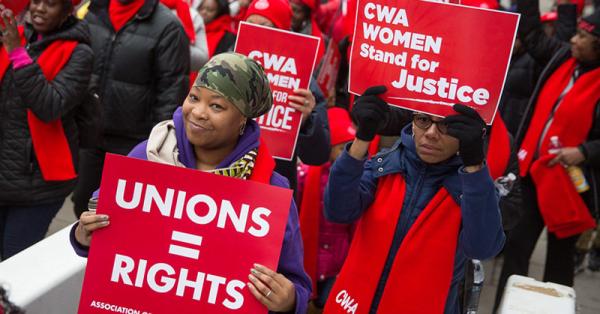
Above photo: Comunications Workers of America.
Rebuilding worker power by strengthening unions is not just good policy.
It is a democratic imperative in the face of authoritarian backsliding.
Key findings:
- In between 1979–2024, median wages rose more in states where unionization declined less.
- The productivity–pay gap has grown more slowly in states with smaller declines in unionization since 1979. In these states, it wasn’t just corporations and the wealthy who benefited from economic growth, but also working people, both unionized and nonunionized.
- In high-union-density states, 2023 median household income was on average more than $12,000 higher than in low-union-density states.
- In recent years, the average unemployment insurance recipiency rate in high-union-density states was 36.0%—double the 18.0% UI recipiency rate in low-union-density states.
- In states with higher union densities, the share of people without any form of health insurance was 5.7%; this rate was 9% in states with lower union densities.
- 70.6% of states with the highest union density have enacted paid sick leave legislation, compared with just 11.8% of low-union-density states.
- States with higher rates of unionization spend substantially more per pupil on education than low-union-density states ($22,777 per pupil vs. $15,568).
- Since 2021, low-union-density states have passed 44 voter restriction laws, whereas high-union-density states passed six such laws.
Why this matters
Unions don’t just improve workers’ paychecks—they shape the social and political fabric of the communities they operate in, lifting standards for union and nonunion workers alike.
What policymakers can do
Policymakers must enact reforms that restore a meaningful right to organize and collectively bargain. They could begin by passing much needed labor law reform—including the Protecting the Right to Organize and the Public Service Freedom to Negotiate Acts.
Full Report
We know that unions promote economic equality and build worker power, helping workers to win increases in pay, better benefits, and safer working conditions. But that’s not all unions do. Unions also have powerful effects on people’s lives outside of work. They help foster solidarity, promote civic and political engagement, provide reliable information to working-class communities about how economic policies impact their lives, and serve as a counterweight to corporate power in our democracy. Throughout history, unions have been engines of resistance to entrenched and undemocratic power—mobilizing working people to challenge inequality, defend civil rights, and push back against authoritarianism in all its forms.
In this report, we document the strong correlation between higher levels of unionization and a range of economic, personal, and democratic well-being measures. In the same way unions give workers a voice at work, with a direct impact on wages and working conditions, the data suggest that unions also give workers a voice in shaping their communities. Where workers have this power, states have more equitable economic, social, and democratic structures.
Background
When workers join together in a union and engage in collective bargaining, their wages, benefits, and working conditions improve. There is a wealth of research documenting the positive effects unions have for workers, both those who are unionized and those who are not.
Higher Wages And Decreased Income Inequality
On average, a worker covered by a union contract earns 12.8% more in wages than a peer in a nonunionized workplace in the same industry with a similar education, occupation, and level of experience (EPI 2025a). This wage advantage is known as the “union wage premium.” But unions don’t just help union workers—they help all workers (Bivens et al. 2017). When union density is high, nonunion workers benefit too because unions effectively set broader standards—including higher wages—which nonunion employers must meet to attract and retain the workers they need (Rosenfeld, Denice, and Laird 2016; Mishel 2021). The combination of the direct wage effect for union members and this spillover effect for nonunion workers means unions are crucial to raising wages for working people and reducing income inequality (Card 1996, 2001; Card, Lemieux, and Riddell 2018).
Smaller Racial Wage Gaps
Unions have historically reduced wage gaps between Black and white workers (Farber et al. 2021). For much of the post-WWII period, Black workers were more likely to be in unions and received a larger wage premium for union membership. Today, Black workers represented by a union are paid 12.6% more than their nonunionized Black peers, and Hispanic workers represented by a union are paid 16.4% more than their nonunionized Hispanic peers (EPI 2025b).
Higher Wages For Women
On average, the wages of women represented by a union are 9.8% higher than those of nonunionized women with comparable characteristics (EPI 2025c). Further, there is suggestive evidence that within workplaces, union bargaining reduces gender wage gaps. For example, Biasi and Sarsons (2020) show that the expiration of teacher collective bargaining agreements led to an increase in the wage gap between men and women with similar credentials, implying that the terms of the collective bargaining agreement had previously helped to minimize such wage gaps.
Increased Government Revenue And Less Need For Safety Net Programs
Unionization has a range of positive economic impacts in addition to decreasing wage inequality and raising wages for historically disadvantaged groups. Sojourner and Pacas (2018) find that union membership yields a positive “net fiscal impact”—or, to put it simply, unionized workers have more income and therefore pay more taxes. Unions pave the way for more income and wealth-building for workers and therefore more revenue for the government.
Sojourner and Pacas (2018) also find that unionized workers need fewer public benefits. Higher incomes allow workers and their families to be less dependent on government benefits and unions also help workers win benefits such as health insurance from their employers.
Greater Access To Employer-Sponsored Benefits Including Health Insurance, Retirement, And Paid Leave
Union workers are far more likely than nonunion workers to be covered by employer-provided health insurance. More than nine in 10 unionized workers have access to employer-sponsored health benefits (compared with just 71% of nonunion workers) and union employers contribute more to their employees’ health care benefits (BLS 2024a). Furthermore, union employers are more likely to offer and contribute more toward retirement plans than comparable nonunion employers. Union workers are also more likely to have paid sick days, vacation and holidays, more input into the number of hours they work, and more predictable schedules (EPI 2021; Shierholz et al. 2024).
Strengthened Health And Safety
Unions also improve the health and safety of workplaces by providing health insurance and paid sick time, requiring safety equipment, and empowering workers to report unsafe conditions without fear of retaliation (Zoorob 2018; Amick et al. 2015). So-called right-to-work (RTW) legislation that weakens unions has been associated with a roughly 14% increase in the rate of occupational fatalities (Zoorob 2018). Higher unionization rates and collective bargaining coverage are also associated with better health outcomes (Muller and Raphael 2023).
Increased Civic Engagement And Broader Community Benefits
Beyond wages, benefits, and safety, recent scholarship shows the indirect effect unions have on people’s political and personal attitudes and on the broader community and economy as a whole. Frymer and Grumbach (2021) find that union membership reduces white racial resentment. Feigenbaum, Hertel-Fernandez, and Williamson (2019) analyze the relationship between unions and political advocacy, specifically on policies related to worker empowerment and economic justice. They find that weakening unions (through the enactment of RTW laws) has significant long-term political and economic effects, such as lower voter turnout, lower organized labor contributions, less voter mobilization, fewer working-class candidates serving in state legislatures and Congress, and less pro-worker state policy. These political consequences undoubtedly affect not only the communities in which they take place, but also the broader economy, as the chosen candidates enact economic policies. Unions are also shown to increase civic engagement. Dean, McCallum, and Grumbach (2023) found that county-level union density was associated with greater access to ballot drop boxes—a highly secure way to increase access to voting—during the 2022 midterm elections.
Our analysis in this report supports this existing scholarship on unions. The strong relationship between union density and a range of economic, personal well-being, and democratic outcomes is consistent with the idea that unions amplify the political power of workers—advancing and defending policies that benefit the broad interests of workers, their families, and their communities.
The data we analyze across a wide range of indicators support the notion that unions play a critical role in improving outcomes for working people and their communities. They do this by advocating for higher wages and better benefits for members, mobilizing and building grassroots coalitions, and acting as a key countervailing forces against rising corporate power. Through this work, unions help produce and sustain positive economic, health, educational, and democratic outcomes in the communities in which they are active, including by strengthening democratic engagement and, as a result, helping to safeguard against anti-democratic forces.
Measuring Union Density Across States And Time
First, a brief note on how we measure union density. In this report, we categorize union density as the share of workers in a state who are members of a union or covered by a collective bargaining agreement. And because measures of state-level union density are volatile from year to year as a result of small sample sizes in many states, we average the data across three years. In particular, “2024” unionization rates are the average, by state, of unionization rates from 2022, 2023, and 2024.
When we do comparisons over time, we use 1979 as the baseline year because 1979 marks the business cycle peak before the steep drop in unionization that began in the 1980s. It should be noted that unionization rates for 1979 are the average of unionization rates from 1978 and 1979—union density for 1977 is not available by state.
In many cases in this analysis, we divide the 50 U.S. states plus the District of Columbia into three equally sized groups based on their current (2022–2024) level of union density. These groupings are shown in Table 1. We refer to the 17 states with the highest union density as “high-union-density states” (with 13.4%–25.5% of workers covered); the next 17 states (including D.C.) are “medium-union-density states” (with 8.2%–13.1% of workers covered); and the remaining 17 are “low-union-density states” (with 3.0%–8.1% of workers covered). Figure A depicts the data from Table 1 in map form. While there are clearly regional clusters within the density groups, unionization rates vary nationwide.
Economic Well-Being
The first category of well-being we examine is economic well-being, broadly defined as working people having the means to support themselves. We look at the relationship between union density and a wide variety of indicators related to economic security and stability including inflation-adjusted wages, the share of workers with access to an employer-provided retirement plan, the gap between productivity and pay, household income, the minimum wage, unemployment insurance recipiency rates, and state and local tax rates. We find that states with higher union density have consistently better outcomes for working people on all of these measures.
Wages
We begin with real (inflation-adjusted) wages—arguably the most fundamental measure of what the economy is delivering for working people. To examine the impact of unionization on wage trends, we look at the relationship between changes in unionization and changes in wages over time.
It’s important to note that union density has declined in all states in recent decades, largely due to a sharp increase in employer opposition to unions and a failure of public policy to adequately protect workers’ right to organize (Shierholz et al. 2024). However, the extent of the decline varies by state. If unions boost wages for working people broadly (i.e., for both union and nonunion workers), then states where union density has fallen less should see stronger wage growth, all else equal—and that’s exactly what we find.
We compare unionization rates and wages in 2024 with those in 1979. Figure B shows a strong, positive relationship between wage growth for the median worker—the heart of the middle class—and changes in unionization over this period. Wages grew faster in states where unionization declined less.
This aligns with a large body of evidence showing that unions directly raise wages for union workers and, when union density is sufficiently high, also lift wages for nonunion workers (Mishel 2021). The fact that wage growth for working people was stronger in states where unionization declined less highlights the fact that unions play a vital role in fostering broadly shared economic progress.
Retirement Security
Evidence shows that unions do not just secure higher wages for their members, they also secure better benefits (EPI 2021). These better benefits for union workers can also help raise standards more broadly, including for workers who are not in unions. For example, Figure C shows the relationship between unionization and access to employer-provided retirement plans, by state. While the share of workers with employer-provided retirement plans has declined in most states since 1979, Figure C shows that states with smaller declines in unionization experienced smaller reductions—or even increases—in access to employer-provided retirement plans. The increased retirement security that comes with access to a workplace retirement plan doesn’t just benefit individual workers—it helps strengthen families and stabilize communities.
The Productivity–Pay Gap
EPI has long highlighted the growing gap since 1979 between productivity—the value of the output generated by workers in an hour of work on average—and the hourly compensation received by typical workers (EPI 2025d). This divergence underscores a core truth: Starting in the 1980s, deliberate policy choices in the U.S. allowed the gains from economic growth to be increasingly captured by the wealthy, rather than being broadly shared across low-, middle-, and high-income earners (Shierholz 2024).
However, the gap between productivity and compensation for working people did not grow at the same pace in all states. Figure D shows that in states with smaller declines in unionization since 1979, the gap tended to grow more slowly—meaning that typical workers saw a slower erosion of the share of productivity growth they were able to capture. In other words, in places where unions remained stronger, it wasn’t just corporations and the wealthy who benefited from economic growth—working people, both unionized and nonunionized, saw a bigger share of the gains.
Household Income
Another important indicator of economic well-being is median annual household income. Looking at total income, not just wages and benefits, provides a full picture of what typical households bring in over the course of a year from all sources.
We observe a clear, positive relationship between unionization and median household income across states. The national median income was $80,610 in 2023. As Figure E shows, high-union-density states had an average median income about $7,400 higher than the national median, while low-union-density states had an average median income about $4,900 lower than the national level. In total, the gap in median household income between high- and low-union-density states was roughly $12,300.
Minimum Wage
Minimum wage laws establish a wage floor for the minimum hourly wage employers must pay workers. Today, the federal minimum wage stands at $7.25—where it has stood for more than 15 years. As a result of federal inaction, state action on the minimum wage has become critical. More than half of U.S. states (29 states and D.C.) have passed laws raising their minimum wage above the federal minimum, though there are still 20 states where the federal minimum wage applies (EPI 2025e).
Minimum wage increases directly boost the pay of the lowest-paid workers—who typically have little to no bargaining power—by effectively shifting the wage negotiation from one between an employer and an individual worker to one between employers and the broader community. Further, since relative pay plays an important role in wage setting, minimum wages also increase the wages of workers who earn somewhat above the minimum, as employers strive to preserve internal wage ladders. This ripple effect, whereby employers give nonmandated raises after an increase in the minimum wage, means that the impact of minimum wage hikes extends beyond workers that are directly affected by the increase (Cengiz et al. 2019).
Unions play a key role in raising minimum wages by advocating for state and local increases. In Los Angeles, Unite Here Local 11 helped advocate for the $25 minimum wage for hospitality workers along with defending against countermeasures from the resistant corporations (Schultheis 2025). In late 2024, Alaska passed a ballot measure raising the minimum wage which was supported by unions (Rosen 2024). Currently, union leaders and lawmakers are pushing a minimum wage increase to $15 per hour through the Pennsylvania state legislature (Lardani 2025). Figure F depicts the geographic variation of union density and 2025 state minimum wages. Not shown in the figure is the fact that the average minimum wage of high-union-density states is $13.70 compared with low-union-density states’ average minimum wage of $9.30.
Unemployment Insurance
When a worker is laid off from a job and their household income falls, unemployment insurance (UI) provides support for workers and their family until they find another job (Banerjee et al. 2021). UI is a joint federal-state program that acts as a key support for the national economy but relies on state UI systems to effectively deliver benefits to unemployed workers. Each state varies in its rules and approaches to operating within the federal UI framework, leading to wide variation in the share of unemployed workers who are receiving UI benefits (also known as UI recipiency rates) (The White House 2024). In 2024, state UI recipiency rates ranged from as high as 59.1% in Minnesota to as low as 9.1% in Florida (DOL-ETA 2025).
Studies show a strong correlation between higher UI recipiency rates and areas where union power is most established, particularly for precarious workers (Clegg et al. 2022). As Figure G shows, there is a strong positive relationship between unionization and state UI recipiency rates. In recent years, the average UI recipiency rate in high-union-density states was 36.0%, double the 18.0% UI recipiency rate in low-union-density states.
State Taxes
According to the Institute on Taxation and Economic Policy’s (ITEP) Tax Inequality Index, Florida has the most regressive tax system in the United States, with low-income families paying a larger share of their income in taxes than the highest-income families (ITEP 2024). Minnesota, by contrast, has the least regressive tax system in the U.S., with low-income families paying a smaller share of their income in taxes than high-income families.
Unionization has likely had a hand in differences like these. Unions are instrumental in influencing state and local policies, including efforts to make tax systems more equitable. Florida is a low-union-density state and Minnesota is a relatively high-union-density state. States like Minnesota achieve more equitable tax outcomes through provisions such as child tax credits, estate taxes, groceries exclusion from sales tax, and graduated income tax structures—the kinds of policies unions often advocate for and help defend.
Figure H highlights the positive relationship between unionization and more equitable state and local taxation. Across high-union-density states, the top 1% pays 8.1% of their income in state and local taxes on average, whereas in low-union-density states, the top 1% has an effective state and local tax rate of just 5.4%.
Personal Health And Well-Being
The second category of well-being we examine is personal well-being, which we define as an individual’s physical and mental health. Within the category of personal well-being, we look at four indicators: health care coverage, Medicaid expansion, access to paid family and sick leave, and education. As we demonstrate below, states with higher union density are more likely to have higher levels of all of these personal well-being metrics.
Access To Health Insurance
The first marker of personal well-being we examine is access to health insurance. By bargaining for employer-sponsored health insurance for employees and their dependents, unions directly impact health care coverage. Access to health insurance with some or all costs covered by the employer—which unions have successfully negotiated for—greatly improves job quality.
Almost all union workers (95%) have access to health insurance, compared with just 71% of nonunion workers (BLS 2024a). Economic research has documented that unionized workers also face lower direct costs for health care coverage than their nonunionized peers (Buchmueller and DiNardo 2001). Unions are an important channel workers use to secure high-quality health insurance, and when union members gain these benefits, nonunion employers are more likely to offer better compensation, including health care benefits, in order to remain competitive (Mishel 2021).
There are a variety of ways people can access health insurance, whether privately through employer-based programs or direct purchase or through a public program such as Medicaid, Medicare, or the Veterans Administration. Private insurance accounts for 54.8% of coverage; Medicaid—a state-federal need-based health care program—accounts for 21.2%; Medicare—an age/disability reliant insurance program—accounts for 14.7%; and the military or Veterans Administration accounts for 1.3% (KFF 2023). Unfortunately, many people—7.9% of the population in 2023—fall through the cracks and are unable to access any private or public health insurance programs, either because their employer does not offer a health care plan or because they earn too much or too little to qualify for one of the public programs. In states that have not expanded Medicaid, 1.4 million people who lack employer-based coverage also fall into the “coverage gap”—a range where their earnings are too high to qualify for Medicaid but too low to cross the threshold where they would become eligible for subsidies to purchase coverage in one of the health insurance “exchanges” set up by the Affordable Care Act (ACA) (Cervantes et al. 2025). This coverage gap could be reduced or eliminated by all states adopting the Medicaid expansions offered by the ACA or by pulling down the income thresholds for eligibility to receive ACA premium subsidies. However, unions can also decrease the coverage gap by empowering workers to demand that employers offer workplace coverage to a wider segment of their workforce. Consequently, it has been shown that unionized workforces spend significantly more on their workers’ benefits, such as health care, than their nonunionized counterparts (BLS 2025).
Figure I shows a clear negative relationship between state unionization rates and the uninsured rate: High-union-density states have an uninsured rate of 5.7% versus a 9.0% rate for low-union-density states. Put another way, people in high-union-density states are much more likely to have some form of health insurance, compared with their peers in low-union-density states.
Medicaid Expansion
To provide a concrete example of how unions intersect with health care coverage even outside explicitly bargained workplace plans, we examine—alongside the uninsured rate—whether a state has expanded Medicaid under the Affordable Care Act to broaden eligibility to more low-income people. The Medicaid public insurance program provides critical health coverage to families and individuals with low incomes. As with the unemployment insurance system, the Medicaid program has broad federal guidelines but is administered by states, with a 2012 Supreme Court decision ruling that Medicaid eligibility and expansion could be decided by states. As a result, eligibility, benefits, and coverage differ greatly by state.
Since 2014, 40 states plus the District of Columbia have adopted Medicaid expansion, leaving 10 states that have not adopted Medicaid expansion (Alabama, Florida, Georgia, Kansas, Mississippi, Sout Carolina, Tennessee, Texas, Wisconsin, and Wyoming). In the states that have not expanded it, Medicaid is not offered to individuals without children, regardless of income (except in Wisconsin, which provides coverage through a waiver). By contrast, states that have adopted Medicaid expansion have extended eligibility to people with incomes up to $21,597 for an individual (138% of the poverty line) (Cervantes et al. 2025). Expanding Medicaid would help to close the coverage gap and provide health insurance to the estimated 1.4 million people who do not qualify for Medicaid and who do not earn enough to be eligible for other subsidized plans under the ACA (Cervantes et al. 2025). Research has found that Medicaid expansion has improved access to health care; improved health outcomes, including fewer premature deaths; lowered uncompensated costs; bolstered financial security; boosted economic mobility; and more (CBPP 2020).
As Figure J shows, there is a clear difference between high- and low-union-density states in terms of Medicaid expansion. All 17 high-union-density states have expanded Medicaid, and Illinois is the only high-union-density state that has a trigger law that requires termination of expansion if the share of federal funding drops. Out of 17 medium-union-density states, 14 have adopted Medicaid expansion. Alabama, Kansas, and Mississippi are the only medium-union-density states that have not adopted expansion, though Indiana, Montana, New Hampshire, and Utah have trigger laws that require termination of expansion if the share of federal funding drops. Ten out of 17 low-union-density states have adopted Medicaid expansion. Florida, Georgia, Sout Carolina, Tennessee, Texas, Wisconsin, and Wyoming are the low-union-density states that have not adopted expansion, and Arkansas, Arizona, North Carolina, and Virginia have trigger laws that require termination of expansion if the share of federal funding drops.
Paid Sick And Family Leave
Paid sick and family leave offers workers the ability to prioritize their health and the health of their loved ones without sacrificing their careers. By providing employees the flexibility to meet personal needs, paid sick and family leave strengthens both families and the economy, effectively improving public health and reducing the spread of disease.
Paid sick leave promotes public health and allows workers to recover and come back to work when ready, rather than needing to put off care and face longer leave down the road (Wething and Slopen 2025; Pichler and Ziebart 2021). While benefiting workers, studies show that the costs of paid sick leave for businesses are extremely modest, generally requiring no measurable change to business practices (Pichler and Ziebarth 2020).
Thanks to unions’ collective bargaining successes, union workers have greater access to paid sick days than nonunion workers: More than nine in 10 workers (91%) covered by a union contract have access to paid sick days, compared with just 79% of nonunion workers (BLS 2024b). While no federal law guarantees paid sick leave to private-sector workers (aside from certain federal contractors), state and local governments have passed a record number of laws in recent years requiring covered private employers to provide paid sick leave to eligible employees (Gould and Wething 2023). Seventeen states and the District of Columbia have enacted paid sick leave laws that require covered private employers to provide paid sick leave from work to their eligible employees to attend to their own health needs or those of a family member (Mitchell 2024). Figure K shows that there is a strong correlation between states with higher union density and paid sick leave legislation. Twelve of the 17 (70.6%) states with the highest union density have enacted paid sick leave legislation, compared with just 23.5% of medium-union-density states and 11.8% of low-union-density states.
Paid family leave supports working families by providing workers with the time and financial security to care for a new child or a seriously ill loved one without risking their job or paycheck. With access to paid family leave, workers do not have to choose between their work and their caregiving responsibilities precisely during the times when they need their paychecks the most (Gould 2018). However, the majority of working people in the U.S. lack access to paid family leave. As of September 2023, approximately just 27% of private-sector workers and 28% of state and local government workers have access to paid family leave (Shabo 2025).
Thirteen states and the District of Columbia have established comprehensive, mandatory state paid family leave systems (BPC 2024), nine of which are in high-union-density states. That means that 52.9% of high-union-density states have mandatory paid family leave legislation, compared with 23.5% in medium-union-density states. Only one state (Colorado) with low union density has paid family leave state legislation.
Education
Across states, unionization is consistently associated with commitment to invest in public education. We measure quality public education in two ways: overall per-pupil spending on public education and the likelihood of states having a voucher program.
– Per-pupil spending on public education
Adequate levels of per-pupil spending are instrumental policy for maintaining quality education. When per-pupil spending is low, students are less likely to get the support they need to achieve their learning goals. Low per-pupil spending also makes it difficult to retain teachers and staff, as districts can’t maintain salaries that are competitive with the local labor market. Increased per-pupil funding, by contrast, pays off for students. A wave of studies leveraging exogenous changes in school spending found that increased funding for schools improves test scores and student attainment (Jackson and Mackevicius 2023). In one study, researchers examined the impact of school finance reforms between 1972 and 2010 and found that a 10% increase in school spending for 12 years lead to increases in high school graduation rates, 7% higher wages, and 10% higher family incomes in adulthood for children from districts that saw the spending increase (Jackson, Johnson, and Persico 2016). Others similarly found that a $1,000 increase in per-pupil spending for low-income districts would reduce the test score gap between low- and high-income school districts by nearly 40% of the baseline gap (Lafortune, Rothstein, and Schanzenbach 2018).
Unions play a key role in negotiating public spending on education. At the school district and state level, education unions advocate for increased education funds for schools. This advocacy clearly works: Figure L shows that states with higher rates of unionization spend substantially more per pupil on education.
– Vouchers
Quality public education is threatened by state-level voucher programs—programs that divert money away from public education toward private schools and homeschooling. Vouchers reduce education quality in two key ways. First, voucher programs yield worse academic achievement outcomes relative to public school. Causal studies of voucher programs across three states and Washington, D.C., show that test score declines can persist over two years or more and are comparable or worse than declines due to COVID-19 and Hurricane Katrina (Barnum 2019; Cowen 2023).
Second, school districts experience an additional cost of providing the same level of education for fewer students in public education. This cost is entirely borne by the students who remain in public education, even though they affirmatively did not make the choice to take up vouchers. When students leave public schools with a voucher, the school districts must still pay the same amount for costs that can’t immediately adjust to declines in enrollment, such as cooling/heating and utilities. These required payments for a district’s fixed costs mean that districts will have even less to spend on the costs—like instruction itself—that can adjust due to changes in enrollment (Wething 2024).
States with lower levels of unionization often don’t have the political resources to fight back against vouchers in legislative fights, and as a result, are more likely to have universal voucher programs, as shown in Figure M. In a universal voucher program, any child, regardless of income or need, can receive a voucher. This means that a large share of students that receive vouchers are already attending private school, with state estimates ranging from 40% to 75%, depending on the state (Lieberman 2023). In effect, states with voucher programs are subsidizing wealthy families to pay for private schools that they would have attended even without the voucher.
Democratic Well-Being
The final category we examine is democratic well-being, specifically the right to vote. Recent sustained attacks on this fundamental right threaten to undermine democratic stability. We look at legislation restricting voting and find that there is a strong correlation between voting restrictions and low union density.
The right to vote is a core tenet of our democracy, won and enshrined after years of sustained protest and activism. Yet many states continue to take actions that disproportionately disenfranchise people of color (Johnson and Feldman 2020). The number of voter suppression laws enacted across the country is high and rising, and the voting rights of all citizens—especially the voting rights of people of color—are under attack. States have passed restrictions on when and where early voting can take place, when and how people can register to vote, who can vote by mail, and what types of identification are required to vote, among other forms of voter suppression. These barriers to voting have disproportionately impacted racial minorities, poor people, and young and old voters, all of whom are less likely to have the accepted voter ID (Brennan Center n.d.).
Figure N shows that since 2021, low-union-density states have passed 44 voter restriction laws, while high-union-density states passed six laws restricting voting. The most familiar restrictions passed are voter ID restrictions—be it Wyoming’s H.B. 279 that creates an ID requirement for people applying in-person for a mail ballot or Idaho’s H.B. 124 that removes student IDs as a valid form of identification. More subtle means of voter restriction can be seen in laws like voter purges, like West Virginia’s S.B. 624 or Mississippi’s H.B. 1310, where registered voters are “purged” from the system due to a variety of reasons, such as lack of response or getting an out of state ID.
Figure O further shows the relationship between union density and voter suppression legislation, by showing the number of states that have not passed any voter restriction laws at all since 2021, by union density. A large majority of low- and medium-union-density states have passed at least one voter restriction bill, while a large majority of high-union-density states have passed none. Among high-union-density states, 12 out of 17 had not passed any voter restrictions between 2021 and 2024, while only four of the medium-union-density states and three of the low-union-density states can claim this distinction.
These results are consistent with other evidence that highlights union efforts to defend voting rights. Unions have long been at the forefront of efforts to defend voting rights—mobilizing members to oppose voter suppression laws, educating communities about their rights, and turning out to vote in the face of rising barriers. In an era of intensifying attacks on democratic participation, this is even more important (Eisen et al. 2019; Bondy 2025).
Conclusion
In this report, we have sought to demonstrate that the benefits of unionization extend far beyond the workplace. High union density is consistently associated with a much broader set of positive spillover effects across multiple dimensions: from higher wages and better benefits; to more equitable tax systems; safer workplaces; stronger public services; and healthier, more inclusive democracies. Unions don’t just improve workers’ paychecks—they shape the social and political fabric of the communities they operate in, lifting standards for union and nonunion workers alike, while their political advocacy helps to drive an array of strongly positive outcomes, especially in states where unions represent a sizeable share of the workforce.
However, union density levels across the country are not nearly as high as they could and should be. While nearly half of all nonunion workers say they want a union in their workplace, just 11.1% of all workers are covered by a union contract (Poydock et al. 2025). Current law places too many obstacles in the way of workers trying to organize and gives employers too much power to interfere with workers’ free choice (Mishel, Rhinehart, and Windham 2020). It is therefore critical that policymakers enact reforms that restore a meaningful right to organize and collectively bargain. One simple way to help accomplish this would be to pass much needed labor law reform. The Protecting the Right to Organize and the Public Service Freedom to Negotiate Acts strengthen rights for both private- and public-sector workers and would give workers access to a union and the well-being it promotes.
The evidence is clear: When unions are strong, workers have more power and communities thrive. In the face of rising inequality and authoritarianism, unions organize, educate, and mobilize working people to defend voting rights, push back against disinformation, and expand civic participation. They help build the democratic muscle memory we need to withstand authoritarian backsliding. Rebuilding worker power is not just good policy—it is a democratic imperative.
Acknowledgments
The authors would like to thank EPI Policy Interns Billy Bonnist and Max Feist and EPI Research Assistant Joe Fast for their valuable research assistance and contributions to this report. The authors would also like to acknowledge the late William E. Spriggs, whose research inspired this report.
References
A Better Balance, Overview of Paid Sick Time Laws in the United States, updated March 15, 2024.
Amick, Benjamin C., III, Sheilah Hogg-Johnson, Desiree Latour-Villamil, and Ron Saunders. 2015. “Protecting Construction Worker Health and Safety in Ontario, Canada: Identifying a Union Safety Effect.” Journal of Occupational and Environmental Medicine 57, no. 12: 1337–1342. https://doi.org/10.1097/JOM.0000000000000562.
Banerjee, Asha, Margaret Poydock, Celine McNicholas, Ihna Mangundayao, and Ali Sait. 2021. Unions Are Not Only Good for Workers, They’re Good for Communities and for Democracy. Economic Policy Institute, December 2021.
Barnum, Matt. 2019. “Do Voucher Students’ Scores Bounce Back After Initial Declines? New Research Says No.” Chalkbeat, April 23, 2019.
Biasi, Barbara, and Heather Sarsons. 2021. “Flexible Wages, Bargaining, and the Gender Gap.” Quarterly Journal of Economics 37, no. 1: 215–266. https://doi.org/10.1093/qje/qjab026.
Bipartisan Policy Center (BPC). 2024. “State Paid Family Leave Laws Across the U.S.” BPC explainer, January 16, 2024.
Bivens, Josh, Lora Engdahl, Elise Gould, Teresa Kroeger, Celine McNicholas, Lawrence Mishel, Zane Mokhiber, Heidi Shierholz, Marni von Wilpert, Valerie Wilson, and Ben Zipperer. 2017. How Today’s Unions Help Working People: Giving Workers the Power to Improve Their Jobs and Unrig the Economy. Economic Policy Institute, August 2017.
Brennan Center for Justice. n.d. “Vote Suppression” (web page).
Bondy, Assaf S. 2025. “Workers For Democracy? Trade Unions and the Struggle Against Democratic Backsliding.” Democratization. https://doi.org/10.1080/13510347.2025.2507359.
Buchmueller, Thomas C., and John DiNardo. 2001. “Union Effects on Health Insurance Provision and Coverage in the United States.” National Bureau of Economic Research Working Paper no. 8238, April 2001. https://doi.org/10.3386/w8238.
Bureau of Labor Statistics (BLS). 2024a. “Table 2. Medical Care Benefits: Access, Participation, and Take-Up Rates, March 2024.” Employee Benefits in the United States. Last modified September 19, 2024.
Bureau of Labor Statistics (BLS). 2024b. “Table 6. Selected paid leave benefits: Access, March 2024.” Employee Benefits in the United States. Last modified September 19, 2024.
Bureau of Labor Statistics (BLS). 2025. “Employer Costs Per Hour Worked For Employee Compensation Of Private Industry Workers, by Union or Nonunion Status, March 2025.” Employer Costs for Employee Compensation. Last modified June 13, 2025.
Card, David. 1996. “The Effect of Unions on the Structure of Wages: A Longitudinal Analysis.” Econometrica 64, no. 4: 957–979.
Card, David. 2001. “The Effect of Unions on Wage Inequality in the U.S. Labor Market.” Industrial and Labor Relations Review 54, no. 2: 296–315.
Card, David, Thomas Lemieux, and W. Craig Riddell. 2018. “Unions and Wage Inequality: The Roles of Gender, Skill and Public Sector Employment.” National Bureau of Economic Research Working Paper no. 25313, November 2018. https://doi.org/10.3386/w25313.
Cengiz, Doruk, Arindrajit Dube, Attila Lindner, and Ben Zipperer. 2019. “The Effect of Minimum Wages on Low-Wage Jobs.” The Quarterly Journal of Economics 134, no. 3: 1405–1454. https://doi.org/10.1093/qje/qjz014.
Center on Budget and Policy Priorities (CBPP). 2020. The Far-Reaching Benefits of the Affordable Care Act’s Medicaid Expansion (chart book). October 21, 2020.
Cervantes, Sammy, Clea Bell, Jennifer Tolbert, and Anthony Damico. 2025. How Many Uninsured Are in the Coverage Gap and How Many Could be Eligible if All States Adopted the Medicaid Expansion?, KFF, February 2025.
Clegg, Daniel, Elke Heins, and Philip Rathgeb. 2022. “Unemployment Benefit Governance, Trade Unions And Outsider Protection In Conservative Welfare States.” Transfer: European Review of Labour and Research 28, no. 2: 195–210. https://doi.org/10.1177/10242589221094240.
Cowen, Joshua. 2023. “How School Voucher Programs Hurt Students.” TIME, April 19, 2023.
Dean, Adam, Jamie McCallum, and Jake Grumbach. Labor Unions and the Defense of American Democracy. Economic Policy Institute, December 2023.
Department of Labor, Employment and Training Administration (DOL-ETA). 2025. “Unemployment Insurance Data,” updated May 29, 2025.
Economic Policy Institute (EPI). 2021. Unions Help Reduce Disparities and Strengthen Our Democracy (fact sheet). April 23, 2021.
Economic Policy Institute (EPI). 2025a, State of Working America Data Library, “Union Wage Premium – Union Wage Premium, Average (Regression-Based),” 2025.
Economic Policy Institute (EPI). 2025b, State of Working America Data Library, “Union Wage Premium by Race/Ethnicity – Union Wage Premium, Average (Regression-Based),” 2025.
Economic Policy Institute (EPI). 2025c, State of Working America Data Library, “Union Wage Premium by Gender – Union Wage Premium, Average (Regression-Based),” 2025.
Economic Policy Institute (EPI). 2025d, “The Productivity–Pay Gap,” updated on May 15, 2025.
Economic Policy Institute (EPI). 2025e, “Minimum Wage Tracker,” updated on July 1, 2025.
EdChoice. 2025. “What are School Vouchers” (web page). Accessed on July 30, 2025.
Eisen, Norman, Andrew Kenealy, Susan Corke, Torrey Taussig, and Alina Polyakova. 2019. The Democracy Playbook: Preventing And Reversing Democratic Backsliding. The Brookings Institution, November 2019.
Farber, Henry S., Daniel Herbst, Ilyana Kuziemko, and Suresh Naidu. 2021. “Unions and Inequality over the Twentieth Century: New Evidence from Survey Data.” Quarterly Journal of Economics 136, no. 3: 1325–1385.
Feigenbaum, James, Alexander Hertel-Fernandez, and Vanessa Williamson. 2019. “From the Bargaining Table to the Ballot Box: Political Effects of Right to Work Laws.” National Bureau of Economic Research Working Paper no. 24259, February 2019. https://doi.org/10.3386/w24259.
Frymer, Paul, and Jacob M. Grumbach. 2021. “Labor Unions and White Racial Politics.” American Journal of Political Science 65, no. 1: 225–240.
Gould, Elise. 2018. “Providing Unpaid Leave Was Only the First Step; 25 Years After the Family and Medical Leave Act, More Workers Need Paid Leave.” Working Economics Blog (Economic Policy Institute), February 1, 2018.
Gould, Elise, and Hilary Wething. 2023. Paid Sick Leave Access Expands with Widespread State Action. Economic Policy Institute, November 2023.
Institute on Taxation and Economic Policy (ITEP). 2024. Who Pays? A Distributional Analysis of the Tax Systems in All 50 States, January 2024.
Jackson, C. Kirabo, Rucker C. Johnson, and Claudia Persico. 2016. “The Effects of School Spending on Educational and Economic Outcomes: Evidence from School Finance Reforms Get access Arrow.” The Quarterly Journal of Economics 131, no. 1: 157–218. https://doi.org/10.1093/qje/qjv036.
Jackson, C. Kirabo and Claire L. Mackevicius. 2023. “What Impacts Can We Expect from School Spending Policy? Evidence from Evaluations in the United States.” American Economic Journal: Applied Economics 16, no. 1: 412–446. https://D.org/10.1257/app.20220279.
Johnson, Theodore R., and Max Feldman. The New Voter Suppression. Brennan Center for Justice, January 2020.
Keisler-Starkey, Katherine, and Lisa N. Bunch. 2024. “Health Insurance Coverage in the United States.” U.S. Census Bureau, September 2024.
KFF. 2023. “Health Insurance Coverage of the Total Population.”
KFF. 2025. “Status of State Medicaid Expansion Decisions.” May 9, 2025.
Lafortune, Julien, Jesse Rothstein, and Diane Whitmore Schanzenbach. 2018. “School Finance Reform and the Distribution of Student Achievement.” American Economic Journal: Applied Economics 10 (2): 1–26. https://doi.org/10.1257/app.20160567.
Lardani, Rachael. 2025. “Pennsylvania Lawmakers, Union Leaders Advocate for $15 Minimum Wage.” WGAL, May 8, 2025.
Lieberman, Mark. 2023. “Most Students Getting New School Choice Funds Aren’t Ditching Public Schools.” Education Week, October 4, 2023.
Mishel, Lawrence. 2021. The Enormous Impact of Eroded Collective Bargaining on Wages. Economic Policy Institute, April 2021.
Mishel, Lawrence, Lynn Rhinehart, and Lane Windham. 2020. Explaining the Erosion of Private-Sector Unions: How Corporate Practices and Legal Changes Have Undercut the Ability of Workers to Organize and Bargain. Economic Policy Institute, November 2020.
Mitchell, Sophia M. 2024. “State Paid Sick Leave Laws.” Department of Labor, December 2024.
Muller, Jessica, and Dennis Raphael. 2023. “Does Unionization and Working Under Collective Agreements Promote Health?” Health Promotion International 38, no. 4. https://doi.org/10.1093/heapro/daab181.
National Center for Education Statistics (NCES). 2024. “National Public Education Financial Survey Data, School Year 2021–2022 (v.1a).” Common Core of Data, June 2024.
Petach, Luke, and Wyant, David K. 2022. “The Union Advantage: Union Membership, Access to Care, and the Affordable Care Act.” International Journal of Health Economics and Management vol. 23: 1–26. https://doi.org/10.1007/s10754-022-09336-7.
Pichler, Stefan, and Nicolas R. Ziebarth. 2020. “Labor Market Effects of U.S. Sick Pay Mandates.” Journal of Human Resources 55, no. 2: 611–659. https://doi.org/10.3368/jhr.55.3.0117-8514R2.
Pichler, Stefan, and Nicolas R. Ziebarth. 2021. “Positive Health Externalities of Mandating Paid Sick Leave.” Journal of Policy Analysis and Management vol. 40, 3: 715–743. https://doi.org/10.1002/pam.22284.
Poydock, Margaret, Celine McNicholas, Jennifer Sherer, and Heidi Shierholz. 2025. 16 Million Workers Were Unionized in 2024. Economic Policy Institute,
Rosen, Yereth. 2024. “Alaska Voters Favor Minimum Wage Hike, Sick Leave Mandate, With Most Votes Counted.” The Alaska Beacon, November 6, 2024.
Rosenfeld, Jake, Patrick Denice, and Jennifer Laird. 2016. Union Decline Lowers Wages of Nonunion Workers. Economic Policy Institute, August 2016.
Schultheis, Emily. 2025. “Los Angeles Tourism Industry and Labor Unions Brawl Ahead Of 2028 Olympics.” Politico, June 23, 2025.
Shabo, Vicki. 2025. Explainer: Paid Leave Benefits and Funding in the United States. New America, January 2025.
Shierholz, Heidi. 2024. “Middle-Out Economics Is Good for Workers, Their Families, and the Broader Economy.” Working Economics Blog (Economic Policy Institute), March 19, 2024.
Shierholz, Heidi, Celine McNicholas, Margaret Poydock, and Jennifer Sherer. 2024. Workers Want Unions, but the Latest Data Point to Obstacles in Their Path. Economic Policy Institute, January 2024.
Sojourner, Aaron, and José Pacas. 2018. “The Relationship Between Union Membership and Net Fiscal Impact.” IZA Institute of Labor Economics Discussion Paper no. 11310, January 2018.
Wething, Hilary, and Meredith Slopen. 2025. “Paid Sick Leave Improves Workers’ Health and the Economy.” Working Economics Blog (Economic Policy Institute), January 30, 2025.
Wething, Hilary. 2024. How Vouchers Harm Public Schools: Calculating the Cost of Voucher Programs to Public School Districts. Economic Policy Institute, December 2024.
The White House. 2024. “Improving Access to Unemployment Insurance.” Council of Economic Advisers (blog post), December 19, 2024.
Zoorob, Michael. 2018. “Does ‘Right to Work’ Imperil the Right to Health? The Effect of Labour Unions on Workplace Fatalities.” Occupational and Environmental Medicine 75: 736–738. https://dx.doi.org/10.1136/oemed-2017-104747.