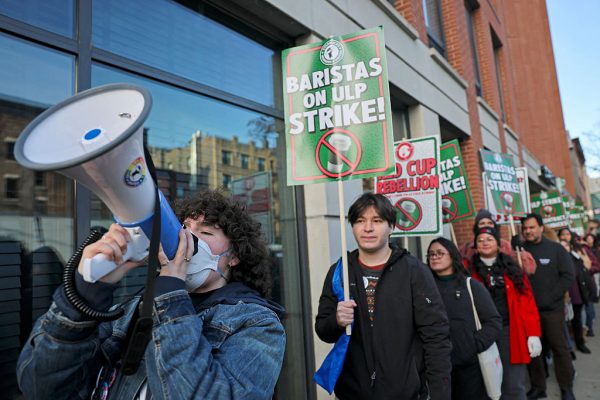
Above photo: Striking Starbucks workers walk the picket line in New York City, on December 1, 2025. Angela Weiss / AFP via Getty Images.
Corporations far beyond Starbucks want to keep baristas out of unions.
Thousands of Starbucks workers across a hundred cities are nearly one month into an expanding, nationwide unfair labor practice strike in protest of the coffee giant’s “historic union busting and failure to finalize a fair union contract,” according to Starbucks Workers United, the barista union that has spread to over 650 stores since its birth in Buffalo four years ago.
The strike comes after years of illegal anti-union antics by Starbucks and follows a historic $39 million settlement announced on December 1 for more than 500,000 labor violations committed by Starbucks management in New York City since 2021.
The rise of Starbucks Workers United has energized the U.S. labor movement, as the struggle to unionize the mega-chain represents far more than baristas pitted against managers: Starbucks is a trend-setting global powerhouse and one of the top U.S. employers. Current fights at places like Starbucks and Amazon will shape the labor movement for decades to come.
This is well understood by industry leaders, in no small part because of Starbucks’s deep interlocks with major corporations across numerous sectors. At its highest levels of governance and management, Starbucks’s closest industry ally may be Walmart, the top U.S. corporate employer and a long-time anti-union stalwart. Starbucks and Walmart, along with other corporations represented on Starbucks’s board of directors, also support major industry groups that carry out the retail and service sectors’ wider agenda of weakening unions.
Moreover, while Starbucks positions itself as a leader on climate and sustainability, it recently brought a longtime board director of oil giant Chevron onto its board, a move that lends legitimacy to accusations of hypocrisy leveled by baristas against the company.
All told, striking baristas are not merely up against the executives of a coffee store behemoth, but a broader constellation of corporate power fully networked into Starbucks’s top leadership.
The New Starbucks Regime
In September 2024, Starbucks hired Brian Niccol as its new CEO — its fourth since 2022. Starbucks sales were stagnant, and Niccol, who had been Chipotle’s CEO since 2018, had a reputation as a successful food service executive. Starbucks’s stock shot up a record 24 percent with the news of Niccol’s hiring.
Under his watch at Chipotle, the company paid $240,000 to workers who sought to unionize a shop in Augusta, Maine, that the company shuttered, and Chipotle was accused of withholding raises from unionizing workers in Lansing, Michigan.
Nearly 500 Starbucks stores had unionized by the time Niccol took over. The new Starbucks’s CEO emphasized boosting sales at stores and promised “high-quality handcrafted beverage[s] to our cafe customers in four minutes or less” — experienced by baristas as speed-ups and surveillance.
Niccol’s total compensation package last year as Starbucks CEO was an astounding $95.8 million. The AFL-CIO ranked Niccol as the fifth-highest paid CEO of 2024, and Starbucks’s 2024 CEO-to-worker pay ratio was an astronomical 6,666-to-1.
Niccol’s also garnered controversy — and the ire of baristas — for accepting a company-paid remote office in Newport Beach, California, and commuting 1,000 miles on Starbucks’s corporate jet to its Seattle headquarters.
The highest governing body over Starbucks — which hired Niccol and can fire him — is the company’s board of directors. Mirroring the CEO turnover, the majority of Starbucks’s board is today composed of new faces compared to just a few years ago.
For the prior 20 years, the Starbucks board had been anchored by Mellody Hobson, who also sits on the board of JPMorgan Chase, the U.S.’s top bank, and is married to billionaire filmmaker George Lucas.
Today, the major corporate ties represented on Starbucks’s board through current or recent past executive or director positions cut across industries, from telecoms (T-Mobile and AT&T) to tech (YouTube and Yahoo), agriculture (Land O’ Lakes) to apparel (Nike), hotels (Hilton) to finance (BlackRock), and much more. The board also reflects Starbuck’s global scope, with representatives from prominent companies in China (Alibaba), Latin America (Grupo Bimbo), and Europe (LEGO).
The Starbucks-Walmart Nexus
Starbucks’s leadership has a close alliance with another anti-union retail powerhouse: Walmart.
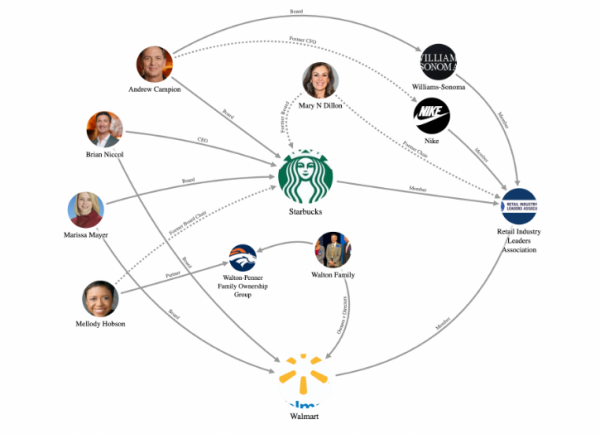
Most notably, Starbucks CEO Brian Niccol is simultaneously a board director of Walmart. Niccol joined Walmart’s board in June 2024, replacing Rob Walton, the son of Walmart founder Sam Walton who had served on the company’s board for over three decades, mostly as its chairman.
But that’s not the only Walmart connection: Starbucks board director Marissa A. Mayer, who became a Starbucks board director in June 2025, has sat on the retail giant’s board since 2012. Niccol was compensated with $274,973 by Walmart in 2025, and Mayer made $299,973. Mayer currently owns 129,642 shares of Starbucks stock, worth around $11 million.
As Walmart directors, Niccol and Mayer are swimming among the heights of billionaire power. The Walton family — who effectively owns Walmart with a 45 percent company stake — is worth $267 billion, and two Walton family members sit on Walmart’s board, including its chairman Greg Penner, who is married to Carrie Walton Penner, the daughter of Rob Walton.
Additionally, Mellody Hobson — again, who left the Starbucks board just a few months ago after a 20 year stint — is also part of the Walton-Penner Family Ownership Group that purchased the National Football League’s Denver Broncos in 2022.
Like Starbucks, Walmart is notorious for its union busting and ability to hold down the wage floor, though its wages have risen in recent years as it was “in the crosshairs of labor activists” and trying to reduce employee turnover, according to the Wall Street Journal.
Just recently, in 2024, the National Labor Relations Board alleged that the retail giant interrogated and threatened pro-union workers at a store in Eureka, California.
As the biggest employers in their respective industries, corporations like Walmart and Starbucks, as well as other top non-union employers like Amazon and Home Depot, understand unions as existential threats, and they’ve historically aimed to crush emerging beachheads through illegal firings, store closures, and endless bargaining delays.
Industry Groups Against Unionization
Starbucks and Walmart’s united front against workers is also reflected in their joint dedication to lobbying and policy groups that carry out the industry’s wider anti-union agenda.
A compelling example of this is the Retail Industry Leaders Association (RILA), one of the leading industry groups for major corporate retailers. While companies carry out their own individual lobbying efforts, they pool their resources into groups like RILA to advance their general interests as an industry.
RILA is dedicated to weakening labor unions and supporting anti-labor campaigns. It spends millions on federal lobbying annually to defend corporate interests around taxation and regulation and to fight pro-labor measures like the Protecting the Right to Organize (PRO) Act.
RILA’s 2025 policy agenda advocates “redesign[ing] and purs[uing] workforce policies and practices to reimagine outdated labor laws.” In 2024, it warned of workers at Amazon and Starbucks winning their first contracts, which “are the holy grail because unions, once embedded, rarely relinquish their hold.”
Both Walmart and Starbucks are RILA members, and Starbucks current and historic ties to RILA run deep. Former Starbucks board director Mary Dillon is the former chair of RILA. Additional companies represented through Starbucks board, like Nike and Williams-Sonoma, are also RILA members.
Starbucks, Walmart, and other corporations represented on Starbucks’s board are also tied to other major anti-union industry groups, such as the National Retail Federation (NRF) and National Restaurant Association (NRA).
While the membership rolls of these groups are not disclosed, corporations like Walmart and Starbucks feature prominently in their leadership and activity. For example, Walmart sits on the anti-union NRF’s board, and the group has supported litigation aimed at combating Starbucks Workers United.
Climate Hypocrisy
Unionizing baristas have long criticized Starbucks for describing its employees as “partners” and adopting a “progressive” veneer while overseeing a fierce anti-union campaign. But the company’s hypocrisy arguably stretches to another area where it claims moral high ground: climate and sustainability.
In June 2025, Starbucks brought in Dambisa Moyo, a longtime board director of Chevron, the second-largest U.S. oil company, as a board member. Moyo has served on Chevron’s board since 2016. In 2024 alone, she took in $457,604 in compensation from Chevron for her board role. According to her most recent disclosure, she owns more than $2.1 million in Chevron stock.
In a 2020 interview, Moyo said it was “very shortsighted” and “naive” for “people to be campaigning for defunding” fossil fuel companies like Chevron that she said “can potentially find solutions to the climate change crisis.”
Since then, Chevron and other Big Oil majors have doubled down on fossil fuel extraction and slashed their low carbon investments, while their climate pledges have garnered criticism. Chevron ranks at the 21st top U.S. greenhouse gas polluter, according to the UMass Political Economy Research Institute’s most recent “Polluters Index.” A 2019 investigation found that Chevron was the world’s second-biggest emitter of carbon dioxide equivalent since 1965.
Moyo has also held board roles at corporations like 3M, which has paid out hundreds of millions of dollars in settlements tied to its production of cancer-causing PFAS “forever chemicals,” and Barrick Gold Corporation, which engages in gold and copper extraction and has faced accusations of human rights violations.
While Starbucks has won industry praise for its sustainability gestures, the decision to bring on Moyo, a clear defender of fossil fuel companies who has millions personally invested in Big Oil stock, raises alarm about the coffee giant’s climate commitments.
Common Foes
Other ongoing labor struggles share common opponents with Starbucks Workers United.
For example, labor unions and community groups in Los Angeles are organizing against displacement and heightened policing, and for living wages, housing protections, and immigrant rights. Their organizing efforts are framed around the 2028 Summer Olympics, which will be held in LA.
Some of the same corporate actors driving Starbucks are overseeing the LA 2028 games. Longtime Starbuck director and former top Nike executive Andy Campion is a board director of the committee organizing LA’s hosting of the 2028 Olympics, while former Starbucks director Hobson is also a LA2028 board member. Starbucks is a “Founding Partner” of the LA2028 games.
Starbucks also historically has strong interlocks with Big Tech, and some Starbucks directors — such as Neal Mohan, the CEO of YouTube, which is owned by Google and its parent company Alphabet — are powerful figures in Silicon Valley. Recent former Starbucks directors also include Microsoft CEO Satya Nadella and Clara Shih, head of Meta’s business AI division.
In recent years, tech workers have been facing off against some of these Starbucks-linked tech CEOs by organizing through unions like Alphabet Workers Union and campaigns like No Tech for Apartheid.
All told, while the ongoing barista strike is part of the larger struggle to unionize Starbucks, it also represents something much broader: a pitched battle against an executive and governance regime interlocked with a wider network of corporate power whose tentacles stretch far behind a chain of coffee shops.