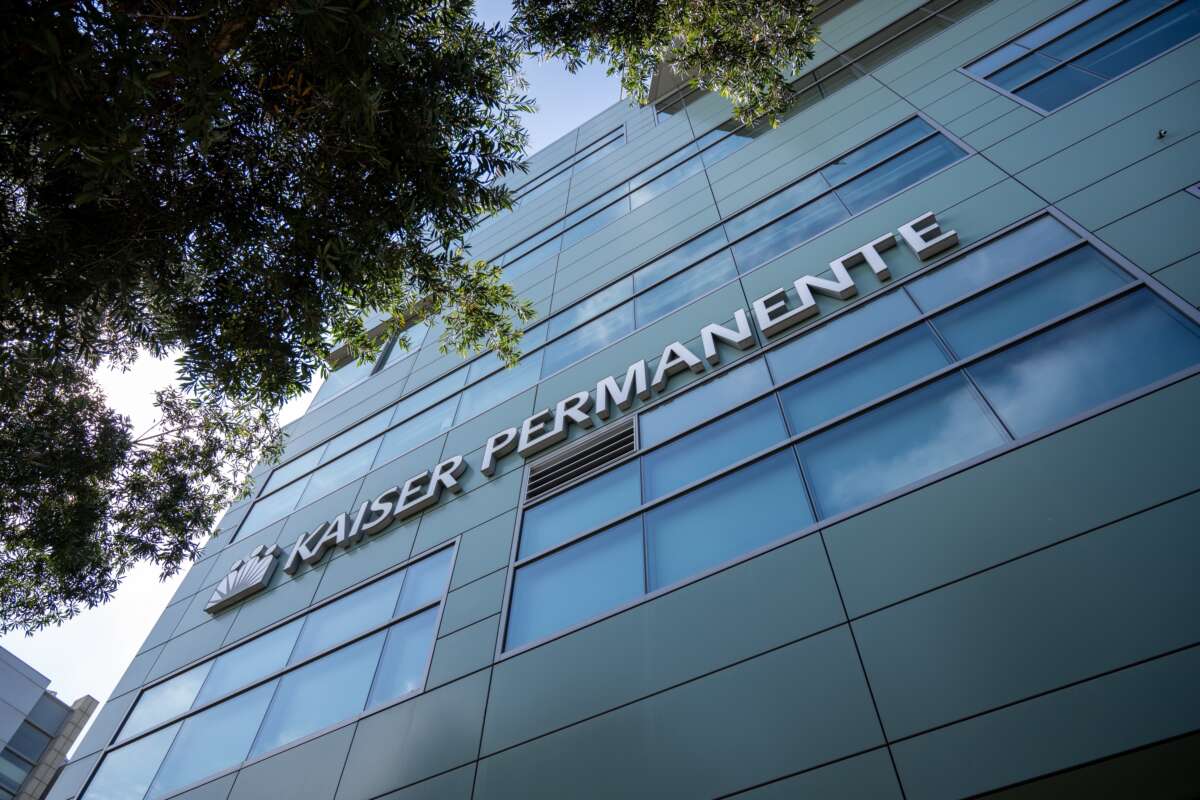
Above photo: A Kaiser Permanente building in San Francisco, California, on September 18, 2025. Smith Collection / Gado / Getty Images.
Overworked and understaffed.
Over 45,000 health care workers at Kaiser Permanente are poised to strike.
“Our patients deserve the best, not mediocrity.”
This phrase has been emblazoned across graphics on the social media feeds of the Oregon Federation of Nurses and Health Professionals (OFNHP), an American Federation of Teachers affiliate, Local 5017. The roughly 6,000 health care professionals of the OFNHP are locked in a contract fight with their employer, Kaiser Permanente, the sprawling health care consortium. The mediocrity in question is not that of the staffers themselves; instead, it warns of the impending consequences for staff and patients alike of the workplace stressors to which Kaiser’s tens of thousands of doctors, nurses, technicians, and others are systematically subjected.
In what has become an extended set of pitched battles with Kaiser management, the OFNHP has set out to address some of the most severe crises in nursing and health care — at Kaiser and elsewhere. Pressure from the rank-and-file to confront chronic understaffing, stagnating pay rates, and a loss of control over their schedules and work arrangements has driven the union to place these demands at the forefront in their return to contract bargaining this year.
But their struggle is not a lonely one, and it’s far from confined to Kaiser’s Northwest branch. The OFNHP is one of the 23 unions that together make up the Alliance of Health Care Unions (AHU), a labor federation that comprises over 60,000 Kaiser workers across California, Hawaii, Oregon, Washington, Maryland, Colorado, Georgia, and Washington, D.C. A significant portion of the Alliance membership is bargaining as a single unit, simultaneously negotiating for better wages and conditions at national and local levels. Strike action has been authorized, and the countdown has begun: If management does not return to the table by October 14, Kaiser Permanente will witness an enormous nationwide walkout of more than 40,000 employees.
The amassing strains on staff, exacerbated by the obstinate bargaining position staked out by management, have led the AHU to play its final card. Should the strike go forward, the number of participants alone would make this one of the single largest labor actions of the year. It’s telling that this year has seen a groundswell of nurses’ strikes and other health care actions — a symptom of the widespread, deeply rooted and ever-worsening issues facing U.S. hospital staff, both at Kaiser and in countless medical facilities across the nation.
Blood From A Stone
The gouging-out of the U.S. frontline health care workforce — in large part attributable to a combination of low pay, punishing hours, burnout, and exhaustion, along with the stresses and risks of COVID-19 — have led to severe strain on remaining employees — which in turn intensifies turnover, perpetuating the cycle. At Kaiser Permanente, several of these unfortunate trends have amplified each other, and in this way have become mutually reinforcing.
Back in 2021, to address similar grievances, the AHU had also voted to authorize a strike; membership came to the brink of a walkout but called it off the night before when management came back to the table. A new contract was won, establishing a staffing committee to address shortages and stemming some of the most immediate concerns by securing a wage increase and blocking management’s attempt to implement a “two-tier” system. But the structural issues remained unresolved, and wage gains that were won four years ago have been diluted by inflation. Now, as that contract is expiring, some Kaiser staff have asserted that, compared to 2021, the pressures on the workforce and the adversarial stance of management have significantly worsened.
Kaiser has a largely unionized workforce, represented by the AHU as well as overlapping memberships like the Coalition of Kaiser Permanente Unions. The health care titan has operated for nearly three decades under a version of a labor-management partnership. Initially implemented as a compromise to avoid a strike in the late 1990s, the Kaiser conglomerate’s unique partnership provides notable concessions to labor, codifying organizing rights and benefits and securing unions a seat at the bargaining table. The central compromise on the part of labor is that, by alleviating these pressures, worker militancy and possible strike action is averted, neutralized before it can take root. In theory, this works to the benefit of all involved.
Broadly, this arrangement is still in place — but sources say that the process has become decidedly less cooperative. Over many protestations, Kaiser administrators have continued to maintain practices that hospital employees have come to feel are absolutely untenable. That they’ve gone so far as to call for a strike, the strongest possible measure, testifies to their feelings as to the absence of alternatives.
Brenda Rowe is a histology technician at Kaiser and an OFNHP member in the technical bargaining unit, which comprises 33 different roles — surgical and laboratory technicians, respiratory therapists, and so on. Her unit members have not yet seen their own particular contract expire and are therefore ineligible to join this strike. (One of their tertiary demands is to remedy this contract-timing misalignment so that all contracts are signed simultaneously.) Still, Rowe and her unit are actively involved in negotiations to settle terms for their renewal next year.
Speaking to Truthout, Rowe emphatically shared that Kaiser technicians are proud to stand in solidarity with the strikers in their local counterpart bargaining units and with the multi-state AHU as a whole. Bargaining units are subdivisions of union membership: in the OFNHP, they include groups for workers with advanced degrees (the “Pro” unit), nurses at various tiers, Rowe’s fellow technical staff, registered dental hygienists, and several others.
Rowe explained how chronic staffing shortages wreak havoc on the complex operations of a hospital. “All of our work is interconnected,” she told Truthout. “It’s all intertwined.… When the nurses can’t step in and cover as much, then that puts more pressure on lab techs, who are dealing with staffing shortages themselves. It’s a no-win situation.”
In response to the union’s charges of staffing shortages, Kaiser Permanente replied in a statement to Truthout:
“Kaiser Permanente meets—and often exceeds—mandated nurse-to-patient ratios and staffing standards. We continue to hire, adding over 6,300 new employees in 2024, including nearly 4,700 in care delivery and more than 1,600 in Alliance-represented roles. “
Neoma Palmer is a physical therapist with a sports-clinic specialty who has been employed at Kaiser for 12 years, largely in outpatient physical therapy. She’s also an OFNHP shop steward, a labor partner (a liaison and support role unique to Kaiser), and, like Rowe, a volunteer on her respective bargaining team. On a call with Truthout, Palmer explained that, “There’s short staffing everywhere, and it’s just been getting worse. We’re seeing, ever since the end of June, that management started to not replace open positions.” Palmer said that as many as “hundreds of jobs” might remain unfilled.
The void of new hiring, along with the first-year attrition rates, are at the same time both symptoms and catalysts of the understaffing crisis. This is also the case for the increasing workloads and stagnant wages that tend to disincline new job seekers, to say nothing of top talent. A large AHU survey of the workforce found that a full 95 percent of respondents felt “Kaiser’s staffing crisis is affecting patient care and access,” while over 90 percent worked in short-staffed departments. According to Palmer, “In the past two decades, we’ve increased our membership in the Northwest by 400 percent.” And yet, in many areas — for example, she says, at the outpatient rehab — the level of staffing “has stayed exactly the same. When you have to be 400 percent more productive … it’s just not possible.”
Kaiser staff have also been constrained in their ability to participate in the creation of their work schedules (often called “schedule templates”). Management has backed away from what was once a more collaborative process. A new inflexible practice of top-down scheduling, said Rowe, doesn’t “allow for adequate charting, adequate break time, being able to leave when you’re supposed to be off work. It’s very disorganized … That’s a very, very big point of contention.”
Like Rowe’s technical unit, the OFNHP’s Pro bargaining unit encompasses staff in around 30 separate disciplines; Palmer is among them. As has been the case for so many other units in AHU locals, Palmer and her colleagues have arrived at unnavigable impasse: Management has seemingly decided to advance no further towards compromise.
“In theory, the partnership works great,” Palmer went on. “But in reality, I don’t think we’ve been working well together for at least the last five to 10 years. Part of that is because we have different management now, and they don’t buy into the partnership as much.” Onetime opportunities for staff input and joint problem-solving, she says, have dried up — replaced by “a more of a traditional top-down approach” from newer managers. “Often, they’ve never worked in health care.”
A likely motivator for this newly uncooperative, profit-focused management is the perverse incentives introduced to health care entities by financialization, especially after the intrusion of private equity firms — as has been apparent time and again at modern institutions like universities and hospitals (Kaiser among them). Many venerable institutions, handwaving away the lofty and noble aims of their founding charters, have moved to prioritize profit, often by leveraging their assets to reap returns for investors. But the intrusion of profit mechanisms reliably distorts institutional motives. Financialization of this type seems to inevitably compromise the original service — for instance, teaching medical students, or treating patients. The consequences of a profit-focused orientation for hospital patients can range from inconvenience to death — as credible research has shown, finding clear causal links between private equity acquisition of hospitals and the actual fatality rates in emergency rooms. At Kaiser, the stakes are no less severe.
“More and more, the managers and directors that are coming in are bean counters that have no experience in health care, but they feel like they can make things more efficient,” said Palmer. “And that’s just not the way it works.”
For many Kaiser employees, it’s becoming nearly impossible to ignore the sense that the incentives of profit and control are the prime reason behind these changes — more than patient care, more than staff welfare. (It’s also both alarming and revealing that Kaiser has proven ready to retaliate against those who blow the whistle on internal understaffing and patient safety concerns.)
Many have also been dismayed to see Kaiser’s reputation and metrics dwindle. “We know our access and staffing is really bad,” Palmer said, “because it’s incredibly difficult to get just basic appointments.” Indeed, earlier this year, Kaiser was issued a $4 million fine from California’s Department of Managed Health Care for its failure to address recurrent major mental health care delays — which had become so bad that they were actually illegal. The department, finding dismal standards that have gone unaddressed, has cited Kaiser multiple on multiple occasions over the years. According to the charges in a National Union of Healthcare Workers report, Kaiser has also, in some cases, resorted to falsifying records of patient schedules to avoid citation by regulators.
Extended wait times are rampant, even in critical treatment areas. As Palmer said with chagrin, “Your cancer screening appointments are only available three, four months past the time when you’re due” to have them. Needless to say, delays of this kind will also inevitably cost patients their lives. Statistically, it’s a near-certainty that they already have.
Kaiser leadership disputed those claims. “The Alliance’s campaign uses strong language, pickets, and strike threats to rally support,” they told Truthout in a statement. “They say their goal is to protect patients by ensuring better care and staffing, but the real issue is wages… Their claims about Kaiser Permanente’s quality and staffing don’t reflect the facts.”
Uncompetitive Compensation
Perhaps the central concern for labor in the negotiations is that Kaiser’s pay has failed to keep up with inflation. In general, Kaiser’s pay runs low compared to other hospital systems, particularly in the Northwest, though pay rates can vary, and are reportedly more reasonable in areas of California.
“One of our main goals in bargaining was to be paid fairly, and to be paid for all hours worked,” Palmer said. (She described how at Kaiser, it’s the norm to consistently get in early, stay late, and/or take on extra work, often multiple hours per week. This is done to keep up with workloads and licensing, but also very often out of a desire to provide patients with more attentive care.)
On wage increases, she says, “We had lots of different ideas … and management had no interest in continuing to bargain with us on that topic.” Asked if she felt that Kaiser was abusing the knowledge that its employees would devote extra unpaid hours to make up shortfalls, Palmer replied without hesitation: “100 percent.”
The AHU negotiates for wage rates that apply to all employees, referred to as “across-the-boards” (ATBs). The AHU is asking that over the four-year contract, ATB raises increase incrementally to 25 percent. Management’s current counteroffer grants 6.5-percent upticks for two years, and reaches 20 percent over four. Over time, this represents a considerable difference: tens of thousands of dollars at some rates.
As if to ensure that their reluctance at the bargaining table feels maximally galling, Kaiser Permanente has continued to grant CEO Gregory Adams millions of dollars in compensation per year, leading to his reliable appearance among the top three highest-paid chief nonprofit executives in the nation. And further congratulations may also be (bitterly) due, as the company itself has also recently attained record multibillion-dollar profits.
Nevertheless, Kaiser negotiators have not budged an inch on wages. Ultimately, despite the painstaking negotiations, Palmer felt that “nothing has been touched when it comes to those really large issues about workloads, templates, and being paid for all hours worked, as well as the local wage increases … At national there has really been no movement as well,” she said. “It’s different this time around than in 2021. I feel like in 2021, Kaiser was still coming to the table and offering different things. They’re not doing that.”
Kaiser disputed the characterization that its pay runs below market, noting that it had offered to boost wages by 21.5 percent over four years. In a statement, Kaiser wrote: “Taking the current economic environment into consideration, our across-the-board 4-year wage increases would normally have averaged 14 percent in total, to be consistent with estimated annual wage inflation. Our offer is significantly higher than that because from the beginning of the negotiations process, the union asked that contract raises consider their lower increases during the pandemic. Our strong offer boosts above-market pay, benefits, and career growth, and raises wages by 21.5 percent over four years.”
Traveling Blues
While it is true that management does regularly act to ease staffing shortages by recruiting extra help, they do so by bringing on travel nurses — akin to temps, or maybe gig workers or freelancers. They’re paid fairly well, and Kaiser outlays considerable funds to make use of them.
Yet how could this major expenditure possibly be of any benefit, even from the vantage of pure self-interest? One possibility is that travel nurses, if not cheap, are less empowered and more expendable. Palmer agreed with this assessment. “I think that they see hiring more union workers as too difficult to deal with,” she said, “whereas they see hiring travelers or externalizing us as a really easy fix, instead of having to deal with bargaining in good faith with us.”
Madeline Litts is a registered nurse at Kaiser, as well as a shop steward who’s also involved in a bargaining unit and the negotiations. As a one-time travel nurse herself, Litts made it clear that criticizing this state of affairs does not imply any personal antipathy toward other individual nurses, travel or otherwise. No matter how skilled and compassionate, travel nurses are just inevitably less familiar with the hospital and procedures than a full employee. Some research has found a correlation with their use and poorer patient outcomes. When they’re used in lieu of permanent staff, Litts feels, there’s a lesser degree “of shared interest, of a commitment there … I’m not anti-travel nurse. I just don’t understand why a business wants to pay more to someone to be less committed.”
Litts says that in bargaining, management made it clear that they “would like to be able to [hire travelers] at-will, without any labor participation.” To help guard against bad hires, Litts and her colleagues asked management for at least a chance to give feedback on resumes. “And they said no. They don’t want us to be able to vet each other.”
Litts herself expressed uncertainty that management is careless enough to place profit over patient welfare. Of course, things are more complex than that. Still, whatever the good intentions of individual administrators — and there are surely many — it appears evident that impersonal, structural pressures are acting upon all involved, with or without their willing complicity.
As of now, it would seem that, if management remains intransigent through October 14, a system-wide strike remains the only recourse for the Kaiser staff of the AHU’s member unions, both to protect their own livelihood and to stem some of the deleterious effects that pressure tactics and profiteering have inflicted on the Kaiser system.
Litts aptly summed up the state of mind of Kaiser staffers. As she told Truthout, “I think the daily frustrations that have built up … there’s a boiling point. When you’re feeling disrespected day to day, publicly disrespected, there’s only so much any of us can take. We take pride in the work we do. We take pride in who we work with. So for it not to feel reciprocated — we don’t want to make things easy for them when they’re not trying to make things easy for us. We’re going to keep showing up at the table and bargaining in good faith, because that’s who we are.”