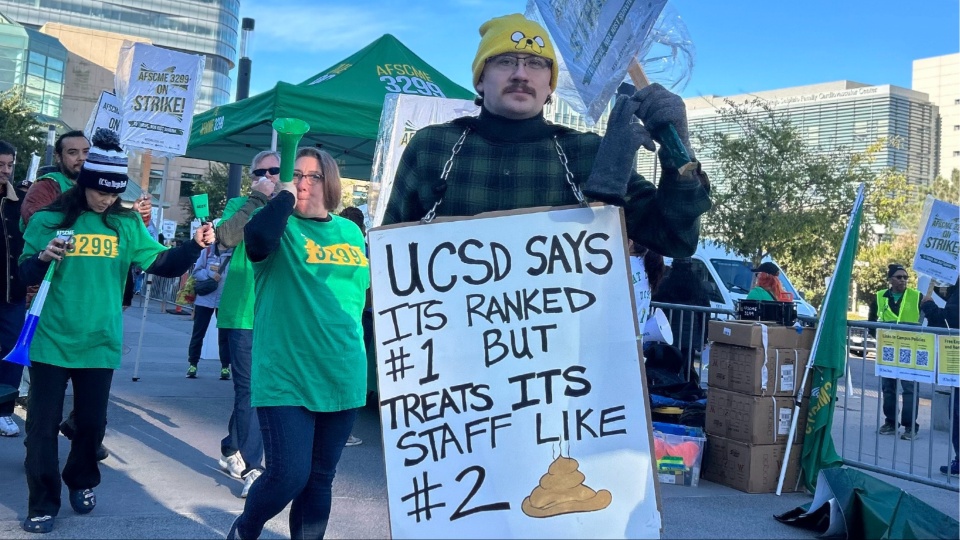
Above photo: AFSCME 3299.
San Diego — As 40,000 AFSCME Local 3299 workers throughout the ten-campus University of California system launched a two-day strike on Nov. 17, two Communist Party members—Alvin, an AFSCME-represented employee at University of California at San Diego (UCSD), and another worker, an AFSCME retiree from UC San Francisco—shared their thoughts before they prepared to picket.
Pay, or lack of it, is the big issue. But so is disparate treatment on a class basis.
While the university system fails to settle contracts addressing the cost of living and affordability crises facing its most economically vulnerable patient care workers, it’s also handed out six-figure salaries and housing subsidies to multiple high administrators.
The union is fighting for livable wages that attract and retain staff, affordable healthcare, the housing benefits the high earners already receive and safe staffing to properly care for and serve patients and students.
Originally, two union locals were set to strike, with registered nurses, members of the 25,000-strong California Nurses Association/National Nurses United, set to walk picket lines in solidarity with them, too. But management came to its senses on November 9 and settled with University Professional and Technical Employees-CWA Local 9119, which represents 22,000 health care and technical workers.
After 16 months of bargaining, that local and UC management tentatively agreed on a four-year contract with an 8% pay hike retroactive to January 1, then increases of 7%, 6%, and 6% in the remaining years of the contract, plus step increases each year.
There’s more parental leave, a 21% cap on health care premium increases over the life of the contract and a “’guaranteed alternatives to layoffs’ process before layoffs are implemented,” including the right to be offered open positions elsewhere—with preferential rehiring at any hospital campus—to avoid layoffs.
But the university hasn’t settled with Local 3299, which forced the workers, system-wide, into their two-day walkout, November 17-18, at 10 University of California system campuses and all their hospital centers.
“We’re striking because UC has failed to address the unaffordability of life,” Local 3299 says on its website. Talks began 22 months ago.
Picket lines went up at 7 a.m., Pacific Standard Time, on Nov. 17 and ran until 4 p.m. on Nov. 18 at University of California-Berkeley, UC Davis and its medical center, UC Riverside, UC Santa Barbara, UC Santa Cruz, UC Irvine and its medical campus, UC San Diego and its Hillcrest and La Jolla Medical Centers, UCLA, its medical center and its Santa Monica Hospital, UC San Francisco’s three hospitals, and UC Merced.
Local 3299 represents custodians, food service workers, patient care assistants, and hospital technicians who have been working without a contract for more than a year. They all face a growing affordability crisis.
The union reports even the lowest-paid UC executives rake in half a million dollars a year and still get housing stipends. Local 3299 says the same stipends could be shared with dozens, if not hundreds, of UC employees, with which they could house themselves and their families.
“UC gives out raises and housing benefits to a bloated layer of top administrators at the expense of its lowest-paid workers. We are fed up and we say this inequality must end!” Local 3299 declares.
Meanwhile, the local reports its members are priced out of local housing markets by wage rates that have failed to keep pace with inflation, leading 13,000 to leave their jobs in the last several years and fueling growing staff vacancy crisis at UC.
Other hospital workers have been forced into long one-way commutes from far-away rural areas to the big California cities where their jobs are. Two years ago, The Sacramento Bee profiled a typical UC hospital systems worker, Veronika Honcharuk, with a 133-mile one-way commute from her rural Placerville home to the University of California at San Francisco.
Honcharuk worked 12 hours a day, three days a week, coding patient records, but was paid so little she took all the overtime she could get, on the “off days.” Rather than make the four-hours-plus roundtrip drive in between–and on little sleep at home–Honcharuk slept in her car.
“I’m worried that more UC workers are going to end up homeless if something doesn’t change. I work 11-hour days, but even I’m behind on my rent and can’t afford the copays to see my doctor. It shouldn’t be this hard to survive.” Ruth Zolayvar, a pharmacy tech at UCSD, wrote on AFSCME’s strike blog.
Alvin offered two reasons he went on strike. “I have two answers to this, one as a party member, the other as a UC worker. As a party member, our party’s goals only have meaning if we are in alliance with organized labor, and I feel it’s my duty to stand with organized labor. So even if I wasn’t a party member, I’d be showing up and showing out for the workers at the campus I graduated from.
“As a worker, if it wasn’t for” former GOP President Ronald Reagan’s “neo-liberal era of attacks on workers, we could have been on track for a $60 an hour minimum wage. Instead, we’re overworked and underpaid. We remain in a precarious position as workers.” And he added, “Never take our rights for granted. We must show up for those unable and unwilling to picket.”
“When I learned more than 200 of my coworkers at UCSD Health had been laid off without notice, my heart sank,” the retiree, said. “How could a health system that was spending hundreds of millions of dollars buying new hospitals and giving big raises to its executives justify laying off the frontline workers who deliver care to patients?”
One big raise, 57% over the past three years, went to UC Health System CEO Patty Maysent. She makes more than enough to hire an out-of-network specialist for any pressing health concerns, the union reported.
UCSD Health says these cuts are due to budget pressures, which is untrue, the union said. Financial data presented to the university system’s Board of Regents forecasts UCSD health’s profits are expected to double over the next decade. Hospital executives split $1.4 million in incentive bonuses this year, while the average laid-off worker made an annual salary of just $66,000.
UCSD also spent $200 million buying a new hospital and is currently negotiating with another health system to purchase two more hospitals in the coming months, apparently without consideration for who will staff them.
Alvin cited the need to improve staffing at his UCSD job site. This would require UC to end its hiring freeze. The signature UC valet service where Alvin works, which employs teams of workers to safely park cars of hundreds of patients each week, operates on a skeletal staff. Valet services are spread even thinner when workers need sick time and vacation time.
“During nearly two years of bargaining, UC has spent billions of dollars acquiring new facilities, lavishing exorbitant raises on its wealthiest executives and funding housing assistance programs to help these same ivory tower elites buy mansions or second homes—but it won’t offer its frontline workers enough to pay the rent or keep pace with the skyrocketing cost of groceries,” said AFSCME Local 3299 President Michael Avant in a recent union press release.
“Our members have had enough of UC’s serial elitism, tone deafness and blatant disrespect for the workers who make this institution run, and that’s why they will strike at every UC campus and Medical Center.”
Research revealed a decline in real wages of nearly 10% and a growing housing affordability crisis plaguing the university’s frontline health and service workforce. That left thousands of UC employees to endure multi-hour commutes, sleep in their cars or rely on limited government housing subsidies. More than a third of this vital workforce voluntarily left their jobs in the past three years, the union reports.
“During the pandemic, UC administrators routinely called us ‘essential heroes,’” added Avant. “We were the ones sanitizing facilities to slow the [virus] spread, answering the call button, and giving sick patients their breathing treatments. Today, we’re being excluded from housing assistance that UC gives to its wealthiest employees, being told to accept wages that offer less purchasing power than we had seven or eight years ago, and being told we should pay twice as much for our health insurance.
“It’s time for UC to get its priorities straight, and to treat us with the respect we’ve earned.”
The retiree remembered struggling to live on UC’s salary in the San Francisco Bay area. Once retired, she was ultimately displaced by the sky-high housing costs there and relocated to San Diego County. “We retirees have a stake in what happens with AFSCME’s contracts. A good contract that protects both active workers and retirees could vastly improve the quality of life for all of us,” she said.
Asked what would a good contract look like, Alvin responded an ideal contract would result in a worker-owned and operated workplace, but that more immediately obtainable demands would be a shorter work week, an option for a six-hour and an eight-hour workday, a 30 hour/week minimum for benefits eligibility, and more paid time off.
And he said the lack of free parking for employees must end. Employees must pay $120/month for parking, and many if not most employees commute long distances, often by car, because of the lack of affordable housing near UC facilities.
Parking and rising health care premiums are two examples of what Alvin described as a fundamental condition of extractive labor, meaning the super-exploitation of workers, management pulling every dollar possible out of workers’ already scant pockets.
Workers say the working class seeks to regain traction in its struggle for workplace democracy, as well as to retain what workers gained in years past. Trump is a reactionary symptom of capitalism’s failure to address workers’ demands, they note.
UC hospital system patients were not left bereft of patient care during the two-day strike.
Though UC was responsible for creating staffing contingencies to support its operations during this legally protected strike, Local 3299 voluntarily exempted a small number of critical care workers from strike participation and created a patient protection task force—a line of communication with UC hospitals—to enable certain striking workers to support emergencies during the work stoppage if UC’s contingency plans are insufficient to meet patient needs.
Mark Gruenberg contributed to this article.