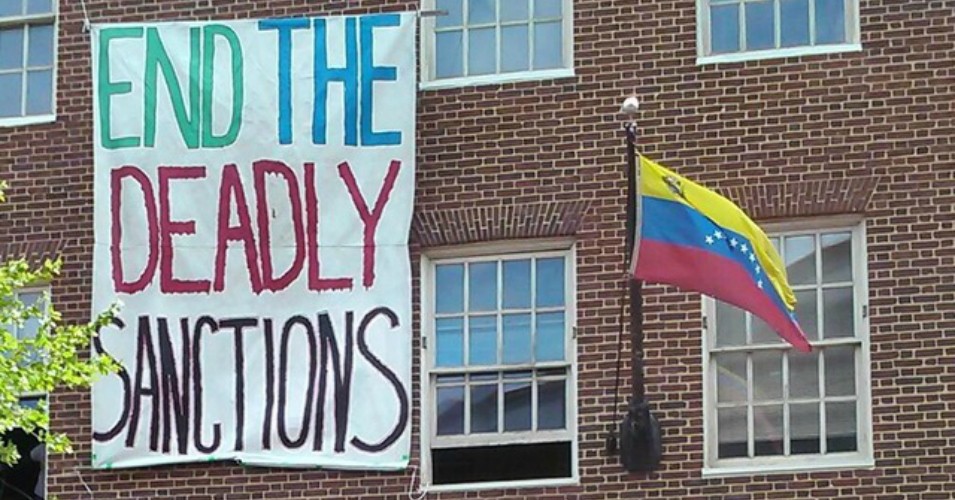
Above photo: Banner outside the Venezuelan Embassy in Washington, DC. The Embassy Protection Collective.
We read with interest the Review about Venezuela’s public health crisis and could not agree more emphatically with the authors. However, the root causes of this economic crisis, specifically, the impact of the US economic sanctions, deserve further inquiry. Since 2014, 43 unilateral, coercive measures have been applied against Venezuela by the US Administration. These have effectively paralysed the economy, blocked oil exportation globally, and frozen Venezuelan financial assets abroad while denying access to international financial systems. This loss in oil revenue and assets has amounted to a shortfall worth billions of US dollars, prohibiting the importation of essential, lifesaving products.
The impact of the US sanctions on the Venezuelan population cannot be overstated. More than 300 000 Venezuelans are at risk due to a lack of lifesaving medications and treatment. An estimated 80 000 HIV-positive patients have had no antiretroviral therapy since 2017. Access to medication such as insulin has been curtailed because US banks refuse to handle Venezuelan payments for this. Thousands to millions of people have been without access to dialysis, cancer treatment, or therapy for hypertension and diabetes. Particular to children has been the delay of vaccination campaigns or lack of access to antirejection medications after solid organ transplants in Argentina. Children with leukaemia awaiting bone marrow transplants abroad are now dying. Funds for such health-assistance programmes come from the PDVSA state oil company. Those funds are now frozen. Food imports dropped by 78% in 2018 compared to 2013. The very serious threat to health and harm to human life caused by these US sanctions are thought to have contributed to an excess of 40 000 deaths in 2017–18 alone.
The UN Human Rights Council reported that “the use of economic sanctions for political purposes violates human rights and the norms of international behavior. Such actions may precipitate man-made humanitarian catastrophes of unprecedented proportions. Regime change through economic measures likely to lead to the denial of basic human rights and indeed possibly to starvation, has never been an accepted practice of international relations.” These sanctions fit the definition of collective punishment of the civilian population, as described by the Geneva (Article 33) and Hague conventions, to which the USA is a signatory. These sanctions are also illegal under international and federal US law. Given the intentional action to destroy a people, in part or in whole, the US economic sanctions and their effect on the preventable mortality of Venezuelans fit the UN definition of genocide.
Furthermore, the US State Department recently boasted about the economic hardship that they have caused through their now expunged communiqué, released on April 24, 2019. They assert that “US policy has and continues to prevent the Venezuelan Government from participating in the international market and has led to the freezing of its overseas assets”. US National Security Advisor John Bolton stated that they are backing the illegal coup in Venezuela, as “it will make a big difference to the United States economically if we could have American oil companies invest in and produce the oil capabilities in Venezuela”. As the sanctions caused the overall loss of $38 billion in the past 3 years, more cuts in imports of medicine, food, medical equipment, and inputs necessary to maintain water, health, and sanitation infrastructure are foreseeable in the immediate future. These measures will undoubtedly cause further grievous harm to the Venezuelan population.
Global peace is fragile given the bellicose stance of the US Government in provoking destabilisation in multiple countries as we head into an election year. Public health practitioners have a long tradition of resoundingly condemning the collective punishment of populations, the violation of international law, and the premature death and suffering that result from punitive economic measures. In fact, we have been successful at building bridges of mutual respect and understanding between populations when government-level diplomacy has failed—for example with the case of Cuba. Pointing to the economic failures of Venezuela as justification for further economic sanctions, causing further economic failures, is a cyclical, fallacious argument and not a legitimate public health approach. We agree with the open letter of American scholars who call for the non-intervention of the USA in the internal affairs of Venezuela, an end to the sanctions, and a negotiated settlement free of foreign coercion. Our role as public health practitioners is to avert population-level harm caused by our policies, both at home and abroad, while seriously investigating the upstream (and root) causes of the causes.