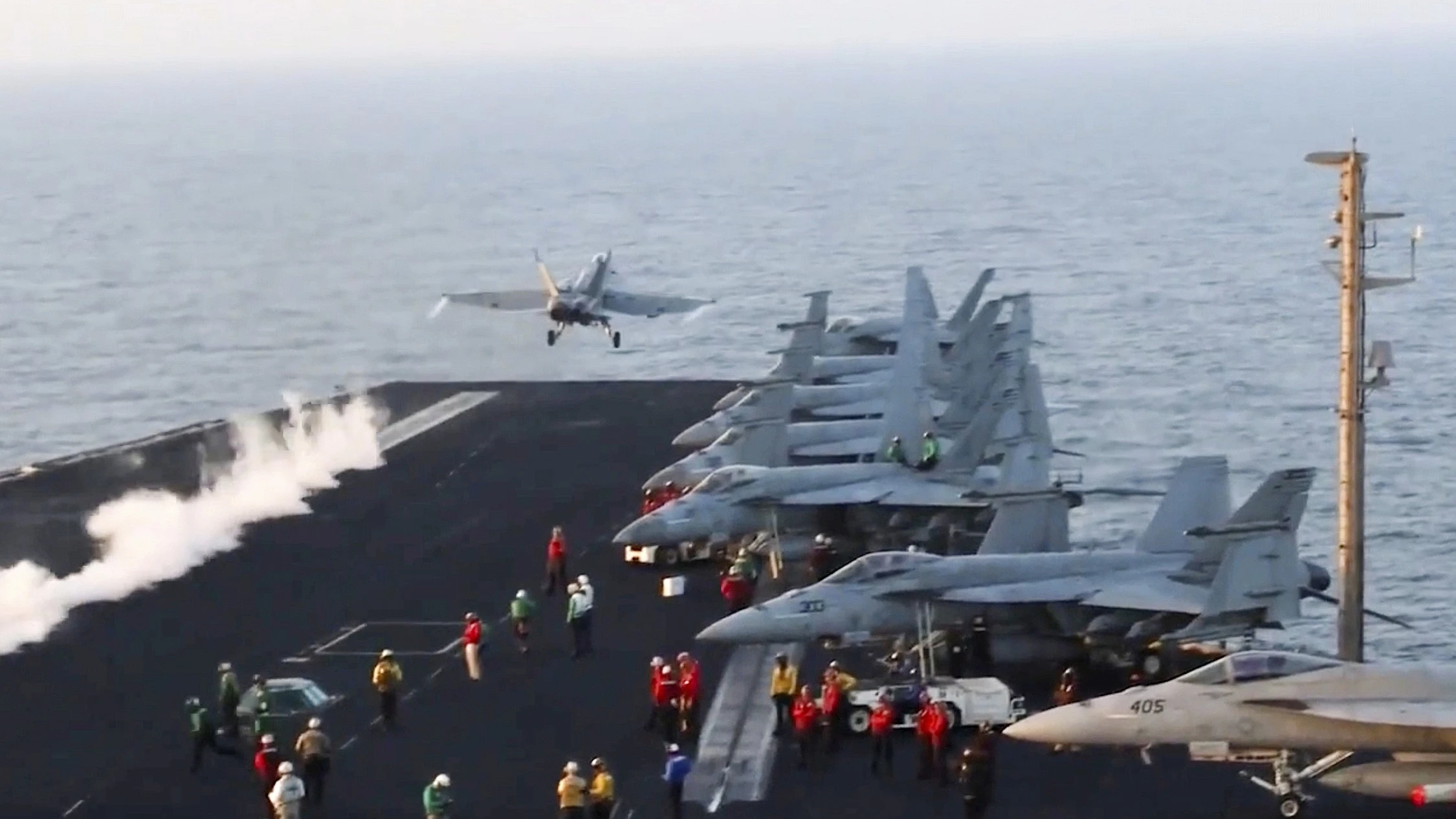
Above photo: US navy via AP.
The Yemeni army remains largely unaffected and continues operations.
Despite the heavy civilian casualties and a deepening humanitarian crisis.
The US signaled on 7 April that it is planning to step up its violent campaign of airstrikes on Yemen, which have killed dozens since last month, including women and children.
“It’s been a bad three weeks for the Houthis, and it’s about to get worse,” US Defense Secretary Pete Hegseth said on Monday in the Oval Office, while seated near US President Donald Trump and Israeli Prime Minister Benjamin Netanyahu.
“It’s been a devastating campaign, whether it’s underground facilities, weapons manufacturing, bunkers, troops in the open-air defense assets – we are not going to relent, and it’s only to get more unrelenting until the Houthis declare they will stop shooting at our ships,” Hegseth added.
Trump said following the meetings with Netanyahu and the defense secretary that “We’ve put a major hurt on the Houthis, which nobody’s been able to do.”
“We’ve really hit them hard. Night after night, and we’ve gotten many of their leaders and their experts. They’re experts on missiles. I mean, they actually make missiles. Nobody thought that, but they make missiles. It’s highly sophisticated,” the president went on to say.
It has been known for years that the Ansarallah movement – which is merged with the Yemeni Armed Forces (YAF) – locally produces its missiles and drones.
The US bombing of Yemen started under former US president Joe Biden’s government in January 2024, at the height of the YAF’s campaign of pro-Palestine naval operations against Israeli-linked shipping. It has now been renewed with severe intensity under Trump’s administration following Sanaa’s vow to reimpose the naval blockade on Israel.
Yemen also restarted missile and drone attacks on Israel after the renewal of the war on Gaza, and has once again been responding to Washington’s attacks with operations targeting US warships in the Red Sea – including the USS Harry S. Truman aircraft carrier.
US jets bombed western Yemen’s Hodeidah on Monday evening. The day before, at least four were killed and 20 others injured in a US strike on a home in the capital, Sanaa.
Since mid-March, over 70 people have been killed and over 140 injured in the US attacks.
On 5 April, Trump posted a video on his X account of a US strike on what he said was “Houthis gathered for instructions on an attack.”
These Houthis gathered for instructions on an attack. Oops, there will be no attack by these Houthis!
They will never sink our ships again! pic.twitter.com/lEzfyDgWP5
— Donald J. Trump (@realDonaldTrump) April 4, 2025
Yemeni authorities revealed that those targeted were tribal leaders gathering to commemorate the Eid al-Fitr holiday.
Trump is a lying, genocidal criminal who bombed a tribal gathering celebrating Eid.
These atrocities pave the way for the #GazaHolocaust.
His supporters are equally satanic.
Anyone claiming Jesus sanctions genocide, ethnic cleansing, or mass slaughter is truly Christ’s enemy. pic.twitter.com/GiRlNgSvnE
— Seyed Mohammad Marandi (@s_m_marandi) April 5, 2025
The deadly US war on Yemen – which has compounded an already severe humanitarian crisis – has cost nearly $1 billion, but has failed to significantly impact Ansarallah and the YAF, according to sources who spoke with CNN and the New York Times (NYT) over the past few days.
Meanwhile, Yemeni missile and drone operations have continued to target US warships in the Red Sea, and the YAF is still capable of shooting down US drones.
While US officials, including Trump, have boasted that the strikes have been effective and have taken out command infrastructure and key figures in Ansarallah, Washington has not specified the names of any Ansarallah or YAF leaders that have been targeted.
Sanaa has also not confirmed whether any of its key figures have been killed.