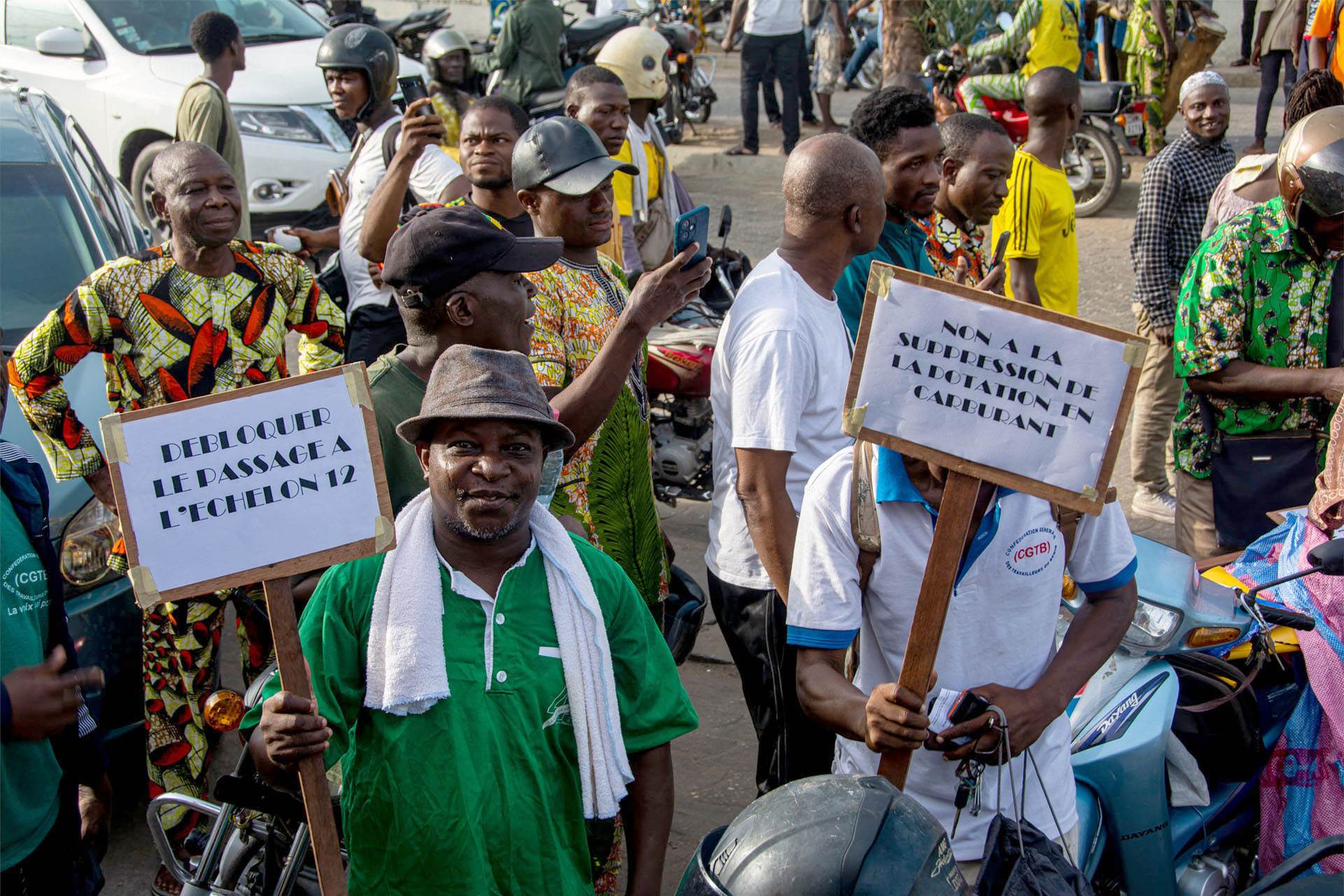
Above photo: Workers in Benin are facing growing repression. In 2024, trade union leaders were arrested for peacefully defending workers’ rights and speaking out against the rising cost of living.
This is the 12th edition of the ITUC Global Rights Index, the only comprehensive, worldwide annual study of the violation of workers’ rights – freedoms that form the basis of the democratic rule of law and fair working conditions for all.
This year’s Index reveals a stark and worsening global crisis for workers and unions. In 2025, average country ratings deteriorated in three out of five global regions, with Europe and the Americas recording their worst scores since the Index’s inception in 2014. Alarmingly, only seven out of 151 countries surveyed received the top-tier rating. The data shows a sharp escalation in violations of fundamental rights, including access to justice, the right to free speech and assembly, and the right to collective bargaining.
In this increasingly hostile environment, a growing number of state authorities are adopting legislation that criminalises civil society organisations – and, potentially, trade unions – as “foreign agents”, further delegitimising their role. Violations of the right to strike and the right to register a trade union remain at record levels, underscoring the intensifying crackdown on workers’ fundamental freedoms.
We are witnessing a coup against democracy: a concerted, sustained assault by state authorities and the corporate underminers of democracy on the rights and welfare of workers. Increasingly, this attack is orchestrated by far-right demagogues backed by billionaires who are determined to reshape the world in their own interests at the expense of ordinary working people.
The 2025 Index is an urgent call to action to resist this coup against democracy before irreparable damage is done. The ITUC’s For Democracy That Delivers campaign aims to unite workers and unions in defence of our rights and in pursuit of a fairer future for all. As the world’s largest democratic force, the union movement embodies the collective power of working people everywhere. Together, we can build a sustainable world where all workers are free to exercise their basic rights and freedoms.
Violations of workers’ rights in 2025
Workers had no or reduced access to justice in 72% of countries, a sharp increase from 65% in 2024.
In the Philippines, charges remain pending against activists who provided humanitarian aid to displaced Indigenous communities in 2018. Meanwhile, two French unionists remain unlawfully detained under harsh conditions in Iran, following their arrest in 2022 on spurious national security charges.
Attacks on the rights to free speech and assembly were reported in 45% of countries – a record high for the Index and an increase from 43% in 2024.
In Benin, workers were arrested during May Day celebrations, highlighting the growing repression of public expression. In the Russian Federation, draconian “Covid” restrictions on public events remain in place, giving authorities the power to prohibit union gatherings under the guise of health measures.
The right to strike was violated in 87% of countries – unchanged from the Index high of 131 countries in 2024.
In Cameroon, a seasonal worker was killed by police during a demonstration by SOSUCAM sugar workers for better pay and safer conditions. In Iraq, police attacked and injured striking oil workers during a protest about their status.
The right to the legal registration of unions was impeded in 74% of countries, unchanged from 2024 and the worst level since the Index began.
About 600 traffic services workers in Kenya were denied the right to form a union due to the misclassification of their roles and restrictions on union membership. In Pakistan, a court declared 62 unions unlawful, infringing the rights of millions of public sector workers.
The right to collective bargaining was restricted in 80% of countries (121), up from 79% in 2024.
In France, nearly four in every 10 collective agreements were imposed unilaterally by employers, without union representation. In Sweden, Elon Musk’s Tesla bypassed negotiations entirely, replacing striking workers with strike-breakers or ‘scabs’, rather than engaging in collective bargaining.
Authorities in 71 countries (47%) arrested and/or imprisoned workers, a marginal improvement on 2024 but almost twice the rate recorded in 2014.
A union president in Cambodia was convicted for speaking out online against the arrest of a casino worker. Activists in Hong Kong, including two union leaders, were convicted for taking part in a democratic council election process.
Workers in three out of every four countries were denied the right to freedom of association and to organise, unchanged from 2024.
In Malaysia, global packaging firm Amcor unfairly dismissed a union secretary as part of its “union-busting” campaign. Jeff Bezos’s Amazon responded to the creation of its first unionised workforce in Canada by closing its Quebec warehouses, resulting in 2,000 job losses.
Workers suffered violence in 26% of countries, down from 29% in 2024.
Armed bandits attacked the home of a union leader in Haiti, forcing him to flee with his family. Thugs violently forced five unionists out of a May Day event at a lithium mine in Zimbabwe.
Trade unionists paid the ultimate price for their activism in Cameroon, Colombia, Guatemala, Peru, and South Africa – killed for defending workers’ rights.
The 10 worst countries for workers in 2025
Each year, the ITUC Global Rights Index rates countries depending on their compliance with collective labour rights and documents the violations of internationally recognised rights by governments and employers.
The 10 worst countries for workers in 2025 were: Bangladesh, Belarus, Ecuador, Egypt, Eswatini, Myanmar, Nigeria, the Philippines, Tunisia, and Türkiye.
The ratings of seven countries worsened: Argentina, Costa Rica, Georgia, Italy, Mauritania, Niger, and Panama.
Three countries improved their ratings: Australia, Mexico, and Oman.
Regional overview: Three regions deteriorate
Middle East and North Africa
The Middle East and Northern Africa remains the worst region for workers’ rights, scoring an average country rating of 4.68, slightly better than the weakest on record of 4.74 in 2024. This indicates that most workers are subject to the systematic violations, or no guarantee of basic labour rights.
In Egypt complex, arbitrary procedures were used to obstruct the registration of unions. In Libya, a government-led union monopoly continued to suppress the development of an independent union movement. Workers in Qatar, Saudi Arabia, and the United Arab Emirates faced outright bans or severe restrictions on freedom of association and the right to organise – particularly affecting migrant workers, who make up a significant proportion of the labour force in these countries.
Conflict and political instability have left workers in Syria and Yemen without access to even the most basic rights. In Yemen, collapse of state institutions has directly impacted the freedom of trade union activity, while in Syria, early efforts have begun to organise workers and reclaim their rights following the fall of the repressive regime of Bashar al-Assad.
War has also affected the stability of the labour market in Israel and Palestine, where thousands of workers – particularly Palestinian workers – have lost their jobs, with more than 200,000 working people denied their wages.
Oman offered a glimmer of progress, improving its rating from 4 to 3 in 2025, due to a series of progressive labour reforms aimed at strengthening social dialogue and dispute resolution.
Asia-Pacific
The Asia-Pacific region improved marginally for the third consecutive year, with an average rating of 4.08, compared to 4.13 in 2024. However, the incidence of violence against workers almost doubled and workers in more countries faced a crackdown on free speech and assembly.
Nine out of 10 countries violated the right to strike and impeded the registration of unions. Almost half reported violence against workers, an alarming doubling in the prevalence of such attacks compared to the previous year. More countries – seven in every 10 – clamped down on free speech and assembly.
Workers across the region continue to face alarming levels of abuse and oppression. Trade union leaders in strong>Cambodia and Hong Kong faced harassment and persecution, while others were unjustly imprisoned in Iran and Myanmar. Authorities in Bangladesh violently suppressed strikes, while Malaysia, Nepal, and Thailand engaged in a range of union-busting activities. In both India and Pakistan, governments and employers persistently bypassed meaningful tripartite social dialogue and consultations with unions. Restrictions on freedom of expression, association and peaceful assembly are widespread in Iran, with the interrogation, arrest, detention and sentencing of labour, cultural rights activists, human rights defenders and journalists.
The Taliban’s crackdown on human rights has had a devastating impact on lives and working conditions in Afghanistan, particularly for women and girls. According to the UN, almost half the population – about 23 million people – will require humanitarian assistance to survive in 2025.
Africa
Africa recorded its second-worst reading on record, deteriorating to 3.95 from 3.88 in 2024. These figures suggest that workers across the region endure systematic violation of their rights. The rights to strike, collective bargaining, and to form or join a union were impeded in 90% of countries. Nigeria entered the top 10 worst countries for the first time.
Most workers, employed in the informal sector, have no labour protection. The rights to strike, to collective bargaining, and to establish or join a trade union are violated in 93% of countries. While fewer countries reported violence against workers, union activists were killed in Cameroon and South Africa.
Strikes and protests were met with violent suppression in Cameroon, Kenya, Mauritania, and South Africa. Employers sabotaged union activity in Botswana, Ethiopia, Guinea, Kenya, Lesotho, Liberia, and Senegal. In Nigeria, a new entry to the 10 worst countries in the world for working people, Eswatini, and Zimbabwe, trade unionists faced repression for their activities, while authorities in Eswatini, Guinea-Bissau and Zimbabwe banned protests and assembly.
Military juntas in West Africa including Burkina Faso, Chad, Gabon and >Mali – prevented unions from operating freely. Conflicts in South Sudan and Sudan have left millions in desperate need of aid and severely threatened the livelihoods of workers. Meanwhile, escalating violence in eastern Democratic Republic of Congo, particularly in and around Goma, conflict has caused immense suffering among civilians and workers. Hospitals are overwhelmed, food supplies are critically low, and at least 700,000 people are estimated to have been internally displaced by the conflict.
Americas
The average country rating in the Americas hit its weakest since the Index began, worsening to 3.68 from 3.56 in 2024 – the largest annual drop since 2017. This figure signifies a regional environment where workers face systematic or regular violations of their rights. The Americas remains the deadliest region for workers: five unionists were killed in Colombia, Guatemala, and Peru.
More countries in the Americas are obstructing fundamental labour rights. In 2025, 92% of countries in the region restricted the registration of trade unions, while workers were arrested or detained in six out of every 10 countries. In addition, 88% of countries violated the right to strike.
Argentina, Costa Rica, and Panama saw their ratings fall from 3 to 4 amid intensifying crackdowns on workers’ rights and trade unions. Mexico, by contrast, saw its rating climb to 3 from 4, following positive reforms to its labour justice system.
Strikes and protests were heavily repressed in both Argentina and Brazil, while companies operating in sectors known for their abusive work conditions engaged in widespread union-busting practices in El Salvador, Costa Rica, Honduras, and Panama.
Europe
Although Europe remains, on average, the least repressive region for workers, there has been a steady deterioration over the last four years. The average rating dropped to 2.78, its worst score since the Index began and down again from 2.73 in 2024. Workers in 52% of countries were denied or restricted access to justice, a leap from 32% in 2024.
Nearly three-quarters of European countries violated the right to strike, and almost a third of them arrested or detained workers. More than half of denied or restricted access to justice – a sharp increase from 32% in 2024.
Georgia’s rating deteriorated to 4 from 3, and Italy’s rating worsened from 1 to 2 due to draconian actions by their governments designed to undermine labour and protest rights.
Authorities in Belgium, Finland and France continued their crackdowns on striking workers, while governments in Albania, Hungary, Moldova, Montenegro and the United Kingdom abused legal powers by excessively broadening the definition of “essential services” to restrict the right to strike. In Greece, Hungary, Serbia, Switzerland, and Türkiye, companies actively undermined union activity to the detriment of employees. This anti-worker climate also saw the emergence of included employer-dominated “yellow unions” in Armenia, Greece, the Netherlands, Moldova, and North Macedonia.
The rise of far-right political parties and movements across Europe has heightened the risk of further erosion in the rights of workers and unions.
A coup on democracy
The findings of this year’s ITUC Global Rights Index present further proof that our democratic freedoms are under attack by an ever-smaller number of people in control of an increasingly disproportionate slice of the pie. Today, a tiny fraction of the global population – less than 1% – controls nearly half of the world’s wealth. This concentration of economic power allows a small group of billionaires to exert outsized influence over global decision-making, including on labour rights and protections, which directly affect the lives of the workers who sustain the global economy.
This coup on democracy is often orchestrated by far-right politicians and their unelected billionaire backers. Whether it’s Donald Trump and Elon Musk in the US or Javier Milei and Eduardo Eurnekian in Argentina, we see the same playbook of unfairness and authoritarianism in action around the world.
One of the most powerful tools we have to resist the erosion of democracy and deepening of inequality is our collective power – through the organisation of workers into independent unions. The global trade union movement is the largest democratic social force in the world. It exists to defend democratic freedoms, improve the lives of workers, and safeguard their interests in the world of work. Joining a union offers protection against exploitation and creates a united front against the well-connected global elite – those intent on reshaping the world to their benefit while forcing workers to bear the cost.
The stronger and more expansive the union movement, the greater our chance of turning the tide – towards a democracy that delivers a fairer, more sustainable future for all.