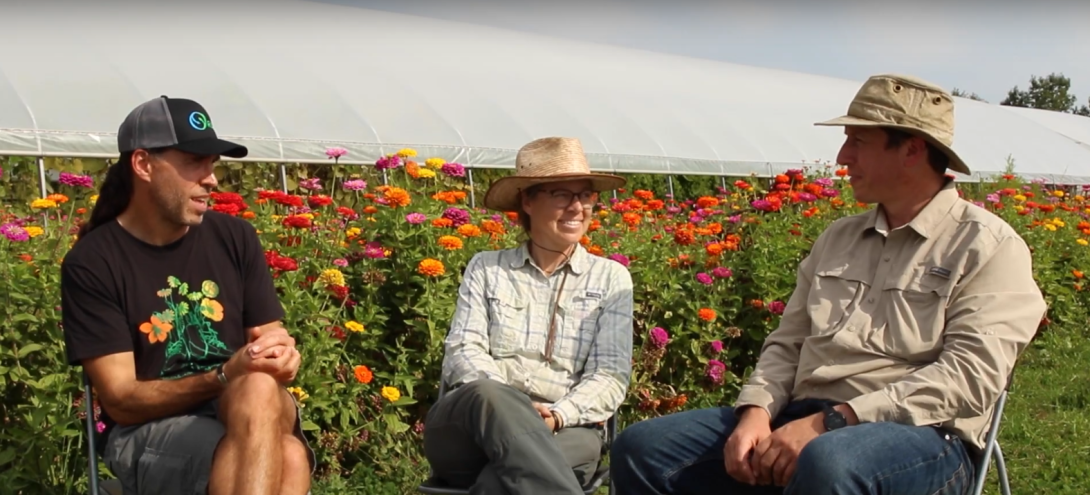
In this video farm tour, we visit Ferme Coopérative Tourne-Sol, a thriving co-op farm just outside Montreal, Quebec. Farmers Dan Brisebois and Emily Board walk us through their seed-growing operation, discuss how their worker co-op farm was founded, and share how it functions today.
You’ll get a behind-the-scenes look at how Tourne-Sol balances vegetable production, CSA distribution, and a robust organic seed business. Learn how collaboration fuels their success and what it’s like to farm as a cooperative in Canada.
Interview by Dan Brisebois for Growing for Market Magazine
Tourne-Sol Co-operative Farm: Nearly two decades of cooperative farming lessons
“Oh, I remember when I was young and I wanted to start a farm co-op with my friends, too!” This was the common refrain my friends and I heard back in 2004 when we’d tell established farmers about the farm co-op we were starting. Our group met studying agriculture at McGill University’s MacDonald campus.
We had gone our own ways for a few years to work on and manage other farms. Now, we were to run our own farm. We decided to do this together as a worker co-op. A lot of what we were talking about excited established farmers, but then they followed up with, “But then I started a real farm on my own.”
No one directly told us not to start a co-op, but there didn’t seem to be a lot of faith that this was a real project. Yet, 18 years later Tourne-Sol Co-operative Farm, about an hour west of Montreal, is still running. And, there are now so many other farmer worker co-ops, that I haven’t even heard of them all.
Here’s the story of how our farm co-op evolved over the last two decades. I’ve broken down this time frame into three phases with management tools and decisions we used at each step.
2005-2010: Getting the farm started
Tourne-Sol Co-operative Farm officially began in January 2005 when we incorporated the farm as a worker co-op. We chose this business structure because we were looking for a democratic way to run a business.
In a worker co-op, the big decisions and vision are carried out by a board of directors elected by the members. Each director has one vote independent of how many shares they own in the business. When we began, all the co-op members were on this board and it didn’t feel like there was much distinction between board business and day-to-day farm ops. This became clearer and clearer over the years.
To join the co-op, each person bought a $2,000 share. (If ever the member leaves, this share will be returned to them.) This gave us our starting budget. A couple of the co-op founders also brought a delivery van and some farm tools. These started out as loans but the farm bought them outright from the members in year two when we had some cash flow.
In year one, we rented four acres that came with an old dairy barn, running water and electricity. We also were able to borrow a tractor and rototiller from our landlords. It was a pretty scrappy beginning, but we had everything we needed.
During the early years, the five of us (Emily, Fred, Reid, Renée and me) focused on the farming. We had been trained on some great farms by some great farmers. Now, we just had to show that we could do it, too.
We started off growing crops on four acres for 110 CSA shares and two farmers markets. There weren’t too many weeds in the field, and we had decent yields from enough crops almost from the start. In this phase we were able to improve our farming quickly by focusing on what was reliable and adjusting our crop plan so that we were growing the right amounts for our sales channels. By 2010, we had more than doubled what we were producing and had 260 CSA shares and still two farmers markets.
For the first two years, we relied solely on the five of us for farm labor. And then we started hiring one or two people per season to help. Being able to count on the five founding members as the majority of our farm labor meant that year after year most of our skills and farm knowledge didn’t leave the farm. It was great not being dependent on recruiting a big team every year, training them in everything, and then having them not return the next year.
Another advantage to having so many dedicated farmers was being able to focus on more than just the vegetables. A number of co-op members explored side ventures during this time: growing seeds, cut flowers, medicinal herbs, herbal teas, and mushrooms were some of the enterprises we tried out.
By the end of this period, seed production was becoming a more pronounced part of the farm. We were growing seeds for a dozen seed companies and had a two-page seed catalog with about 20 varieties.
So the farming was going pretty well in this first phase. The biggest challenges were communicating with each other. It was easy to fall into disagreements about expectations and who was supposed to do what. We solved some of this by developing clear schedules and using detailed blackboards, but that only went so far.
The tool that really helped us get through these hurdles was NVC (Non Violent Communication). We worked with an NVC trainer to learn how the words we use to communicate with each other don’t necessarily transmit the meaning we think they do, and to separate our judgements and interpretations of what’s happening from describing the actual facts. NVC had a huge impact, helping us maintain our friendships and farm relationships during these early years when we had few commitments and a lot of time to invest in Tourne-Sol.
2011-2018: Growing the family
There were two farm babies born during the first phase of Tourne-Sol. In the second phase there were a lot more farm babies. By 2015, the founding members had seven babies. During the same time, we doubled the farm business.
We increased our CSA shares to 350 weekly families, were still going to our biggest farmers market, and our seed business had taken off with an online store and a retail seed rack program. We also purchased the land we were farming.
One tool that helped us transition into this phase was Holistic Management. In 2012 we took a six-day workshop run by Fran and Tony McQuail of Meeting Place Organic Farm. Holistic Management helped us move our planning from being all about profitability and efficiency to focusing on a holistic goal that included quality of life. The biggest impact was to gradually phase out farmers markets so we could have our weekends with our families. We also began monthly farm BBQs for family and friends to work on the social part of the farm.
The other big change that helped us as we scaled up our farm and our families was to increase the size of our farm team. We started hiring more people on the farm to help us get the stuff done as the farm grew, and at the same time that founding members took parental leave and had more family responsibilities.
At the end of this phase, we had two employees who’d been working with us for over four years. They both wanted to join the co-op. We weren’t totally sure what it meant for folks to join the co-op, but we wanted to figure out how to welcome Sophie and Julien as co-op members.
We decided to follow a common co-op process and made Sophie and Julien first become auxiliary co-op members for about a year and then transitioned them to full members. We also re-evaluated the qualifying share to become a member and raised it to $7,000. (All the current members had at least this many shares in the business at this point.) This qualifying share could be paid by deducting a percentage of wages for a period of time.
As new faces began to sit around the meeting table, we realized how much our farm management had become a group mind of five people who had been working together for years. Now we needed to start developing clearer management tools and systems to be able to effectively include these new members into the decision-making. This brings us to the next phase of our story.
2019-2023: Getting systematized
At this point our CSA has 500 members and seed sales are about 50 percent of our gross sales. We have about 18 folks working on the farm to make that all happen. Our team is vital to Tourne-Sol’s success so we want folks to stay on the farm and become co-op members.
This phase has been about figuring out how both to get new employees up to speed quickly, but also about delegating more responsibility to everyone on the team. Protocols and recorded systems have been key to this.
At its simplest, this means taking the time to write out everything we do. We’ve moved to using Google Docs and Google Sheets for notes and crop planning so that we can easily collaborate on the same files. We’ve also worked with an HR consultant to help us set up these systems and to create an employee handbook.
This phase also has been about codifying what it means to be a co-op member and how you become one. Our policy is now that once you’ve worked for 18 months, you can ask to be an auxiliary member. Once you’ve been an auxiliary member for 18 months, you can ask to be a full member. At each step, the board of directors votes on whether to accept the new members.
In the last six months three of our employees (Calla, Camélia, and Amiya) have become auxiliary co-op members. And we’re now ready to move to a new phase.
The Tourne-Sol future
We currently have 10 co-op members, and I think that number will be increasing in the next couple of years. This next phase will probably be about many of the same themes we’ve dealt with before — how to communicate clearly and make good decisions — but now with many more co-op members at the table. We’re already exploring new tools to help us to do this. This last year, we’ve begun using a governance system called Holacracy.
Holacracy is a governance model that aims to distribute power and decision-making throughout an organization. Individuals have a number of roles where they have authority to make decisions. We’re still fresh to Holacracy, but it has changed our meeting structure and is helping clarify everyone’s roles on the farm.
So 19 years later, now that we’re the established farmers, it’s great when young folks come out and tell us that they want to start a farm co-op. We can smile at them and tell them, “What a great decision!”
Dan Brisebois is the host of the Seed Growers podcast and blogs about seeds, spreadsheets, and farming at danbrisebois.farm. He is co-author of Crop Planning for Organic Vegetable Growers. He is also a founding members of Tourne-Sol Co-operative Farm. Tourne-Sol produces certified organic seeds and vegetables for their online seed store and 500 weekly veggie baskets.